Egyptian Blue: The First Synthetic Pigment
Egyptian blue was the first pigment humans made rather than dug up. It is also one of the most stable ever created, and it still glows in infrared for archaeologists today.
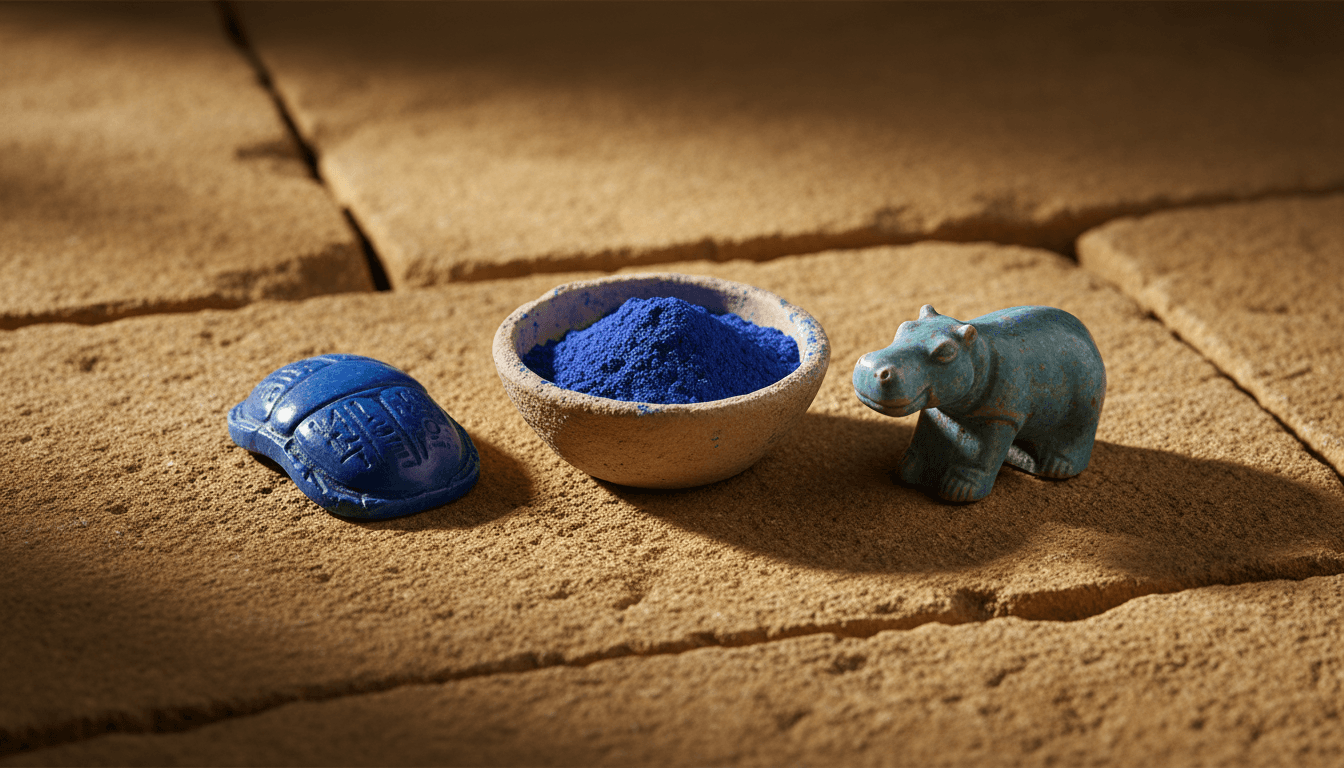
Synthetic pigment feels like a modern idea — something chemistry gave painters in the last few centuries, alongside Prussian blue and the cadmiums. It isn't modern at all. Around 3100 BCE, Egyptian craftspeople were already manufacturing a pigment from scratch, by heating sand, copper, and lime together in a kiln — more than four thousand years before anyone in Europe worked out how to do the same thing with a different colour.
At a glance
- What it is
- calcium copper silicate (cuprorivaite, CaCuSi₄O₁₀)
- First made
- around 3100 BCE, Egypt
- Made from
- silica (sand), copper, calcium (lime), and a flux
- Fired at
- roughly 800–900 °C
- Used until
- about 800 CE, then the recipe was lost
- Key property
- extremely stable; luminesces in infrared
Why it counts as "first"
Humans had used pigments — ochres, charcoal, ground minerals — for tens of thousands of years before this, but all of those were found, not made. Egyptian blue was the first pigment produced by a chemical reaction that doesn't occur anywhere in nature: sand, copper, and lime don't spontaneously turn blue on their own. That distinction matters more than it sounds. A found pigment is limited by whatever the local geology happens to provide. A manufactured one is limited only by the recipe — and the moment humans could make a colour rather than dig it up, they could start designing the palette instead of just collecting it.
How it was made
The recipe combines silica (usually quartz sand), copper (from malachite or scrap bronze), calcium (from limestone), and a flux such as natron to lower the melting point — fired to roughly 800–900°C, hot enough to fuse the ingredients into a crystalline calcium copper silicate but not so hot that the structure breaks down. Miss the temperature window and the result is a dull green or grey rather than blue; hit it, and the copper ions lock into a layered silicate lattice that produces both the colour and, unexpectedly, the pigment's most useful modern property.
Why it's still vivid on tomb walls
The pigment is a silicate — essentially a ceramic — and ceramics are among the most chemically durable materials humans make. Unlike organic dyes, which fade, or lead-based pigments, which darken, Egyptian blue's copper is locked into its crystal lattice where it can't easily react with anything around it. That's the whole explanation for why it survives on tomb paintings after four and a half thousand years largely unchanged, easily outlasting the civilisation, and several civilisations after it, that made it.
The property nobody could have known about
Excited by visible light, Egyptian blue luminesces in the near-infrared — a wavelength invisible to the human eye but easily captured by an infrared-sensitive camera. Archaeologists now use this to detect the pigment on artifacts where it's faded to invisibility, buried under later paint layers, or present only in traces too faint to see directly. The technique has turned up Egyptian blue in Greek and Roman contexts far from Egypt, mapping trade connections its ancient makers never intended to leave evidence of. A pigment made five thousand years ago has become a working diagnostic tool for the archaeologists who study it.
Advertisement
Where it travelled, and where it disappeared
Egyptian blue spread across the ancient Mediterranean — into Mesopotamian art, Greek and Roman painting, and decorative work generally — as the manufactured, affordable alternative to lapis-derived ultramarine and azurite. The Roman writer Vitruvius described a version of the process, which is part of how modern chemists reconstructed the recipe. But production ended around 800 CE, as the Roman world that had sustained the trade fragmented and the workshops that held the knowledge closed without ever writing the recipe down clearly enough to survive them. The pigment's existence was essentially forgotten until nineteenth-century chemists, analysing samples from ancient sites, worked out what it actually was.
Not a one-off: two more manufactured blues
China independently developed a closely related chemistry — barium copper silicates known as Han blue and Han purple, used in painting, decoration, and on the Terracotta Army — suggesting the leap from found colour to made colour happened more than once, in civilisations with no contact with each other. The most recent chapter in the same story is YInMn blue, discovered by accident in 2009 by chemists at Oregon State University while heating metal oxides for an unrelated experiment — the first new stable inorganic blue pigment in two centuries. The pattern repeats: humans make a colour, use it, sometimes lose it, and sometimes find it again.
The bottom line
Egyptian blue isn't a footnote before the "real" history of synthetic pigment begins with Prussian blue or the cadmiums — it is the beginning, nearly five thousand years earlier than most people assume. It proved a colour could be manufactured rather than mined, and it did so with a stability that has let it outlast the empire that invented it, the centuries it spent forgotten, and every organic pigment made since.
FAQ
Was Egyptian blue really the first synthetic pigment?
Yes — it's the earliest known pigment produced by a chemical reaction that doesn't occur naturally, made around 3100 BCE, roughly 4,800 years before Prussian blue, the next widely cited "first" synthetic pigment.
Why is Egyptian blue so stable?
It's a silicate, chemically closer to a ceramic than to most pigments, with copper locked into a crystal lattice where it can't easily react with moisture or air.
Why does Egyptian blue glow under infrared light?
Copper ions in its crystal structure absorb visible light and re-emit it as near-infrared radiation, a property archaeologists exploit to detect the pigment where it's invisible to the naked eye.
When was the recipe lost, and when was it rediscovered?
Production ended around 800 CE as the trade networks and workshops that made it disappeared; chemists identified its composition again in the nineteenth century.
Is Egyptian blue related to Han blue?
Not directly, but they're chemically similar — both are copper silicates, one calcium-based and Egyptian, one barium-based and Chinese, apparently invented independently.