How to Ship a Painting Without Damage
Shipping is where good work gets ruined. Learn how to pack canvases, panels, and paper so they survive the trip, and what to do about insurance and tracking.
You spend three weeks on a painting, photograph it, sell it — and the real risk begins right there. Most artwork that gets ruined isn't ruined in the studio. It's ruined in a box, somewhere between leaving your hands and being opened at the other end, and almost every case traces back to the same handful of preventable mistakes.
What actually damages art in transit
Couriers treat your painting as cargo, not art: boxes get dropped, stacked, and crushed, and the forces involved — impact, compression, vibration — aren't gentle. Nearly all shipping damage comes down to one of three causes: the work moved inside its box and struck the sides; the surface touched packing material or another part of the piece directly; or the outer box had no rigid structure and simply crushed inward. Solve those three and you've solved almost the whole problem before the label goes on. It's worth settling, too, before a piece ever ships, who's actually responsible if it arrives damaged — a question that should be answered in writing well before a box gets taped shut.
The materials that actually work
| Material | Use it for | Skip |
|---|---|---|
| Glassine paper | direct surface protection | bubble wrap touching the paint |
| Foam board / corrugated cardboard | a rigid sandwich layer | packing peanuts (they shift and settle) |
| Closed-cell foam | cushioning for valuable work | newsprint (transfers ink) |
| A double-walled outer box | crush resistance | a single-walled or reused box |
| Packing tape | sealing | masking or painter's tape (both peel) |
Packing a stretched canvas
- Lay glassine or glassine-backed foam directly over the painted face and tape it in place without the tape touching the surface.
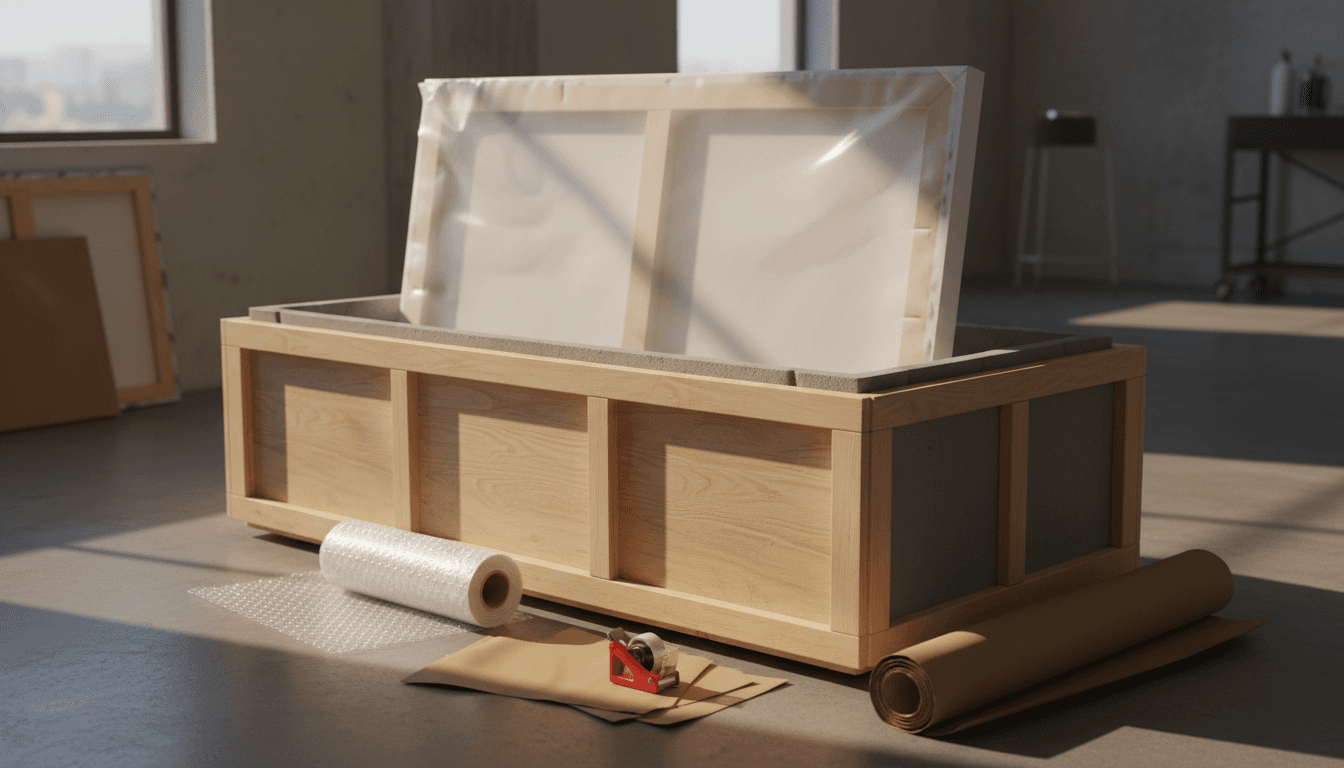
- Sandwich the canvas between two pieces of foam board or corrugated cardboard, each slightly larger than the work, so the board absorbs any impact before the canvas does.
- Wrap the whole sandwich in bubble wrap.
- Suspend the wrapped package inside the outer box with at least two inches of cushioning on every side, so nothing can shift once it's sealed.
- For very large or valuable canvases, build a simple crate or use a purpose-made art shipping box — the extra rigidity is the difference between arriving and arriving intact.
Packing panels and works on paper
Panels are rigid, which helps in one way and hurts in another: they crack and warp if bent, so keep them dead flat and unsupported at the edges. Sandwich a panel between two rigid boards larger than the piece and make sure nothing presses directly on the corners.
Works on paper are the most vulnerable of all, because a crease is permanent. Never roll something that should stay flat, and never ship paper unprotected in an envelope. Interleave sheets with glassine, support the flat work with rigid board on both sides, and cushion the whole package inside a stiff mailer. If a piece genuinely must roll, use a wide tube with the image facing out and pack the tube itself against crushing.
Advertisement
Labeling, insurance, and tracking
Mark the box clearly — "Fragile," "This Side Up," and a note that it contains original artwork — where a handler will actually see it. Include your return address and a printed copy of the shipping details inside the box, since labels fall off and boxes go missing.
Insure the shipment for the work's real value, and check what the carrier's standard policy actually covers — many exclude fine art or cap it low by default. Keep the receipt, the tracking number, and photographs of both the packed box and the work before packing, in the same spirit as the accurate, unedited documentation you'd want on file for any other reason; a claim without documentation is a fight you'll lose. Send the tracking number to the buyer and watch it move — a shipment that goes quiet in transit is far easier to chase while the trail is still fresh.
FAQ
What's the single biggest cause of shipping damage?
The work shifting inside its box and striking the sides — solved almost entirely by rigid cushioning and a box sized to leave no room to move.
Can I ship a canvas with just bubble wrap?
No — bubble wrap cushions but provides no rigid protection against a crush or a corner impact, which is exactly where canvases fail most often.
Should I ever roll a painting or work on paper to ship it?
Only if there's no alternative and the piece was designed to tolerate it — a crease in paper is permanent, so flat, rigid support is almost always the better choice.
Does standard shipping insurance cover fine art?
Often not, or only up to a low cap — check the carrier's actual policy and insure separately for the work's real value if needed.
What should I photograph before shipping?
The finished, packed box and the artwork itself immediately before packing — both are the documentation a damage claim will actually need.