The Quiet Power of Negative Space
Why the empty areas of a composition often do more work than the marks themselves.
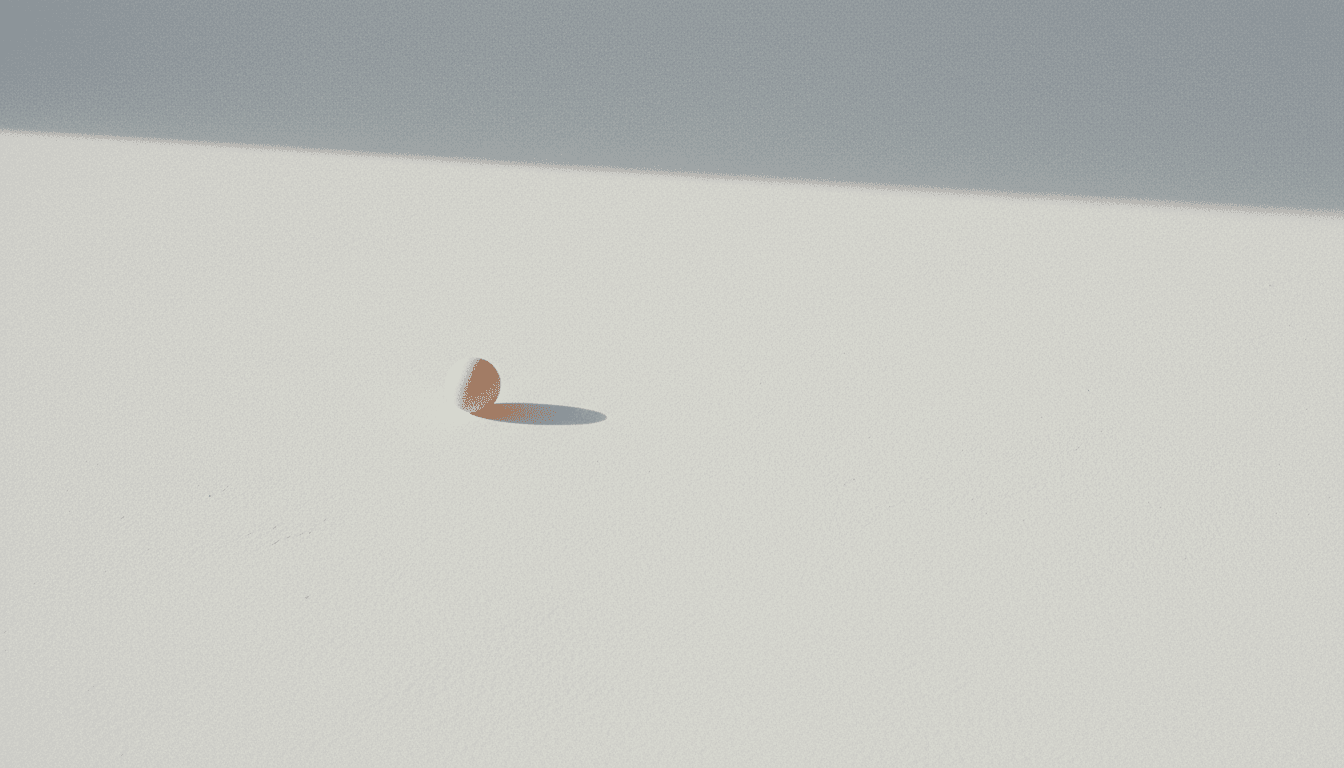
Negative space does more compositional work than the marks it surrounds. That's a strange thing to claim about the part of a picture that, by definition, has nothing in it — but the empty area around and between a composition's subjects isn't leftover canvas. It's structure, doing a job the filled-in parts can't do on their own.
The obvious objection
Empty space is empty. It's the part of the page that didn't get painted, the area a more finished or more ambitious artist would have filled in. Calling it "structural" sounds like a way of dignifying what's really just absence — surely the actual information in an image lives in the marks, not in the gaps between them.
The evidence: perception doesn't work that way
The psychologist Edgar Rubin gave this problem its clearest demonstration in 1915, with the reversible figure now known as Rubin's vase: a single silhouette that reads as either a vase or two facing profiles, depending entirely on which area the eye assigns as "figure" and which it assigns as "ground." Nothing in the image changes between the two readings — only which region the brain treats as the subject and which it treats as the empty backdrop. That's the whole objection answered directly: the eye doesn't treat filled and empty regions as unequal partners. It's constantly deciding which is which, and a shape only reads as a shape at all because the space around it has been assigned the opposite role.
Painting exploited this long before psychology had a name for it. The Southern Song court painter Ma Yuan, working in China around 1160 to 1225, became so associated with pushing all of a composition's solid content into one corner or edge — a branch, a boat, a single figure — while leaving the rest of the silk essentially bare, that he was nicknamed "One-Corner Ma." The empty three-quarters of the painting isn't unfinished; it's standing in for mist, distance, and open water, and removing it would collapse the sense of scale the single occupied corner depends on entirely. The blank silk is load-bearing in much the same way a blank canvas can already be making an argument before a single mark lands on it — emptiness read as content rather than absence.
The counter-consideration: isn't this just ordinary composition and balance?
A fair pushback: every composition manages a relationship between filled and empty areas, and calling that "negative space" might just be relabeling basic balance and pacing under a fancier name. There's something to this — negative space isn't a separate ingredient from composition, it's one lens on the same problem. But the lens changes what you notice. Balance, described only in terms of the positive shapes, treats emptiness as neutral padding around the real content. Ma Yuan's paintings, and Rubin's vase, show that the "empty" region is actively assigned a role — mist, distance, a second interpretation entirely — not simply left over once the important decisions were made elsewhere.
Advertisement
The verdict
Negative space wins the argument because it does two jobs the positive shapes can't do alone: it controls pacing, telling the eye where to rest before moving on, and it controls emphasis, since isolating a single object in a large empty field gives that object more weight than its actual size would justify. A composition packed edge to edge exhausts attention before it's earned any; a composition with room to breathe slows the eye down on purpose. Knowing what to leave empty takes at least as much judgment as knowing what to fill in — arguably more, since there's no brushstroke there to hide a bad decision behind.