Why Charcoal Smudges Differently on Various Paper Surfaces
The physics of charcoal adhesion to paper. How fiber structure, tooth, and surface energy determine smudging, and why hot press behaves completely differently than cold press.
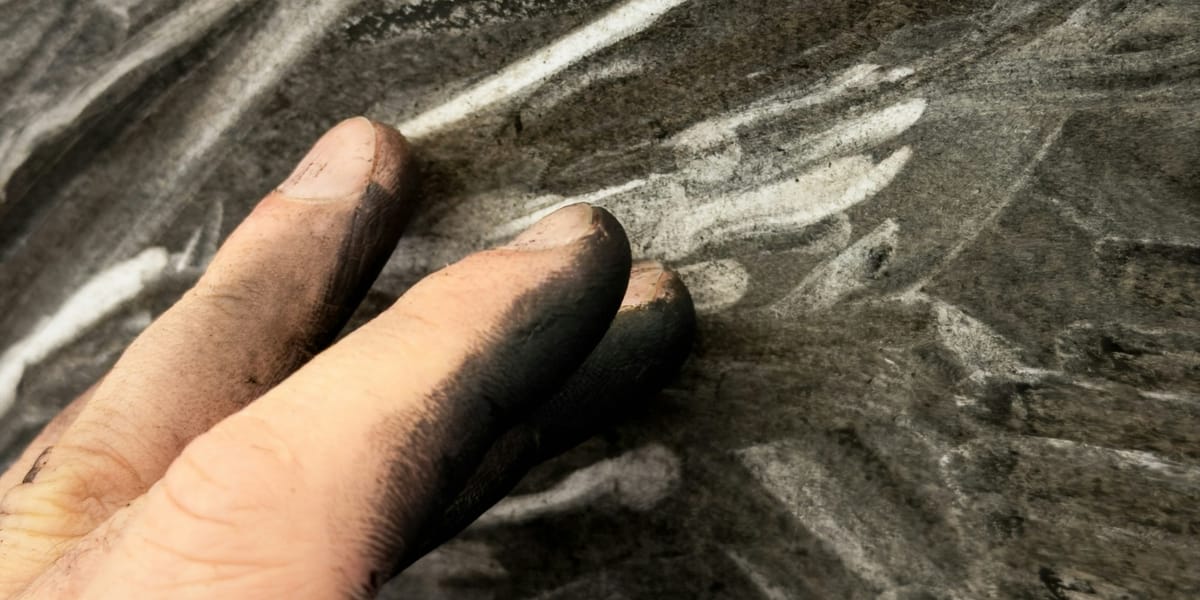
Drag charcoal across smooth hot press paper and it glides, depositing minimal material that smudges at the slightest touch. The same charcoal on rough cold press paper grabs and holds, creating dense blacks that resist smudging even under deliberate rubbing. These dramatically different behaviors stem from how paper surface structure interacts with charcoal particles at microscopic scales. The texture you feel with your fingers indicates physical geography that determines whether charcoal sits loosely on the surface or gets mechanically trapped in fiber valleys and pockets.
Understanding these interactions requires looking beyond the obvious surface roughness to consider fiber arrangement, sizing chemistry, and the physical mechanisms that hold charcoal particles in place. Charcoal doesn't chemically bond to paper the way ink does. It's purely mechanical adhesion, friction, and geometric trapping. Change the paper surface and you change the geometry available for trapping, the friction between particles and fibers, and ultimately how easily the charcoal moves under contact or pressure.
This isn't about one paper being better than another. Each surface type creates different possibilities and constraints that suit different drawing approaches. The artist who understands why surfaces behave differently can choose deliberately based on intended technique rather than discovering through frustrating trial and error that their usual paper doesn't work for a new approach. The physics is consistent even if the applications vary.
Paper Tooth and Fiber Structure Fundamentals
Paper tooth refers to the surface texture created by exposed fiber ends and the microscopic peaks and valleys of the fiber network. This three-dimensional surface structure determines how charcoal particles interact with the paper, whether they sit on surface high points or get pressed into low points between fibers. Understanding tooth means understanding paper as a physical landscape at scales invisible to naked eye perception.
Paper is a mat of cellulose fibers pressed together and bonded at contact points. The fiber orientation, how tightly they're compressed, and how they're bonded creates the surface character. In rough papers, fibers are less compressed and oriented more randomly, creating a coarser surface with more pronounced peaks and valleys. Smooth papers have fibers compressed more tightly with more uniform orientation, creating a surface with much finer texture and smaller variations in height.
The depth of these surface features relative to charcoal particle size determines trapping effectiveness. Charcoal particles range from submicron fragments to pieces several hundred microns across depending on how hard you press and what type of charcoal you're using. Vine charcoal creates larger, coarser particles. Compressed charcoal creates finer particles. The paper's surface features need to be deep enough and frequent enough to trap the specific particle sizes being deposited.
Cold press watercolor paper has pronounced tooth with surface features measuring tens to hundreds of microns in depth. These valleys are large enough to mechanically trap even coarse charcoal particles. When you draw on cold press paper, particles fall into these depressions and get wedged between fiber clusters. Rubbing the surface doesn't easily dislodge them because they're physically blocked by surrounding fibers. You'd need to dig particles out, which usually just pushes them deeper.
Hot press paper has much finer surface texture, with features measuring only a few microns in depth. Most charcoal particles are too large to fit into these shallow depressions and instead sit on top of the fiber structure. There's minimal mechanical trapping, so particles are held primarily by weak adhesive forces and friction. Light contact is enough to disturb them because nothing is physically blocking their movement. This is why hot press smudges so readily.
The fiber type affects surface character beyond just texture. Cotton fibers are longer and stronger than wood pulp fibers, creating different surface structures. Rag papers made from cotton linters have a distinct feel and hold charcoal differently than wood pulp papers. The fiber length affects how fibers lay on the surface and what kind of gaps form between them. Longer fibers can create larger pockets, while shorter fibers pack more densely with smaller interstices.
Surface sizing adds another layer to this structure. Sized papers have gelatin, starch, or synthetic compounds applied to the surface to control absorption and modify surface energy. This sizing can fill in some of the fiber structure texture, smoothing the surface slightly. It also changes the chemical surface properties in ways that affect how charcoal adheres. Unsized papers have more exposed cellulose fiber ends, which interact differently with charcoal than sized surfaces do.
The paper making process itself influences tooth. Machine-made papers often have directional fiber alignment because fibers orient along the flow direction during manufacturing. This can create subtle differences in tooth depending on which direction you draw. Handmade papers have more random fiber orientation, creating more uniform tooth in all directions. These differences are subtle but noticeable to experienced artists working on large sheets.
Calendering, the process of pressing paper between rollers, directly controls final surface smoothness. Light calendering leaves surface texture largely intact. Heavy calendering compresses the surface significantly, crushing down peaks and creating much smoother surfaces. Hot press paper gets its name from being pressed with heated rollers, which compresses the surface even more than cold pressing. This mechanical modification of the fiber structure is how manufacturers create papers with different tooth from the same base pulp.
How Binding Mechanisms Work Without Adhesive
Charcoal adheres to paper entirely through physical mechanisms rather than chemical bonding or adhesive action. Understanding these binding mechanisms explains why charcoal behaves so differently from liquid media and why the same factors that affect smudging also determine how well charcoal stays on the paper long-term.
Mechanical trapping is the primary binding mechanism on rough papers. Charcoal particles pressed into surface depressions get blocked from movement by surrounding fibers. Think of it like rocks wedged in a crevice, they don't need glue to stay there, they're mechanically constrained. The particle has to overcome the physical barrier of surrounding fibers to move, which requires energy. Light touch doesn't provide enough energy to dislodge trapped particles. This is why rough paper holds charcoal securely.
Friction between charcoal particles and cellulose fibers provides resistance to movement even for particles sitting on surface high points. The microscopic roughness of both charcoal and cellulose creates high-friction contact. Static friction must be overcome before particles can slide. On textured surfaces where particles contact multiple fibers at different angles, the friction forces sum from all contact points, creating significant resistance to motion. This is separate from mechanical trapping but contributes to overall adhesion.
Van der Waals forces provide weak attractive forces between charcoal and cellulose molecules at very short range. These forces arise from temporary dipoles in electron clouds and are always present between nearby surfaces. They're extremely weak at any meaningful distance but become significant when surfaces are in intimate contact. On smooth papers where charcoal makes close contact with the cellulose surface, van der Waals forces contribute noticeably to adhesion. On rough papers where contact is less intimate, these forces matter less than mechanical effects.
Electrostatic attraction can temporarily increase adhesion right after charcoal application. Drawing creates friction that can generate static charge on both paper and charcoal particles. Opposite charges attract, creating additional binding force. This is why freshly applied charcoal sometimes seems more firmly attached than it is after sitting for a while. As charges dissipate through humidity in the air or surface conductivity, this electrostatic component of adhesion decreases. The effect is subtle but real, particularly in dry environments.
The combination of these mechanisms determines total effective adhesion. On rough cold press paper, mechanical trapping dominates and provides strong binding even when other forces are minimal. On smooth hot press, mechanical trapping is negligible and adhesion depends primarily on friction and van der Waals forces, which are much weaker. This explains the dramatic difference in smudge resistance between surface types.
Particle size affects which binding mechanisms dominate. Large particles experience more mechanical trapping because they're more likely to extend into surface depressions and contact multiple fibers. Small particles can fit into tiny surface features where friction becomes relatively more important. The same paper can hold large particles through trapping and small particles through friction, creating different binding for different charcoal applications.
Pressure during application affects binding by pressing particles deeper into surface texture. Light application leaves particles sitting higher on the surface where they're more easily disturbed. Heavy pressure embeds particles into available depressions and increases the contact area between particles and fibers, increasing both trapping and friction. This is why lightly sketched lines smudge more easily than heavily applied darks even on the same paper.
The binding mechanisms are reversible under appropriate conditions. Mechanical trapping can be overcome by dislodging particles with sufficient force. Friction can be overcome by sliding forces. Van der Waals forces can be overcome by separating surfaces. This reversibility is what makes charcoal erasable and fixable but also vulnerable to smudging. Unlike liquid media that dry to create permanent bonds, charcoal remains physically bound and potentially removable indefinitely.
Humidity affects binding through its influence on surface energy and friction. Moisture in the air can be absorbed by cellulose fibers, slightly swelling them and modifying surface texture. High humidity can also create thin moisture films on surfaces that modify friction and van der Waals forces. Generally, moderate humidity increases charcoal adhesion slightly while very high humidity can reduce it through moisture interfering with contact. Very low humidity increases static generation but may decrease adhesion if paper becomes too dry and brittle.
Willow vs Vine vs Compressed Charcoal Particle Differences
Different charcoal types create particles with different characteristics that interact with paper surfaces in distinct ways. Understanding these differences helps explain why the same paper can behave very differently with different charcoal types and why artists often have strong preferences for specific combinations.
Vine charcoal is made by charring grape vine or other thin twigs in oxygen-poor environments. The resulting charcoal is relatively soft and friable, creating coarse, irregular particles when applied to paper. These particles range widely in size, from several hundred microns down to fine dust. The irregular shape creates more surface area for friction contact but also means particles don't pack efficiently on the paper surface. Vine charcoal sits loosely even on smooth paper, which is why it's so easily erased but also why it smudges readily.
The particle size distribution in vine charcoal tends toward larger fragments because the charcoal itself is structurally weak. Pressing vine charcoal against paper tends to break off chunks rather than create fine powder. These larger particles are more susceptible to mechanical trapping in paper tooth but also more easily dislodged by light contact because they extend further above the surface. On very smooth paper, large vine charcoal particles barely adhere at all because there aren't depressions deep enough to trap them.
Willow charcoal is similar to vine but typically made from willow shoots, resulting in slightly denser, harder material. The particle characteristics fall between vine and compressed charcoal. Willow creates somewhat smaller particles than vine on average, with more consistent size distribution. The particles are still irregular and porous but tend to be denser than vine charcoal particles. This gives better adhesion than vine while maintaining relatively easy erasability.
Compressed charcoal is powdered charcoal mixed with binder (usually gum arabic or wax) and compressed into stick form. When applied to paper, it creates much finer, more uniform particles than natural charcoals. The binder holds particles together somewhat, creating aggregates rather than individual particle deposition. The average particle size is much smaller, often in the range of a few microns to tens of microns. This finer material can fit into smaller surface features and creates more intimate contact with paper surfaces.
The presence of binder in compressed charcoal fundamentally changes adhesion behavior. The binder provides additional adhesive force beyond the mechanical and physical forces that hold natural charcoal. This makes compressed charcoal harder to erase but also more resistant to smudging. On smooth papers where natural charcoal barely adheres, compressed charcoal creates reasonably secure marks because the binder contributes adhesion that isn't dependent on surface texture.
Density differences affect how particles interact with paper surface. Natural charcoal is porous and relatively light. Compressed charcoal is denser because it's packed powder. This density difference affects how particles respond to friction and pressure. Denser compressed charcoal particles penetrate into paper texture more effectively under the same application pressure. They also have more mass, which affects how friction forces resist movement.
The carbon structure differs between charcoal types too. Natural charcoals retain some of the wood's cellular structure, creating particles that are themselves porous and textured. Compressed charcoal has crushed structure and added binder, creating particles that are less porous and have smoother surfaces. This affects friction at the particle level. Porous natural charcoal particles have more microscopic roughness that creates friction. Smoother compressed charcoal particles can actually slide more easily at the particle scale even though the binder provides overall better adhesion.
Color intensity relates to particle characteristics in ways that affect smudging perception. Compressed charcoal creates much deeper blacks than natural charcoal because the fine particles pack more densely on the paper surface. This dense packing means disturbing the charcoal affects more material in a given area, making smudges more visible. Natural charcoal's coarser particles create lighter values that show smudging less obviously even when particle displacement is similar.
The hardness range in compressed charcoal varies by binder content. Soft compressed charcoal has less binder and creates particles that behave more like natural charcoal but still finer and more uniform. Hard compressed charcoal has more binder and creates particles that are almost like graphite in their behavior, adhering strongly and resisting smudging effectively. This range gives artists control over the smudge characteristics by choosing appropriate compressed charcoal hardness.
Erasability connects directly to particle characteristics and smudge resistance. Vine charcoal's large, loosely adhering particles erase cleanly because they can be lifted from the surface. Compressed charcoal's fine particles with binder adhesion resist erasure, often requiring kneaded eraser or aggressive rubbing. This inverse relationship between erasability and smudge resistance reflects the same binding mechanisms operating at different scales. What's hard to remove deliberately is also hard to remove accidentally through smudging.
Hot Press vs Cold Press Surface Energy Effects
Beyond the obvious texture differences, hot press and cold press papers have different surface energy characteristics that affect charcoal adhesion through chemical and physical interactions. These surface energy differences combine with texture to create the dramatically different smudging behavior between paper types.
Surface energy refers to the tendency of a surface to interact with other materials through molecular forces. High surface energy surfaces attract and wet more readily. Low surface energy surfaces repel and don't wet well. Cellulose naturally has relatively high surface energy because of its polar hydroxyl groups. But sizing, calendering, and other treatments modify this, creating papers with different surface energies even when made from the same fibers.
Hot press paper typically has lower surface energy than cold press because the heavy pressing and heating during manufacturing compact the fiber structure and can modify surface chemistry. The compressed fibers present fewer hydroxyl groups at the surface, reducing polarity and surface energy. Additionally, hot pressing can drive more sizing into the surface, further reducing surface energy. This lower surface energy creates weaker van der Waals forces between charcoal and paper.
Cold press paper retains more of cellulose's natural high surface energy because the fibers are less compressed and less modified by processing. The rougher surface also provides more exposed fiber surface area, presenting more hydroxyl groups for potential interaction with charcoal. This higher surface energy doesn't create strong adhesive forces with nonpolar charcoal, but it does affect how particles initially deposit and how moisture in the air influences the charcoal-paper interface.
The hydrophilic nature of cellulose means paper surfaces attract water from humid air. This absorbed moisture creates a thin film on fiber surfaces that can affect charcoal adhesion. On high surface energy cold press paper, this moisture film tends to be more uniform and less likely to interfere with charcoal contact. On lower surface energy hot press paper, moisture can bead up slightly rather than forming uniform films, potentially creating variable adhesion across the surface.
Sizing chemistry directly modifies surface energy in controlled ways. Gelatin sizing increases surface energy slightly compared to unsized paper because gelatin is also polar. Starch sizing behaves similarly. Synthetic sizing with alkyl ketene dimer or alkenyl succinic anhydride reduces surface energy significantly because these molecules have hydrophobic tails that orient outward from the paper surface. The type of sizing determines whether the paper surface is more or less receptive to charcoal adhesion.
The wetting behavior of liquids on different papers indicates surface energy differences. Water beads up on low surface energy hot press paper but spreads on high surface energy cold press. This same wetting behavior affects fixative application. On hot press, fixative can bead and create uneven coverage. On cold press, fixative penetrates more uniformly. This relates to smudging because post-fixative smudge resistance depends on achieving even fixative coverage, which is easier on higher surface energy surfaces.
Surface energy affects not just adhesion but also how charcoal marks develop during application. On low surface energy surfaces, charcoal particles tend to skid and aggregate rather than deposit smoothly. This creates streaky, uneven coverage. On high surface energy surfaces, particles deposit more uniformly with less aggregation. This difference in deposit behavior during drawing influences both the appearance of marks and their subsequent smudge resistance.
The interaction between surface energy and surface roughness isn't simply additive. A rough surface with high surface energy behaves differently than the sum of roughness and energy effects would predict. The roughness creates geometric trapping while the surface energy affects particle-fiber contact at trapped locations. Optimal smudge resistance requires both mechanical trapping from roughness and good interfacial contact from appropriate surface energy.
Different charcoals respond to surface energy variations differently. Natural charcoal is nonpolar and doesn't benefit from high surface energy papers through chemical attraction. The adhesion is purely mechanical and frictional. Compressed charcoal with binder can benefit from surface energy matching if the binder is polar (like gum arabic). The binder can form hydrogen bonds with cellulose hydroxyl groups on high surface energy papers, creating additional adhesion beyond mechanical effects.
Aging affects surface energy over time. Papers oxidize slowly, cellulose chains break down, and sizing degrades. Generally, paper surface energy increases with age as polar cellulose becomes more exposed. This means old hot press paper may develop surface characteristics more like fresh cold press in terms of surface energy, though the physical texture remains different. This aging can affect how charcoal behaves on old papers compared to fresh papers of the same nominal type.
Fixative Chemistry and Darkening Effects
Fixative spray transforms charcoal's relationship with paper by adding a binding layer that locks particles in place. Understanding how fixative works and why it changes charcoal appearance helps in deciding whether to use it and predicting how much darkening will occur with different paper types and charcoal applications.
Traditional fixative uses natural resins like damar or mastic dissolved in volatile solvents. When sprayed, the solvent evaporates and leaves a thin resin film over the charcoal. This resin penetrates slightly into the paper surface and surrounds charcoal particles, binding them together and to the paper. The resin creates a matrix that locks particles in position, preventing movement that would cause smudging. Modern fixatives often use synthetic acrylic resins that work similarly but with different long-term aging characteristics.
The darkening effect from fixative occurs because the resin changes the optical properties of the charcoal layer. Unfixed charcoal particles scatter light between particles and at particle-air interfaces. This scattering reflects light back before it penetrates deeply into the charcoal layer, creating a lighter appearance. When fixative fills the spaces between particles, it eliminates air gaps and reduces scattering. More light penetrates into the charcoal layer before reflecting back, making the charcoal appear darker.
The refractive index matching between resin and charcoal particles affects how much darkening occurs. Air has refractive index of 1.0, creating large refractive index mismatch with charcoal (refractive index approximately 2.0-2.5 depending on structure). Resins typically have refractive index around 1.5, creating smaller mismatch. This reduced mismatch means less light scatters at particle-resin interfaces compared to particle-air interfaces. Reduced scattering means darker appearance.
The amount of darkening depends on the initial charcoal application density. Light charcoal applications have more air gaps between particles, so fixative creates more dramatic darkening by filling those gaps. Heavy charcoal applications already have particles packed closely with less air between them, so fixative creates less obvious darkening. This is why fixative darkens light sketching more noticeably than dense blacks.
Paper surface characteristics affect how fixative penetrates and how much darkening occurs. On rough cold press paper, fixative can penetrate into the paper texture between charcoal particles, creating more optical coupling and more darkening. On smooth hot press paper, fixative sits more on the surface with less penetration, creating less dramatic darkening. The same fixative applied to the same charcoal mark will darken it differently on different papers.
The solvent in fixative can temporarily dissolve or swell some charcoals, particularly compressed charcoal with soluble binders. This creates additional darkening beyond the optical effects as dissolved charcoal redistributes into paper texture. Natural charcoals are less affected by this because they don't have soluble components. This is another reason compressed charcoal often shows more darkening from fixative than natural charcoal.
Multiple light coats darken less than one heavy coat of fixative. Light coats allow solvent to evaporate before much resin accumulates, depositing less material per coat. Building up protection gradually through multiple coats gives more control over darkening. Heavy single coats deposit more resin, fill more air gaps, and create more dramatic darkening. Professional illustration technique uses many very light coats specifically to minimize darkening while achieving fixation.
Workable fixatives contain additives that make the surface receptive to additional charcoal after fixing. These create a slightly rough surface that provides tooth for new charcoal application. This modified surface changes how subsequent charcoal adheres and smudges, usually providing better control than unfixed paper but different handling than the original surface. Understanding this allows building up complex charcoal drawings through fixing-and-layering approach.
The spray pattern and application distance affect fixative results. Close application with concentrated spray deposits heavy resin layers that darken more and can create wet spots that disturb charcoal. Distant application with diffuse spray deposits lighter, more even coatings. Manufacturer recommendations for distance (usually 30-45cm) balance adequate fixation against minimal disturbance and darkening. Cold weather can affect spray characteristics, making fixative come out heavier or lighter than intended.
Fixative doesn't make charcoal completely permanent. It significantly improves smudge resistance but heavy rubbing can still disturb fixed charcoal, particularly on smooth papers where mechanical trapping doesn't help. The resin binding is stronger than unfixed adhesion but not as permanent as dried paint. Over time, resin can become brittle or degrade, potentially reducing fixation effectiveness. Museum-quality archival fixatives are formulated to minimize this aging degradation.
Environmental factors affect fixative performance. High humidity can interfere with solvent evaporation and resin deposition, creating uneven fixation. Very dry conditions can cause too-rapid evaporation, potentially creating surface film before resin penetrates properly. Temperature affects viscosity and spray characteristics. Ideal fixative application conditions are moderate temperature and humidity, avoiding extremes that interfere with proper film formation.
Historical Grounds for Charcoal Drawing
Historical drawing practices used prepared grounds specifically formulated for charcoal work. These grounds had surface characteristics optimized for charcoal adhesion and erasability in ways that modern commercial papers often don't match. Understanding these traditional preparations reveals principles about surface design for charcoal that remain relevant even when working with contemporary materials.
Pumice-prepared vellum or paper was a classical ground for charcoal drawing. The surface was rubbed with powdered pumice to create controlled abrasion that increased tooth without damaging the support. This mechanical texturing created microscopic scratches and roughness that trapped charcoal particles effectively. The pumice also burnished the surface slightly, creating a smooth but textured finish that gave both good adhesion and relatively easy erasability. The technique required skill to achieve even texture without over-abrading.
Bone dust or ground cuttlefish bone mixed with gum arabic created a coating that could be applied to paper or board to create receptive grounds. This coating dried to a slightly rough, absorbent surface that held charcoal well while remaining erasable. The porosity of the bone powder created microscopic texture at a scale particularly suited to charcoal particle trapping. This preparation was popular for detailed charcoal studies where precise control was needed.
Gesso grounds, made from chalk or gypsum mixed with animal glue, created surfaces that worked well for both silverpoint and charcoal. The fine chalk particles created controlled tooth that gripped charcoal particles effectively. The glue binder created a hard, smooth surface at the macro scale while maintaining microscopic texture. Multiple thin coats built up a coating with optimal characteristics for charcoal adhesion and erasability. This ground required time to prepare but created superior drawing surfaces.
Tinted grounds using colored pigments mixed into gesso or chalk preparations allowed working with both charcoal and white chalk for heightening. The mid-tone ground provided a reference value that made it easier to judge both darks from charcoal and lights from white chalk. These grounds were particularly popular for figure studies during the Renaissance and Baroque periods. The tinting pigments were chosen for stability and for providing appropriate contrast with charcoal.
Linen or canvas sized with rabbit skin glue and coated with chalk created larger format grounds for charcoal cartoons and preparatory studies. The fabric support was flexible but the sizing and chalk coating created a relatively rigid surface that held charcoal well. This preparation was essential for large-scale preparatory drawings that would guide fresco or painting execution. The grounds had to withstand handling during transfer processes while maintaining charcoal adhesion.
Blue-gray grounds became popular in the 18th century for charcoal and chalk studies. The blue tone came from smalt (ground cobalt glass) or similar pigments mixed into the ground preparation. These grounds provided excellent color contrast for both charcoal and white chalk while being less harsh than pure white grounds. The specific texture and absorbency of these grounds was carefully controlled to match charcoal working properties preferred at the time.
Japanese and Chinese paper preparations for charcoal or ink work involved different approaches based on different aesthetic and technical priorities. Sized kozo or gampi papers created smooth, strong surfaces that didn't trap charcoal as aggressively as Western rough papers but provided different possibilities for mark-making. The Eastern tradition emphasized calligraphic mark quality over tonal gradation, requiring different surface characteristics than Western approaches.
Some historical artists prepared surfaces by toning with dry pigment dust before drawing in charcoal. This created a colored ground through mechanical application rather than binder-suspended pigment. The loose dust could be fixed after drawing or left as is. This technique required different paper characteristics than liquid toning because the paper had to hold both the toning dust and the charcoal effectively.
The historical emphasis on preparing grounds rather than using commercial papers reflected different priorities. Artists controlled every aspect of surface characteristics to match specific techniques and aesthetic goals. This attention to surface preparation is less common now because commercial papers offer wide variety, but the principle remains valid. Understanding what surface characteristics you need and choosing or modifying papers to achieve them produces better results than assuming any paper labeled for charcoal will work equally well.
Modern artists can adapt historical ground preparation techniques when contemporary papers don't provide desired characteristics. Lightly abrading smooth paper with fine sandpaper increases tooth. Coating paper with gesso creates new drawing surfaces. Tinting with watercolor or diluted acrylic creates grounds for charcoal and white chalk work. These adaptations apply historical knowledge to contemporary materials, bridging traditional technique with modern availability.
Removing or Correcting Charcoal Without Ghost Lines
Charcoal's mechanical binding to paper means it can theoretically be completely removed, but practical erasure often leaves traces. Understanding why ghosts persist and how to minimize them involves understanding what happens to paper fibers and charcoal particles during both application and removal.
Ghost lines occur when charcoal particles penetrate into paper fiber structure deeply enough that surface erasure doesn't reach them. On rough papers with deep texture, charcoal can work its way into fiber interstices that erasers can't access. Pressure during drawing pushes particles deeper than they naturally fall. Once embedded in paper structure, these particles are mechanically protected from eraser contact. Surface removal leaves these embedded particles visible as faint ghost lines.
Kneaded erasers work differently than rubber erasers and can minimize ghosting in some situations. Kneaded erasers lift charcoal through adhesion rather than abrasion. The putty-like material conforms to paper texture and can reach into surface depressions somewhat better than firm rubber erasers. The adhesive pickup doesn't disturb paper fibers as much as abrasive erasure, reducing fiber damage that can itself create permanent marks. For light charcoal applications, kneaded erasers often achieve cleaner removal.
Rubber erasers remove charcoal through abrasion, wearing away surface material along with embedded charcoal. This can achieve more complete removal than adhesive lifting but risks damaging paper surface. The abrasion can compress or tear fiber ends, creating permanent surface texture changes that show as marks even after charcoal is removed. On soft papers with loose fiber structure, aggressive rubber erasure can create noticeable surface damage that looks like ghost lines.
Vinyl or plastic erasers are firmer than rubber and create different abrasion patterns. They can sometimes remove embedded charcoal that softer erasers leave behind, but they're also more likely to damage paper surfaces. The trade-off is between removal effectiveness and surface preservation. For heavily applied charcoal on robust papers, plastic erasers work well. For light sketching on delicate papers, they're too aggressive.
Eraser technique affects ghosting significantly. Light repeated strokes remove charcoal gradually with minimal fiber damage. Heavy single strokes compress fibers and can embed remaining charcoal more deeply even while removing surface material. Erasing with the eraser edge rather than flat surface concentrates pressure in smaller areas, allowing deeper penetration into paper texture for better particle removal at the cost of more localized fiber disturbance.
Paper quality determines how well charcoal can be removed without damage. Papers with strong, long fibers resist eraser abrasion better and return to original texture after erasure. Cheap papers with short, weak fibers deteriorate visibly when erased, creating fuzzy areas that show as ghosts even if charcoal is completely removed. The paper damage is the ghost, not remaining charcoal. This is why professional charcoal paper costs more; the fiber quality supports extensive erasing.
Compressed charcoal is harder to remove completely than natural charcoal because the binder creates adhesion beyond mechanical trapping. Even aggressive erasure may leave binder residue that holds remaining fine particles. This residual binder can itself be visible as a ghost or can create surface texture changes that accept new charcoal differently than adjacent areas. Binder ghosts are essentially impossible to remove without damaging paper.
Charcoal dust that isn't directly part of marks can cause ghosting when spread by eraser motion. Erasing one area smears charcoal dust into adjacent areas, creating faint overall darkening that looks like imperfect removal. Blowing away or brushing off loose charcoal before erasing minimizes this dust spreading. Some artists use compressed air or soft brushes to remove loose particles before attempting erasure.
The direction of eraser strokes relative to paper fiber orientation can affect removal effectiveness. Paper has grain from fiber alignment during manufacturing. Erasing against the grain can catch fiber ends and improve particle removal but also creates more fiber damage. Erasing with the grain is gentler but may slide over embedded particles without dislodging them. Experimentation determines optimal eraser direction for specific papers.
Complete ghost elimination sometimes requires removing the top paper layer through aggressive abrasion. This is essentially re-surfacing the paper at the local area. It works but changes paper character permanently and creates obvious texture differences between erased and unerased areas. This approach makes sense for correcting critical errors but not for general reworking. The technique is essentially paper surgery, not simple erasure.
Accepting and working with ghosts rather than fighting them can be a valid approach. Many historical charcoal drawings show underlying work that wasn't completely erased. These pentimenti become part of the drawing's history and visual character. The obsession with complete erasure is partly a modern concern driven by expectations of pristine surfaces. Understanding that charcoal is inherently imperfectly erasable can shift approach toward techniques that embrace revision marks rather than trying to hide them.
Why Newsprint Behaves Completely Differently
Newsprint's unique behavior with charcoal stems from its composition, manufacturing process, and lack of sizing. Understanding these differences helps explain why newsprint is terrible for finished charcoal work but useful for specific practice and learning applications where its unusual characteristics actually help rather than hinder.
Newsprint is made from groundwood pulp, mechanically processed wood fibers that retain lignin and other non-cellulose components. This is cheaper than chemical pulping that removes lignin, but it creates very different paper properties. The lignin makes newsprint acidic and causes rapid yellowing and deterioration. More immediately relevant for charcoal work, the lignin and other non-cellulose components affect surface energy and fiber bonding in ways that change charcoal adhesion dramatically.
The lack of sizing in newsprint means extremely high absorbency and very exposed fiber structure. Sized papers have gelatin or other treatments that coat fibers and control absorption. Unsized newsprint has raw fiber ends and surfaces directly exposed. This creates very high surface energy compared to sized papers. Paradoxically, this doesn't improve charcoal adhesion because charcoal is nonpolar and doesn't benefit from high surface energy. What it does create is a very soft, weak surface that damages easily.
The fiber length in groundwood pulp is much shorter than in chemical pulp. Short fibers create weaker paper with less internal bonding. The surface is mechanically weak and fibers are easily displaced or damaged by abrasion. When charcoal is applied to newsprint, the pressure can actually disturb fibers, embedding charcoal into the damaged fiber structure. This creates marks that are partially from charcoal and partially from compressed or displaced fibers. Erasing then removes some charcoal but the fiber damage remains as ghost marks.
Newsprint's surface is relatively smooth despite loose fiber structure. The short fibers pack densely during papermaking, creating fine surface texture without pronounced peaks and valleys. This smoothness means minimal mechanical trapping of charcoal particles. Charcoal sits on the surface with only weak adhesion, making it extremely susceptible to smudging. The combination of loose surface fibers and smooth texture creates worst-case scenario for charcoal adhesion.
The absorbency affects fixative behavior dramatically. Fixative applied to newsprint gets absorbed deeply into the fiber structure rather than staying primarily at the surface. This creates several problems. First, it uses much more fixative than sized papers require. Second, the deep penetration can create strike-through where fixative becomes visible on the back of the paper. Third, the absorbed fixative can darken the paper itself, not just the charcoal, creating overall darkening that changes the entire drawing value structure.
Newsprint's rapid deterioration makes it unsuitable for any work meant to last. The lignin oxidizes when exposed to light, creating acids that break down cellulose. Paper becomes yellowed and brittle within months or years depending on light exposure. Old newsprint becomes so fragile it crumbles when handled. Obviously this makes it inappropriate for finished artwork meant to survive more than a few years. The deterioration also affects how charcoal adheres over time as the paper surface chemistry changes.
The extreme smudginess of charcoal on newsprint becomes an advantage for gesture drawing and rapid sketching exercises where marks are meant to be loose and temporary. The easy smudging encourages bold marks without overthinking because mistakes are easily wiped away. The slippery surface promotes continuous movement rather than careful rendering. For learning to draw energetically and overcoming perfectionist tendencies, newsprint's terrible archival properties and poor charcoal retention actually help.
The cheapness of newsprint allows using large quantities without concern for waste. Students can draw freely, using whole pads for practice sessions, because the cost is minimal. This economic accessibility is newsprint's main virtue. It democratizes practice by removing cost as a barrier to using plenty of paper. The fact that the paper isn't suitable for finished work doesn't matter when the goal is practice and exploration rather than creating permanent pieces.
Some artists deliberately exploit newsprint's rapid deterioration for work meant to be temporary or ephemeral. The yellowing and breakdown becomes part of the work's character and intentional limited lifespan. This is obviously a specialized application, but it demonstrates that newsprint's negative qualities can be turned into conceptual strengths for specific projects. The material's limitations become constraints that shape meaningful engagement rather than just technical problems to overcome.
Modern "student grade" charcoal papers sometimes use similar groundwood pulp but with some sizing and better processing. These papers share some of newsprint's weaknesses, particularly rapid yellowing, but have slightly better charcoal adhesion and surface strength. They occupy a middle ground between true newsprint and professional charcoal papers. Understanding that "charcoal paper" isn't a single standard but a range of quality levels helps in choosing appropriate paper for specific purposes and budgets.
Surface Preparation Techniques for Better Adhesion
Artists can modify paper surfaces to improve charcoal adhesion or alter smudging characteristics. These preparation techniques range from simple to complex, allowing customization of commercial papers to better match specific needs. Understanding the principles behind these preparations helps in developing personal approaches beyond standard commercial options.
Light sanding with fine grit sandpaper increases paper tooth by creating controlled abrasion. This is particularly useful for smooth papers that don't provide enough mechanical trapping. The abraded surface has microscopic scratches and raised fiber ends that better grip charcoal particles. Too much sanding damages the paper structure, so the technique requires light touch and frequent checking. Generally 400-600 grit sandpaper provides enough texture increase without excessive damage. The sanding should be even across the surface to avoid creating patchy areas with different charcoal acceptance.
Pumice powder rubbed across paper surface with a soft cloth creates texture similar to sanding but with more control over the final surface character. The powder abrades gently and uniformly. Different pumice grain sizes create different texture levels. Very fine pumice creates subtle texture improvement. Coarser pumice creates more aggressive texturing. The technique requires working the pumice across the surface systematically to ensure even treatment. Dusting off excess pumice after application reveals the modified surface.
Toning paper with watercolor, gouache, or diluted acrylic creates colored grounds that change how charcoal appears and can modify surface characteristics. Water-based toners are absorbed into paper fibers and, depending on pigment and binder loading, can fill in some surface texture or add slight texture of their own. Heavy toner application can reduce tooth by filling depressions. Light toner application changes color without significantly affecting texture. The toner surface can accept charcoal differently than raw paper, sometimes providing better or worse adhesion depending on the specific toner formulation.
Gesso coating creates entirely new drawing surfaces on paper or board. Acrylic gesso builds up a slightly textured surface that can be controlled through application technique and sanding. Multiple thin coats create smoother surfaces. Single thick coats create more texture. The final surface can be left as-applied or sanded smooth for maximum control. Gesso surfaces generally provide good charcoal adhesion with better erasability than heavily textured papers. The coating essentially creates miniature canvas or panel surfaces on paper supports.
Sizing paper with diluted PVA, rabbit skin glue, or gelatin modifies surface energy and reduces absorbency. This creates a more controlled surface that accepts charcoal with less penetration into fiber structure. Sized surfaces can make charcoal more erasable because particles don't embed as deeply. The sizing needs to be applied carefully to avoid creating spotty absorption patterns that show as uneven charcoal acceptance. Spray application or careful brushing with highly diluted size provides most even results.
Burnishing smooth paper with a hard tool compresses fibers and creates even smoother, harder surfaces. This is counterintuitive if you want more tooth, but it creates surfaces where charcoal behaves very predictably even if adhesion is minimal. Burnished surfaces are good for precise work where you're willing to fix heavily to achieve permanence. The burnishing can be done with smooth stones, bone folders, or metal burnishers. The technique creates glass-smooth areas that can contrast with unburnished texture in the same drawing.
Fixing paper before drawing creates sealed surfaces that resist charcoal penetration. This pre-fixation makes charcoal sit entirely on the surface with minimal fiber embedding. The result is lower natural adhesion but cleaner, more controllable marks that can be erased more completely. The technique works well when you want to build up charcoal through layering with fixative between layers, as each fixed layer creates new drawing surface. This is similar to traditional grounds that were prepared specifically for drawing rather than using raw paper.
Creating tooth through additive processes involves applying materials that create texture rather than abrading existing surface. Marble dust mixed with acrylic medium creates a textured coating similar to gesso but with different particle characteristics. The angular marble particles create pronounced tooth that grips charcoal aggressively. Ground pumice or ground glass mixed into coatings creates different texture patterns. These additive approaches allow creating surface characteristics that don't exist in commercial papers.
Combination preparations using multiple techniques can create optimized surfaces. For example, toning with gouache to create color, then sizing with diluted PVA to control absorbency, then light sanding to restore some tooth lost during sizing. The sequential application of different treatments allows very precise control over final surface characteristics. This level of surface preparation is time-consuming but can be worthwhile for important finished work where surface properties directly impact results.
Testing preparations on sample sheets before using on actual work is essential. The interaction between preparation techniques and specific papers varies. A preparation that works well on one paper may behave completely differently on another. Creating test sheets with different preparation approaches sampled side by side allows direct comparison of how charcoal adheres, smudges, and erases on each surface variation. This empirical testing is more reliable than theoretical prediction because paper composition and manufacturing variations affect results in ways that are difficult to predict.
What Modern Drawing Papers Actually Optimize For
Contemporary commercially available drawing papers are engineered for specific uses, but those uses don't always align with serious charcoal work. Understanding what papers are actually optimized for helps explain why some papers marketed for charcoal work poorly and why papers marketed for other purposes sometimes work better.
General-purpose drawing paper is optimized for versatility across multiple media. This means compromising specific characteristics to provide acceptable but not optimal performance for charcoal, graphite, pen, and marker. These papers typically have moderate tooth, moderate sizing, and moderate strength. They work adequately for student use across various techniques but don't excel for any specific application. The charcoal behavior on these papers is often mediocre, with fair adhesion but excessive smudging and difficult erasability.
Papers marketed specifically as "charcoal paper" often optimize for texture rather than overall performance. They tend to have pronounced tooth that grips charcoal well but may use cheaper pulp that deteriorates quickly or erases poorly. The assumption is that users want visible texture and good initial adhesion, not necessarily archival permanence or clean erasability. This matches student use patterns but doesn't serve artists creating finished work. Reading specifications beyond the "charcoal paper" label reveals actual quality.
Watercolor papers optimize for dimensional stability when wet and for controlled pigment absorption. These characteristics don't directly correlate with good charcoal performance. Rough watercolor paper provides excellent mechanical trapping for charcoal but may be over-textured for fine charcoal work. Hot press watercolor paper is often too smooth for good charcoal adhesion. Cold press watercolor paper often works well for charcoal despite not being marketed for it because the moderate texture and good fiber quality suit charcoal's mechanical binding requirements.
Printmaking papers optimize for fiber strength and controlled ink absorption. Many printmaking papers work very well for charcoal because strong long fibers provide durable surfaces that withstand extensive erasing. The controlled absorption from sizing creates good charcoal adhesion without excessive embedding. Papers like Rives BFK or Arches Cover, marketed primarily for printmaking, are often superior for charcoal work than papers specifically labeled for charcoal. The fiber quality and surface preparation serve charcoal's needs even though that wasn't the design intent.
Pastel papers optimize for tooth and color variety. The pronounced texture that helps hold pastel particles also works well for charcoal. However, many pastel papers use colored pulp rather than surface toning, and the colored fibers can create odd effects with charcoal. Some pastel papers have surfaces that are almost abrasively rough, which can damage softer charcoals. But certain pastel papers, particularly those designed for both pastel and charcoal use, provide excellent surfaces with optimal tooth and good erasability.
Bristol board optimizes for smooth, hard surfaces suitable for pen work and precise detail. The heavily calendered smooth Bristol is generally poor for charcoal because particles don't adhere well to the slick surface. Vellum finish Bristol has slight tooth that can work for compressed charcoal or very controlled natural charcoal work, but it's not ideal for gestural or tonal charcoal applications. The plate finish Bristol is essentially useless for charcoal except in specialized applications where you want deliberately minimal adhesion.
Sketching papers optimize for economy and rapid use rather than permanence or specific media performance. These are designed for practice, ideation, and temporary work. They often use cheaper pulp and minimal processing, resulting in weak surfaces that may yellow quickly. Charcoal performance is unpredictable because quality varies significantly between brands and even between batches from the same manufacturer. These papers serve their purpose for throwaway sketches but shouldn't be expected to perform well for finished charcoal drawings.
Toned papers marketed for figure drawing or for mixed media optimize for color variety and moderate tooth. The color is usually achieved through tinted pulp or surface coating. Surface characteristics vary widely between brands. Some toned papers have excellent charcoal adhesion with good erasability. Others have surfaces that repel charcoal or don't allow clean erasure. The color variety is the selling point, with surface characteristics being secondary. Testing specific brands is essential because the "toned paper" category includes enormous variation in actual surface quality.
Archival papers optimize for longevity through acid-free pulp, quality sizing, and stable surface treatments. These papers aren't necessarily optimized for any specific drawing medium but provide the foundation for work meant to last. An archival paper with appropriate tooth will serve charcoal better long-term than a paper specifically marketed for charcoal but made with acidic pulp that deteriorates. For finished work, archival quality should be the primary selection criterion, with surface characteristics being the secondary consideration. You can modify surface characteristics through preparation techniques, but you can't make non-archival paper archival after the fact.
The disconnect between marketing and actual charcoal performance means artists need to test papers empirically rather than trusting labels. A paper labeled "charcoal paper" may work poorly for your specific technique. A watercolor or printmaking paper not marketed for charcoal may work beautifully. Understanding what different paper types are actually optimized for helps identify candidates worth testing. Then personal testing with your specific charcoals and techniques reveals which papers actually perform well for your needs.