How Clay Body Composition Affects Warping in Large Sculptural Forms
Why large ceramic sculptures warp and crack during drying. How clay body composition, particle size, and grog content determine whether ambitious forms survive.
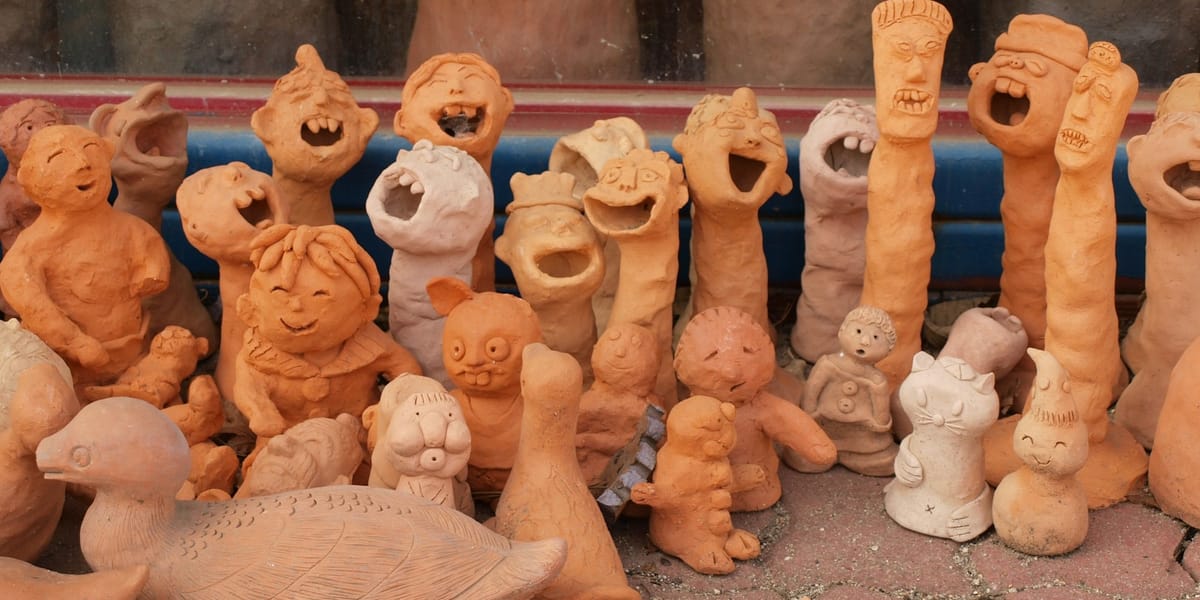
The twenty-inch tall torso looked perfect when you finished building it. Three days later, one shoulder has sagged forward, the neck has twisted fifteen degrees off center, and a crack runs from armpit to hip.
This isn't bad technique. It's physics.
Large ceramic sculpture warps because clay shrinks as water evaporates and different areas dry at different rates. The shoulder dried faster than the torso, contracted more, and pulled the whole form out of alignment. The crack opened where mechanical stress exceeded the material's tensile strength.
Understanding why this happens and how to prevent it requires examining clay at molecular level, particle size distribution, the role of non-plastic materials, water content relationships, and how all these factors interact during the critical drying phase when most failures occur.
The simple answer is "use more grog" or "dry slower." Both help. Neither addresses the actual material science that determines whether ambitious sculptural work survives or destroys itself through internal stress as it dries.
Clay body composition for large sculptural forms involves balancing contradictory requirements. You need enough plasticity to build complex shapes. But excessive plasticity means high shrinkage and warping. You need strength during construction. But materials providing strength often reduce workability. You need uniform drying. But large masses of clay dry from outside surfaces inward, creating moisture gradients that generate stress.
Professional sculptural ceramicists develop clay bodies addressing these specific challenges rather than using commercial formulas designed for wheel-thrown functional ware. The requirements differ fundamentally.
The Molecular Reality of Shrinkage
Clay shrinks because water molecules occupy space between clay platelets. As water evaporates, the platelets move closer together, and the overall volume reduces.
The shrinkage happens in stages with different characteristics. Water on the particle surfaces evaporates first during plastic-to-leather-hard transition. This causes most dimensional change and generates most warping stress. Additional shrinkage occurs during leather-hard-to-bone-dry phase as water between particles continues evaporating. Final shrinkage happens during firing as the clay vitrifies.
The amount of shrinkage depends on several factors: the clay particle size and shape, the packing density of particles, the amount of water in the plastic clay, and the presence of non-plastic materials that don't shrink.
Finer particle clays contain more water because smaller particles have greater surface area per unit volume. More surface area means more absorbed water molecules. More water means more shrinkage when it evaporates.
Ball clay particles measure roughly 0.5 to 2 microns. Kaolin particles range from 1 to 10 microns. These tiny platelets pack together with enormous water-holding capacity. A clay body composed primarily of fine particles might shrink 12-15% from wet to dry.
That percentage seems abstract until you build a three-foot tall sculpture. Fifteen percent of thirty-six inches is 5.4 inches of total shrinkage. If different areas dry at different rates, the shrinkage happens unevenly, creating warping and cracking.
The physics gets worse with scale. A small hand-built bowl might warp slightly without cracking because the mechanical stresses remain below the material's strength threshold. Scale that bowl up to thirty inches diameter and the same warping forces exceed material strength, creating cracks.
This isn't failure of technique. It's inevitable consequence of material behavior at that scale unless you modify the clay body to reduce shrinkage and increase strength during drying.
Particle Size Distribution and Plastic Behavior
Clay bodies for large sculpture need broader particle size distribution than throwing bodies to balance plasticity against shrinkage.
A throwing body wants maximum plasticity for wheel work. This means high percentage of fine particles that pack tightly and hold lots of water. The resulting clay stretches beautifully on the wheel but shrinks substantially and lacks the structural strength needed for large sculptural forms.
Sculptural bodies need enough plasticity for hand-building techniques (coiling, slab construction, solid modeling) but not the extreme plasticity that potters require. This allows formulating with broader particle range that reduces shrinkage while maintaining workability.
The particle size distribution affects how clay behaves mechanically. Fine particles create plasticity but weak green strength. Coarser particles (still clay, just larger) provide structural support but reduce plasticity. The distribution between these extremes determines performance characteristics.
A functional balance for sculptural work might include 30-40% fine ball clay for plasticity, 30-40% medium-particle kaolin for workability and reduced shrinkage, and 20-30% grog or other non-plastic materials for strength and shrinkage control.
These percentages vary based on the specific materials, firing temperature, construction techniques, and scale of intended work. A sculptor building eight-inch figures needs different clay than someone building six-foot installations.
The art involves understanding what each component contributes and how they interact. Ball clay alone would be too plastic, too high-shrinkage, and structurally weak. Kaolin alone lacks sufficient plasticity. Grog alone obviously doesn't work. The combination creates material greater than the sum of parts.
Grog: The Non-Plastic Foundation
Grog consists of fired clay ground to specific mesh sizes and added back to plastic clay bodies. It provides the single most effective tool for controlling shrinkage and warping in large forms.
The grog doesn't shrink because it's already been fired. It went through all its dimensional change during the firing that created it. Adding this pre-shrunk material to plastic clay reduces the overall shrinkage percentage of the clay body.
The math is straightforward. If clay body shrinks 12% and you add 20% grog by dry weight, the overall shrinkage drops to roughly 9.6% (80% of 12%). This reduction might prevent warping and cracking that would occur at higher shrinkage rates.
But grog does more than just dilute shrinkage. The particle geometry creates structural skeleton within the clay matrix that resists deformation. Think of grog particles as aggregate in concrete, providing reinforcement that limits how much the clay can move.
The grog size matters enormously. Fine grog (60-80 mesh) integrates into clay matrix more completely, providing shrinkage control with minimal texture. Coarse grog (20-40 mesh) creates visible texture and provides maximum structural support but can interfere with surface detail.
The amount of grog changes the clay's working properties significantly. At 10-15% grog content, you barely notice texture and maintain good plasticity. At 20-30%, the clay becomes noticeably coarser and less plastic but gains substantial strength. Above 30%, the clay becomes difficult to work and loses structural integrity because insufficient plastic clay exists to bind the grog particles.
The grog type also matters. Commercial grog is usually ground firebrick or fired stoneware. Some sculptors make custom grog by firing and grinding their own clay body, creating grog that matches the thermal expansion of the clay matrix. This reduces stress during firing.
Grog placement within a form can be strategic. Some sculptors use heavily grogged clay for structural elements and bases that support weight, switching to finer clay for detailed surface work. This requires joining clays with different shrinkage rates, which creates its own challenges.
Alternative Non-Plastic Materials
Grog isn't the only non-plastic material that controls shrinkage and provides structure. Each alternative offers different properties and challenges.
Sand works mechanically similar to grog but costs less and comes in consistent sizing. Silica sand doesn't shrink and provides structural support. But sand particles are smoother than grog, creating less mechanical interlocking. The clay can potentially move around the sand rather than being reinforced by it.
Sand also introduces silica to the clay body, affecting vitrification and glaze fit. This might be desirable or problematic depending on firing temperature and intended surface treatment.
Molochite (calcined kaolin) provides non-plastic material that's pure white and very fine. It works well for light-colored sculpture where grog's color and texture would be problematic. The fine particle size means you can add substantial percentages while maintaining smooth surface.
Perlite creates extremely lightweight clay bodies by introducing air pockets into the matrix. Sculptors building large installations where weight matters sometimes use perlite-enhanced bodies. But perlite reduces strength and creates fragile surfaces that damage easily.
Paper fiber (cellulose pulp) creates temporary structure that burns out during firing. The fiber mechanically reinforces the clay during drying, reducing warping. During firing, it combusts, leaving voids that reduce weight and thermal stress.
The fiber content can reach 20-30% by dry weight, dramatically changing the clay's behavior. The resulting material resembles papier-mâché more than traditional clay during construction. After firing, the burned-out fiber leaves lightweight, porous structure.
Nylon fiber provides similar reinforcement without burning out. It works well for very large, unfired sculptures or for adding tensile strength during construction and drying. The synthetic fiber remains in the finished work, affecting surface quality and potentially firing behavior.
Sawdust, rice hulls, and other organic materials create texture during drying and burn out during firing. These traditional materials still serve specific purposes in contemporary sculptural practice, particularly for very large or architectural work.
Water Content and Drying Dynamics
The water content in plastic clay determines not just workability but the intensity of shrinkage stress during drying.
Wetter clay is easier to work but shrinks more and creates greater internal stress. Drier clay requires more physical effort during construction but generates less shrinkage stress.
For large sculptural forms, using clay at slightly stiffer consistency than feels optimal during construction pays off during drying. The reduced water content means less total shrinkage and less mechanical stress as the form dries.
The challenge involves maintaining consistent water content throughout a large piece. The surface dries faster than the interior, creating moisture gradient. The dry exterior wants to shrink while the wet interior resists, creating stress that manifests as warping or cracking.
Controlling the drying rate through environmental management becomes crucial. Slow, even drying allows the moisture gradient to remain shallow, reducing internal stress. Covering work with plastic slows surface drying. Leaving it exposed accelerates moisture loss.
The geometry of the form affects drying dynamics profoundly. Thin sections dry faster than thick masses. Horizontal surfaces dry faster than vertical because gravity pulls moisture downward. Enclosed forms trap moisture inside, creating unequal drying rates between interior and exterior surfaces.
These geometric factors mean that even with ideal clay body composition, poor drying management will cause warping and cracking. The clay composition provides foundation, but drying technique determines whether ambitious forms survive.
Some sculptors use humidity chambers to control drying rates precisely. Others rely on careful plastic wrapping and gradual exposure. The specific technique matters less than understanding that moisture content relationships drive the mechanical stresses that destroy large work.
Thermal Expansion Mismatch
Even if sculpture survives drying intact, firing introduces new opportunities for failure through thermal expansion mismatch between clay matrix and non-plastic materials.
Different materials expand and contract at different rates when heated. If the clay matrix and the grog have significantly different thermal expansion coefficients, stress develops during heating and cooling cycles.
During initial heating to 500-600°C, any remaining water converts to steam and escapes. Organic materials combust. The clay undergoes chemical changes. If these processes happen too quickly or unevenly, the thermal stress can crack the work.
At vitrification temperatures (1200-1300°C for stoneware), the clay becomes glass-like and flows slightly. During cooling, this glass-like matrix contracts. If grog or other additives contract differently, the mismatch creates stress.
Using grog made from the same clay body minimizes thermal expansion mismatch. The grog and matrix expand and contract similarly because they're chemically identical. Commercial grog from unknown sources might introduce mismatch that causes problems during firing.
Sand introduces silica with known thermal expansion properties. At 573°C, quartz undergoes inversion from alpha to beta form, changing volume suddenly. If the clay body contains substantial free silica and is heated too quickly through this temperature, the rapid volume change can crack the work.
These thermal considerations mean that clay body composition for large sculpture must account not just for drying behavior but firing dynamics. The body that survives drying might still fail during firing if thermal properties aren't compatible.
Building Techniques and Clay Body Requirements
Different sculptural construction methods place different demands on clay body composition.
Coiling builds forms through sequential addition of clay coils. This technique requires clay that bonds well between layers while maintaining enough structure to support growing weight. The clay needs sufficient plasticity to blend coils seamlessly but not so much plasticity that the form slumps under its own weight.
A coiling body might use moderate grog content (15-20%) to provide structure while maintaining enough plasticity to blend coils. Too much grog makes blending difficult. Too little allows slumping.
Slab construction creates forms from flat clay sheets. The slabs must maintain their shape during handling and assembly without cracking at bends or joints. This requires somewhat stiffer clay than coiling, potentially with higher grog content for structural integrity.
The slab thickness affects clay body requirements. Thin slabs (quarter-inch) need relatively fine, plastic clay to roll without cracking. Thick slabs (two inches plus) benefit from heavily grogged bodies that resist warping during drying.
Solid modeling creates forms by adding and subtracting from clay masses. This technique generates least structural stress during construction but creates greatest drying challenges due to thick walls and varying cross-sections. Very open, grogged bodies work best to facilitate moisture escape from interior masses.
Hollow building through pinching or pressing thin walls requires plastic clay that can be compressed without cracking. But large hollow forms develop tremendous stress during drying as unsupported walls try to shrink. These pieces need carefully formulated bodies balancing plasticity against shrinkage control.
Each technique has its practitioners who've developed specific clay bodies through decades of trial and error. The formulas get traded informally through workshops, residencies, and studio visits rather than published in textbooks.
Scale-Specific Clay Body Development
The clay body that works perfectly for twelve-inch figures fails catastrophically for six-foot sculptures. Scale changes everything about material requirements.
Small sculpture tolerates higher shrinkage and less structural reinforcement. The physical forces remain manageable. A 10% shrinkage on a six-inch piece means 0.6 inches of movement. The same percentage on a seventy-inch piece means seven inches of movement generating proportionally greater mechanical stress.
The weight-bearing requirements also scale non-linearly. A small figure supports its own weight easily. As scale increases, the weight increases by the cube of linear dimensions while structural strength only increases by the square. This means large sculpture needs proportionally more structural support from grog and other reinforcement.
The drying dynamics become more challenging at scale. A small piece might dry evenly in days or weeks. A large piece requires months of carefully controlled drying to prevent the moisture gradients that cause warping and cracking.
Professional sculptors working at architectural scale often develop multiple clay bodies: a structural body for support elements and thick masses, a surface body for areas requiring detail or specific color, and sometimes intermediate bodies for joining between different sections.
These different bodies must have compatible shrinkage rates to join successfully. A 10% shrinkage body can't reliably attach to a 15% shrinkage body because the differential movement will separate them during drying.
The vitrification temperatures must also match. You can't fire a low-fire body joined to high-fire body without one being over-fired or under-fired. This limits the material combinations available for multi-body construction.
Commercial vs Custom Clay Body Decisions
Most commercially available clay bodies are formulated for wheel-thrown functional ware rather than large-scale sculptural work.
The commercial stoneware or porcelain you buy from ceramic suppliers works beautifully for bowls, mugs, and small decorative objects. It's typically too plastic, too high-shrinkage, and structurally inadequate for ambitious sculpture.
Some suppliers offer "sculpture bodies" with added grog, but these often represent generic formulations that might or might not suit specific needs. The sculpture body that works for someone building life-size busts might be wrong for someone creating abstract geometric forms.
Mixing custom clay bodies allows precise control over material properties but requires understanding the raw materials, access to dry ingredients, space for mixing, and willingness to experiment.
The basic process involves calculating desired percentages of ball clay, kaolin, feldspar, silica, and non-plastic materials, then mixing these dry materials with water to achieve proper consistency. The calculations consider both the working properties and fired characteristics.
Testing custom bodies requires making test tiles or small forms, drying them under the same conditions as intended large work, and firing to intended temperature. The shrinkage, warping, strength, and fired color all get evaluated before committing to large sculptures.
Many sculptors develop signature clay bodies through years of adjustment. The body evolves based on changing techniques, scale ambitions, firing conditions, and material availability. This ongoing refinement represents significant knowledge accumulated through experience.
The alternative involves modifying commercial bodies by adding grog, sand, or other materials to existing formulations. This approach requires less expertise than formulating from raw materials but offers less control over final properties.
Regional Material Variations
Clay deposits vary regionally, affecting the characteristics of commercially available bodies and raw materials for custom formulation.
Kentucky ball clays behave differently than Tennessee ball clays despite both being ball clay. Georgia kaolins have different properties than English China Clay. These variations mean that a clay body formula from one region might not work identically when mixed with locally available materials elsewhere.
This geographic variation created historical regional ceramic traditions. Staffordshire pottery developed specific characteristics because of local clays. Jingdezhen porcelain used nearby kaolin deposits. Contemporary sculptors working in different locations face similar material constraints.
The water quality also affects clay behavior. Hard water with dissolved minerals creates different plasticity than soft water. The pH affects deflocculation and influences how the clay body handles during mixing and construction.
Temperature and humidity in the studio environment affect drying rates and working properties. A clay body formulated for New England studios where heating systems create dry winter air might behave differently in humid Southern studios.
These environmental and material variables mean that clay body formulation isn't purely technical exercise. It involves adapting general principles to specific local conditions through experimentation and adjustment.
When Clay Body Can't Solve the Problem
Some warping and cracking problems result from construction or drying technique rather than clay body composition, and no material adjustment will fix them.
Building too quickly without allowing previous sections to firm up creates stress that manifests during drying. The fresh soft clay bonds to firmer clay below, creating joints with different moisture content that will shrink at different rates.
Uneven wall thickness within a form guarantees differential drying and warping. Thick sections hold moisture longer than thin sections. As the thin parts shrink, they pull on the thick parts that can't shrink yet because they're still wet inside.
Poor drying management overrides even ideal clay body composition. If you dry work too quickly or unevenly, no amount of grog or particle size optimization prevents warping and cracking.
Structural ambition that exceeds material limitations can't be solved through clay body adjustment. Cantilevered forms, extreme undercuts, and unsupported spans create mechanical stresses that ceramic materials fundamentally can't handle beyond certain scales.
These technique-based problems require solutions through construction methods, armatures, modular assembly, or simply accepting limitations on what's buildable in clay. The material has inherent constraints that skill and knowledge can push against but not eliminate.
Testing and Iteration as Essential Process
Developing clay body for specific sculptural needs requires systematic testing rather than hoping formulas from books or workshops will work.
The testing process starts with small samples mixed in quantities sufficient to evaluate but not so large that failures waste materials. Five-pound test batches allow making several small forms to assess working properties and drying behavior.
The evaluation criteria include: workability during construction, slumping resistance, surface quality, drying warping, cracking during drying, fired shrinkage, fired strength, and fired color. Each criterion might push toward different compositional choices.
A body that works perfectly during construction might warp unacceptably during drying. One that dries well might slump during construction. The iteration involves balancing these competing requirements through compositional adjustment.
The testing timeline extends over weeks because proper drying can't be rushed. You need to observe how test pieces behave under the same drying conditions you'll use for actual work.
Documenting the tests through photos, measurements, and notes creates knowledge base that informs future adjustment. The shrinkage percentages, cracking patterns, and warping tendencies all provide data for refining the formula.
Some sculptors run dozens of tests over months or years before arriving at clay body that reliably produces successful large work. This investment of time and materials represents necessary research that supports ambitious practice.
The Economics of Scale and Material Choice
Building large ceramic sculpture requires substantial material investment that influences clay body decisions.
Commercial sculpture bodies cost more than standard stoneware because of added grog and specialized formulation. Mixing custom bodies from raw materials might reduce costs but requires labor and expertise.
For sculptors producing multiple large works annually, the cost differential becomes significant. A heavily grogged commercial body might cost twice what standard stoneware costs. Using several tons yearly makes the expense considerable.
This economic pressure pushes toward custom formulation despite the additional labor involved. Buying raw materials in bulk and mixing bodies reduces per-pound costs substantially compared to bagged commercial clay.
The calculation must also factor in failure rates. If cheap commercial body results in 30% of large works cracking during drying, the material cost savings disappear through wasted labor and lost pieces. More expensive but more reliable custom body becomes economically rational.
The kiln costs for firing large work also influence material decisions. Reducing firing temperature from cone 10 to cone 6 cuts fuel costs substantially. This might drive choosing clay body that matures at lower temperature even if the working properties aren't quite as good.
These economic considerations mean that clay body development isn't purely technical decision. It involves balancing material costs, labor investment, failure rates, firing expenses, and the value of finished work in ways that vary for each sculptor's practice and market position.