Giclee vs. Lithograph: What Actually Differs
Giclee and lithograph prints look similar framed, but they are made by different processes with different materials — and that changes their longevity and their value.
Hang a giclée print and a lithograph side by side and most people can't tell them apart from across a room. That's exactly the confusion this article exists to clear up: the two are made by completely different processes, one of them is almost always a reproduction and the other can be an original artwork in its own right, and mixing up which is which is one of the more common ways buyers overpay or get misled.
At a glance
| Giclée | Lithograph | |
|---|---|---|
| Process | Inkjet printing | Printing from a flat stone or metal plate |
| Invented | Named 1990–91, process late 1980s | 1796 |
| Usually is | A reproduction of an existing artwork | Can be an original print, or a commercial reproduction |
| Longevity | High, with pigment inks on archival paper | High, depending on paper and ink |
| Typical value driver | Edition size, if limited at all | Whether it's original, hand-pulled, and by a recognised artist |
Where the word "giclée" actually came from
The term is younger than most people assume, and its origin story is oddly specific. Around 1990, the printmaker Jack Duganne was working at Nash Editions in California — a fine-art print studio co-founded by Graham Nash of Crosby, Stills & Nash — producing large-format prints on a modified Iris printer, a machine originally built for commercial prepress proofing rather than art. Duganne wanted a name that would separate these prints from ordinary "Iris proofs," and settled on the French word giclée, from gicler ("to spray" or "to squirt"), describing what the inkjet nozzles were literally doing.
The name stuck to the process rather than the specific printer, and it's since been applied to inkjet fine-art printing generally — which is also exactly why it doesn't tell you much about quality on its own. There's no licensing body that governs who can use the word.
What a giclée print actually is
Strip away the French, and a giclée is a high-quality inkjet print, typically made with archival pigment inks on acid-free paper or canvas. Done well, it's genuinely durable — pigment-based inks on the right substrate can last decades without meaningful fading. The word describes a printing method, not an artistic category, and in the overwhelming majority of cases what's being printed is a reproduction: a digital scan or photograph of a painting or drawing that exists somewhere else, in another medium.
That's not a flaw in the technology. It's simply a different kind of object than an original print, and the distinction matters enormously for value.
Lithography's much older, and different, story
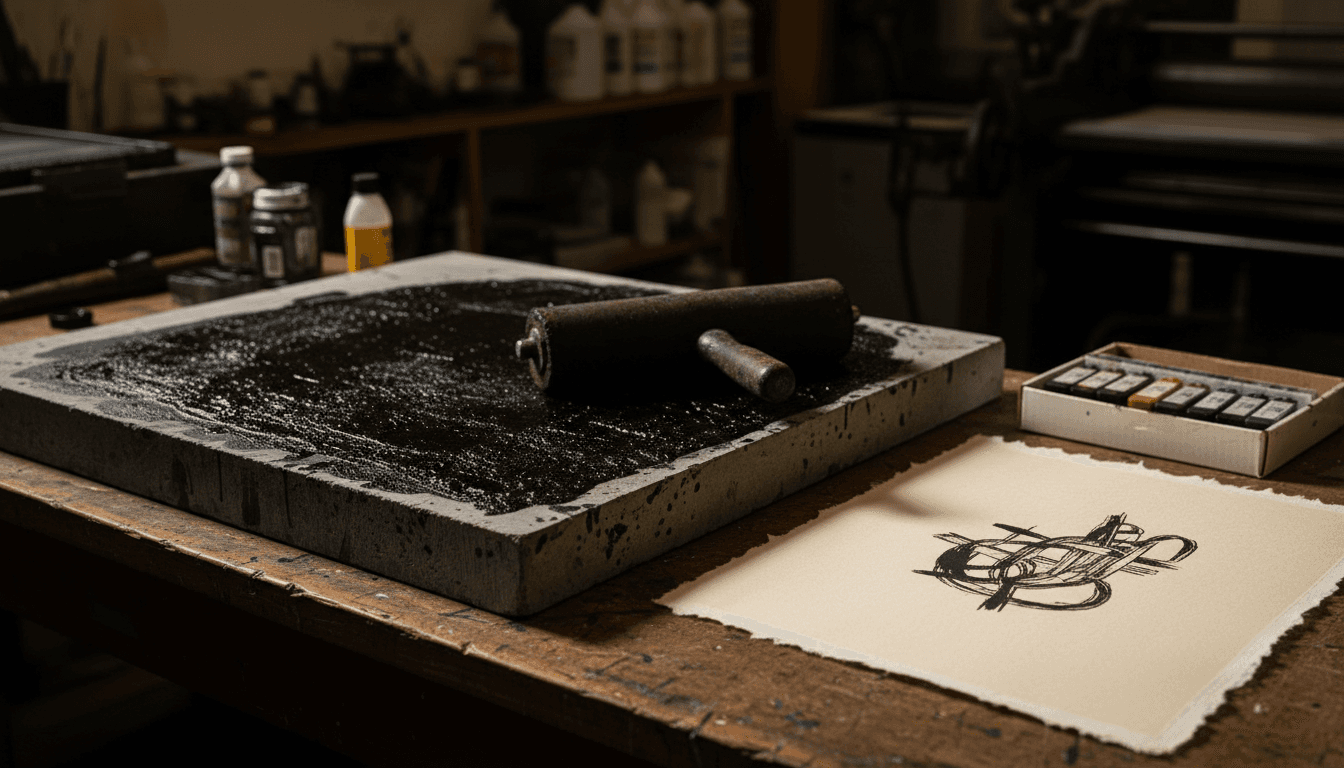
Lithography works on a principle discovered in 1796 by the German playwright and inventor Alois Senefelder: grease and water repel each other. An artist draws directly onto a flat limestone slab or metal plate with a greasy medium; the surface is chemically treated so ink clings only to the drawn areas; and the image transfers to paper under pressure. Unlike a woodcut (which prints from a raised surface) or an etching or engraving (which print from a recessed, incised one), lithography prints from a flat, or "planographic," surface — which is part of why it allows a freedom of mark-making closer to actual drawing than any other printmaking method.
Advertisement
A lithograph made this way, drawn and pulled by hand, is an original work of art existing in multiple copies — not a copy of something else. That's the version of "lithograph" worth paying original-print prices for.
The catch: offset lithography
The same underlying chemistry also runs a huge, entirely commercial industry: offset lithography, which transfers an image from a plate to a rubber roller and then to paper, used for everything from posters to magazines to mass-market reproductions of famous paintings. An offset lithograph shares its chemistry with a hand-pulled original, but not its status — it's a commercial reproduction, full stop, regardless of how the word "lithograph" on the label makes it sound. Knowing which kind you're looking at is the single most important question to ask before buying.
The questions that actually determine value
- Original or reproduction? A hand-pulled lithograph the artist made directly is an original artwork; a giclée or an offset lithograph of an existing painting is a reproduction, however well made — the same distinction that anchors any serious guide to assessing a print's value.
- What's the edition size, and is it honoured? A publisher who reprints beyond a stated edition size destroys the scarcity that gives a limited edition its value, and whether an edition is limited or open in the first place changes what that scarcity is even supposed to mean.
- Is it signed, and how? A pencil signature by a recognised artist adds real value, and a genuine artist's proof marking carries its own separate weight; a signature printed as part of the image (or an unknown artist's signature of any kind) adds far less.
- What are the materials? Pigment inks on archival paper outlast dye-based inks by a wide margin; acid-free paper survives where cheap stock yellows and turns brittle.
Longevity: it's the materials, not the label
"Lithograph" doesn't guarantee durability any more than "giclée" guarantees fragility — both claims run the wrong way. A giclée printed with pigment inks on a properly coated archival substrate can be extremely lightfast; a giclée using cheaper dye-based inks can visibly fade within a few years on a sunny wall. What actually determines longevity is the specific ink chemistry and paper, and a reputable printer will be able to tell you which they used without hedging.
How to tell them apart with a loupe
If the label is missing or you don't trust it, a jeweller's loupe or a strong magnifying glass will usually settle the question. An inkjet print, giclée included, shows a fine, semi-random spray pattern of tiny dots in several ink colours — the printer building up colour and tone by overlapping droplets. A hand-pulled lithograph shows continuous fields of solid ink with the slight texture of the plate or stone underneath, and often a very faint plate mark or paper impression at the edges where the printing surface met the sheet. An offset lithograph, meanwhile, shows a regular, mechanical dot pattern (a halftone screen) — visibly more uniform and grid-like than an inkjet's spray. None of this requires expertise; it just requires looking closely enough.
Where planographic printing sits among the print families
Printmaking is usually grouped by how the ink sits relative to the printing surface, and it's worth knowing where lithography fits. Relief printing (woodcut, linocut) inks a raised surface; intaglio (etching, engraving) inks a recessed one, wiped clean on top so ink survives only in the incised lines; lithography is planographic — image and blank space sit on the same flat plane, separated only by chemistry rather than by height. That flatness is exactly why lithography allows a drawn, painterly line that relief and intaglio methods, constrained by carving or cutting, can't easily reproduce.
The bottom line
"Giclée vs. lithograph" isn't really a contest between two kinds of print quality — it's a question about what kind of object you're buying. A giclée is a reproduction made by a printer, however skilled; a hand-pulled lithograph can be an original made directly by the artist. Both can look identical on a wall. Only one of them is the artist's own hand at work, and that difference is the whole market.
FAQ
Is a giclée print an original artwork?
Almost never — it's typically a high-quality reproduction of an existing painting or drawing. A giclée is only "original" in cases where the artist created the digital file specifically as the artwork itself, which is rare.
Do giclée prints fade?
Pigment-ink giclées on archival paper are highly lightfast and can last decades; dye-based ink giclées fade considerably faster. The ink type matters more than the word "giclée" itself.
Are lithographs always more valuable than giclées?
Only if the lithograph is a genuine hand-pulled original — an offset lithograph is a commercial reproduction and isn't automatically worth more than a well-made giclée of comparable quality.
Where does the word "giclée" come from?
Coined around 1990 by printmaker Jack Duganne at Nash Editions, from the French word for "to spray," describing inkjet printing on a modified Iris printer.
When was lithography invented?
In 1796, by Alois Senefelder in Germany, based on the principle that grease and water repel each other.