Engraving vs. Etching: How to Actually Tell Them Apart
Both are cut into metal and printed under pressure — but a burin and a needle-plus-acid produce genuinely different lines. Here's how to tell an engraving from an etching with just a loupe.
You're looking at an old print labelled simply "engraving," and something about the loose, sketchy lines doesn't match what that word usually means. It might be mislabelled — plenty of old prints are — or it might genuinely be an etching filed under the wrong name, since both processes produce the same basic kind of print and get confused constantly. Once you know what to actually look for, telling them apart takes under a minute.
What they share
Both engraving and etching are intaglio processes — ink sits in recessed lines cut or bitten into a metal plate, the surface is wiped clean, and damp paper is pressed onto the plate under enormous pressure, pulling ink up out of the grooves. That pressure leaves a genuine physical trace: a slightly raised, rectangular indentation in the paper around the image, called a plate mark, where the edge of the metal plate pressed in. Any real intaglio print — engraving, etching, drypoint, or a mix — should show one; a print with no plate mark at all is worth a second look, since it may be a later photomechanical reproduction rather than an original impression from the plate.
How engraving is actually made
An engraver cuts lines directly into a copper plate using a hand tool called a burin, physically pushing a V-shaped groove through solid metal. This takes real physical strength and total control, and it produces a very specific, identifiable line: because the burin naturally cuts deeper as the hand pushes harder into a curve and shallower as it eases off, engraved lines characteristically swell in the middle and taper to a fine point at each end. Albrecht Dürer is one of history's most famous engravers, and his prints show exactly this — crisp, confident, tapering lines built up into extraordinarily precise tonal detail.
How etching is actually made
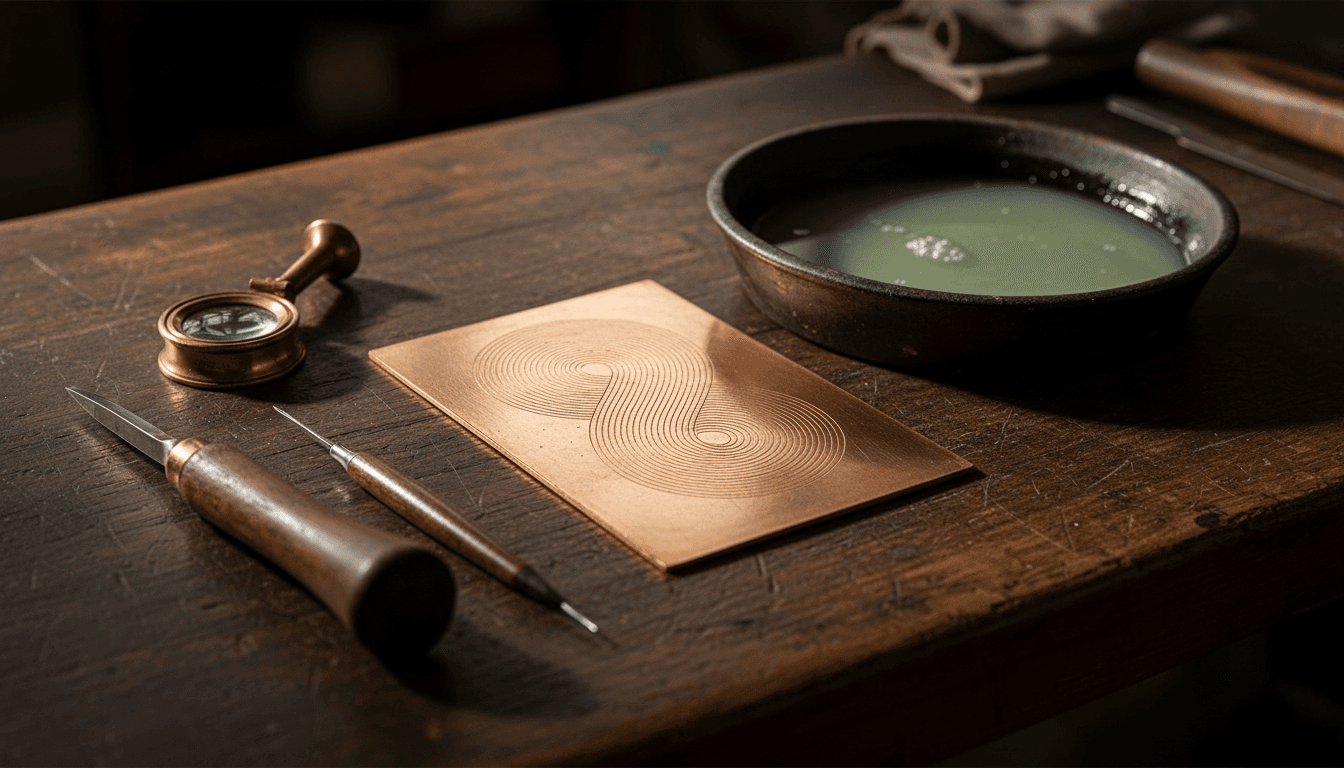
Etching replaces physical cutting with drawing and chemistry. The plate is coated with an acid-resistant ground — traditionally a wax or resin — and the artist draws through that coating with a fine needle, exposing bare metal wherever the line goes, a process that feels much closer to drawing with a pencil than carving with a chisel. The plate is then submerged in acid, which bites into the exposed lines while the coated areas stay protected; once the ground is cleaned off, the plate inks and prints the same way an engraving does. Because acid bites down at a roughly constant rate regardless of how fast or slow the hand moved, etched lines tend to stay closer to a uniform width along their length — no burin-driven taper — and the technique's ease of mark-making gives etching a looser, more spontaneous, sketch-like quality. Rembrandt is etching's defining master, often combining it with drypoint (a related technique scratching directly into bare metal without acid) for extra richness in a single plate.
Advertisement
Telling them apart with a loupe
- Check for taper. A line that visibly swells and thins along its length points to engraving; a line of consistent width throughout points to etching.
- Look at the overall feel. Engraving reads as controlled, precise, almost architectural; etching reads as freer and more drawing-like, closer to a pen sketch.
- Look for a plate mark. Its presence confirms an original intaglio impression rather than a later photomechanical copy; its absence is a warning sign, not a guarantee either way.
- Consider that many prints are both. Artists regularly reworked an etched plate with a burin afterward to sharpen or darken specific passages, so a single print can legitimately show both engraved and etched lines side by side, and — as with any question about a print's proof status — a mixed technique isn't itself a flaw, just something worth knowing before you price or catalogue the piece.
FAQ
What's the simplest way to tell an engraving from an etching?
Look at how the lines behave — engraved lines taper and swell along their length from the burin's changing pressure; etched lines stay closer to a uniform width, since acid bites at a constant rate.
What is a plate mark, and why does it matter?
It's the indentation left in the paper by the edge of the metal plate during printing, and its presence is a good sign you're looking at an original intaglio impression rather than a later reproduction.
Can a single print use both techniques?
Yes — artists often etched a plate first for the overall composition, then reworked specific areas with a burin or drypoint needle afterward for added depth or detail.
Who are the classic masters of each technique?
Albrecht Dürer for engraving, prized for extraordinary tonal precision; Rembrandt for etching, prized for a looser, more expressive line, often combined with drypoint.
Is one technique better or more valuable than the other?
Neither is inherently superior — value depends on the artist, the edition, the impression's condition, and its documented history, not which intaglio method produced it.