Why Gouache Reactivates With Water While Acrylic Doesn't
The chemistry behind gouache's water solubility versus acrylic's permanent film. Why gum arabic stays reactivatable while acrylic polymers lock permanently.
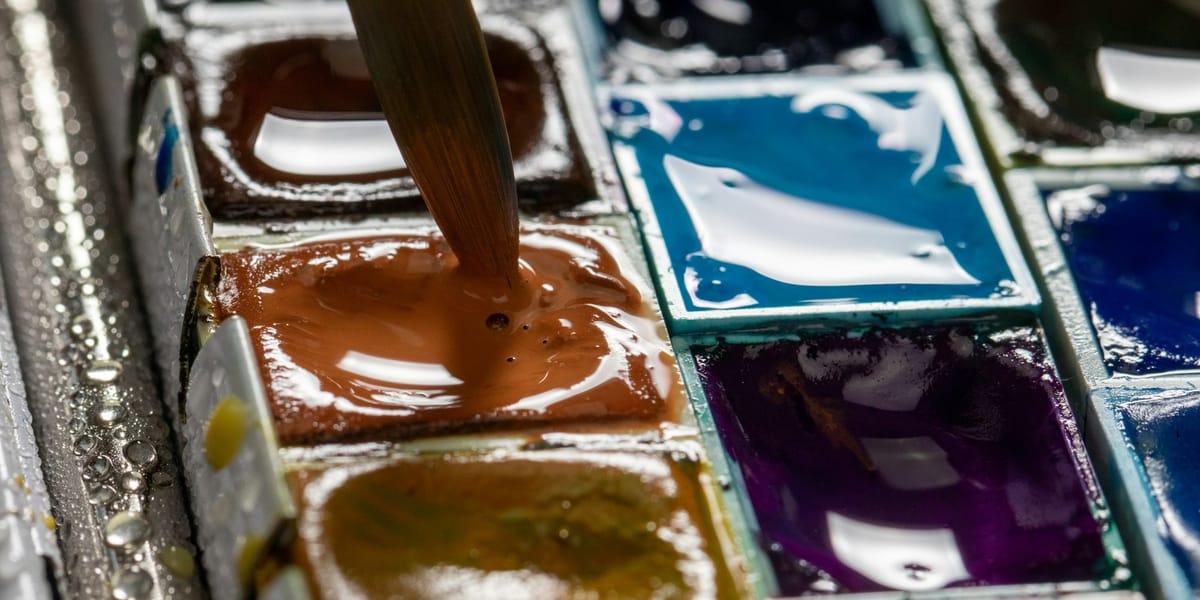
Put water on dried gouache and it dissolves back into workable paint. Do the same with acrylic and nothing happens. The dried film sits there impervious, completely unaffected by moisture that would turn gouache into a puddle. This fundamental difference in behavior stems from completely different binder chemistry, with implications that extend far beyond whether you can rework dried paint.
Understanding why these materials behave so differently requires looking at what actually happens at the molecular level when paint dries. Gouache and acrylic both start as pigment suspended in liquid, but they cure through entirely different mechanisms that create fundamentally different dried films. One remains chemically unchanged and water-soluble. The other undergoes irreversible transformation into water-resistant plastic. The difference isn't just about convenience or working properties. It's about the chemistry of how organic molecules interact with water versus how synthetic polymers form permanent structures.
This distinction affects everything from painting technique to long-term stability, from conservation challenges to why certain artists choose one medium over the other for specific applications. The reactivation property that defines gouache as a medium isn't a design feature so much as an inherent consequence of using gum arabic as binder. Similarly, acrylic's permanence once dry isn't an added benefit but an inevitable result of polymer film formation. Both behaviors are chemistry, not choice.
Gum Arabic Chemistry and Water Solubility
Gouache uses gum arabic as its primary binder, a natural polysaccharide derived from acacia tree sap. This material has been used to bind pigments for centuries because it dissolves readily in water, dries to a hard but brittle film, and holds pigment particles in suspension effectively. What makes it suitable as paint binder also makes it permanently water-soluble, since the chemistry doesn't fundamentally change when the water evaporates.
Gum arabic is a complex branched polysaccharide composed primarily of arabinose and galactose sugar units. The molecular structure contains numerous hydroxyl groups that form hydrogen bonds with water molecules. When you mix gum arabic with water, these hydroxyl groups interact with water through hydrogen bonding, pulling the polysaccharide chains apart and allowing them to dissolve. The gum doesn't react with water chemically, it just forms a solution through physical interaction.
When gouache paint dries, the water evaporates but the gum arabic molecules remain unchanged. They don't cross-link, they don't polymerize further, they don't undergo any chemical transformation. The dried film is essentially solid gum arabic with pigment particles trapped in it. Because the gum molecules still have all their hydroxyl groups available, they're ready to form hydrogen bonds with water again the moment moisture touches the surface. Add water and the dried gum dissolves back into solution exactly as it did originally.
This reversible dissolution is thermodynamically favorable because forming hydrogen bonds between gum arabic and water releases energy. The polysaccharide chains prefer being in solution, surrounded by water molecules, over being packed together in the solid state. The only reason dried gouache stays solid is because there's no water present. Introduce water and the system spontaneously shifts back toward the dissolved state because that's the lower energy configuration.
The arabinogalactan protein complex in gum arabic also contributes to water solubility. The protein component has hydrophilic amino acid residues that attract water molecules. This dual polysaccharide-protein structure makes gum arabic even more water-loving than simple polysaccharides would be. The molecular architecture evolved in the acacia tree to be easily dissolved and transported in aqueous plant systems, which translates directly to high water solubility in paint applications.
Temperature affects how readily dried gouache reactivates but doesn't change the fundamental solubility. Warmer water dissolves gum arabic faster than cold water because increased thermal energy helps overcome the activation energy barrier for breaking up the solid structure. But cold water will eventually dissolve dried gouache too, it just takes longer. The solubility itself is intrinsic to the gum arabic chemistry regardless of temperature.
Humidity can partially reactivate gouache even without liquid water contact. High humidity means water vapor in the air, and those water molecules can form hydrogen bonds with gum arabic at the paint surface. This softens the dried film and can cause colors to shift or migrate slightly. In very humid conditions, gouache paintings can actually become tacky to the touch as the gum arabic absorbs moisture from the air. This hygroscopic behavior is both a vulnerability and a confirmation of the material's fundamental water solubility.
The concentration of gum arabic in the paint formulation affects how readily it reactivates but doesn't eliminate the property. Higher gum content means more binder to dissolve, which takes more water or more time. Lower gum content reactivates faster. But the basic chemistry remains the same across the formulation range. As long as gum arabic is the binder, water solubility is inevitable.
Some gouache manufacturers add small amounts of other materials to modify working properties, things like glycerin for flexibility or honey for moisture retention. These additives can slightly affect reactivation behavior but don't fundamentally change the water solubility of the gum arabic binder. The paint still reactivates because the primary binder still dissolves in water. You'd have to replace the gum arabic entirely with a different binder to eliminate water solubility.
Acrylic Polymer Film Formation
Acrylic paint uses synthetic polymer binders, typically polymethyl methacrylate or related acrylic copolymers, dispersed in water as tiny particles. When the paint dries, these polymer particles don't just sit there like gum arabic molecules do. They undergo film formation, a process where individual particles coalesce into a continuous plastic film. This film formation is irreversible and creates a structure that water cannot redissolve.
The polymer particles in wet acrylic paint are suspended in water but aren't dissolved in it. They're discrete spheres, typically 100-200 nanometers in diameter, stabilized by surfactants that prevent them from clumping together. The particles themselves are hydrophobic, made of water-repelling polymer chains. Only the surfactant coating allows them to exist in aqueous suspension. This is fundamentally different from gouache, where the binder actually dissolves in the water.
As acrylic paint dries, water evaporates and the polymer particles get pushed closer together. Eventually they're forced into contact, and at this point the surfactants that kept them separate can no longer do their job. The particles start to deform where they touch, flattening against each other. Surface tension and capillary forces between particles drive this deformation. The particles are above their glass transition temperature at room temperature, which means the polymer is soft enough to flow under these forces.
Once the particles deform enough that their surfaces merge, polymer chains from adjacent particles interdiffuse across the boundaries. This is the critical step where individual particles stop being discrete entities and start becoming a continuous film. Polymer chains from one particle entangle with chains from neighboring particles, creating a network that spans the entire paint layer. This entanglement is physical, not chemical bonding, but it's permanent under normal conditions because the polymer chains are too long and too entangled to spontaneously separate.
The final dried acrylic film is a solid plastic layer with pigment particles embedded in it. The polymer chains are locked together in a dense, tangled matrix that doesn't dissolve in water because the polymer itself is hydrophobic. Water molecules can't penetrate this matrix to separate the polymer chains. Even if water could somehow get in, the chains are so thoroughly entangled that they wouldn't come apart without breaking the entanglements, which requires energy that water molecules at room temperature can't provide.
This film formation process is thermodynamically irreversible under normal conditions. Going from dispersed particles to coalesced film is a one-way process. The system moves from higher entropy (many separate particles) to lower entropy (one continuous film) because the energy released through particle fusion and chain entanglement makes this the favored state. Reversing it would require adding substantial energy to overcome the entanglements and recreate separate particles, which isn't going to happen from simple water contact.
Different acrylic formulations use different polymer chemistries, but all rely on this same basic film formation mechanism. Some use pure polymethyl methacrylate, others use copolymers that incorporate butyl acrylate or other monomers to adjust hardness and flexibility. These variations change the final film properties like brittleness or elongation but don't change the fundamental film formation process. All form irreversible films that don't redissolve in water.
The glass transition temperature of the polymer determines how readily film formation occurs. Polymers with Tg below room temperature form films easily because the polymer is soft enough to deform and flow at normal temperatures. Polymers with Tg above room temperature need plasticizers or coalescing aids to enable film formation without heating. But once the film forms, the Tg determines how hard or soft the dried paint feels. Higher Tg means harder, more brittle film. Lower Tg means softer, more flexible film.
Some acrylic paints include small amounts of water-soluble components like surfactants or thickeners that remain water-soluble even after the film forms. These can sometimes be leached out by prolonged water exposure, which might make the surface slightly tacky or change the gloss, but they don't make the actual polymer film redissolve. The paint might be affected at the surface by water, but the bulk polymer film remains intact and insoluble.
Modern acrylic formulations are designed to form films under a range of environmental conditions, from cold to warm temperatures, from dry to humid environments. This robustness comes from careful control of particle size, polymer composition, surfactant type, and inclusion of film formation aids. But all this engineering is about optimizing the film formation process, not changing its fundamental irreversibility. Once acrylic paint dries properly, the film is permanent.
Why Layering Techniques Differ Completely Between Media
The reactivation difference between gouache and acrylic creates fundamentally different possibilities and constraints for layering techniques. Each medium requires its own approach based on how dried layers respond to subsequent paint application. Ignoring these differences leads to muddy colors, disturbed underlayers, or poor adhesion depending on which way you violate the medium's constraints.
Gouache reactivation means every layer remains vulnerable to water from subsequent applications. When you paint over dried gouache, the moisture in your fresh paint partially dissolves the layer underneath. Gentle application with a soft brush and not too much water minimizes this disturbance, but some reactivation is inevitable. This makes traditional wet-on-wet blending techniques possible even in layers applied hours apart. You can soften edges, create gradations, and blend colors across layers in ways that treat the entire paint structure as one continuous working surface.
But this same reactivation becomes a problem when you want distinct layers that don't interact. Painting a dark color over a light gouache layer requires careful technique to avoid lifting the light paint and muddying your dark. Using thicker paint with minimal water helps. Quick, decisive brushstrokes that don't scrub the surface reduce disturbance. Some artists let gouache dry thoroughly and work very carefully over it with barely damp paint. Others embrace the mixing and plan compositions around it.
Acrylic's permanent film formation means each layer seals completely once dry. You can paint over dried acrylic with wet acrylic and the underlayer won't budge. This enables clean layering of transparent glazes over opaque passages without any color mixing between layers. You can build up complex color through multiple thin layers that remain optically distinct because they don't physically intermix. This is similar to oil glazing technique but much faster since acrylic dries in minutes rather than days.
The permanence also means you can't blend across dried acrylic layers the way you can with gouache. Once an acrylic layer dries, that's it. Any blending has to happen while the paint is wet. This creates pressure to work quickly and decisively before the paint sets. You can't go back and soften an edge hours later unless you're willing to paint over it entirely. The medium forces commitment in ways gouache doesn't.
Acrylic's isolation of layers makes color correction easier in some ways. Made a mistake? Let it dry and paint over it. The underlayer is sealed and won't interfere with new paint. Gouache doesn't work this way. Paint over a gouache mistake and you risk reactivating it and having the error bleed through or muddy your correction. Sometimes you have to physically remove dried gouache before repainting, which isn't possible with acrylic's permanent film.
The optical effects of layering also differ. Gouache layers that partially reactivate and intermix create complex color that includes some physical pigment mixing along with optical effects from transparent layers over opaque ones. Acrylic layers stay completely separated, so the optical effects are purer, more like stained glass than like mixed paint. This can create cleaner, more intense color in acrylic glazing compared to gouache layering where some dulling from intermixing is inevitable.
Drying time shapes layering workflow differently in each medium. Gouache dries quickly, often in minutes, but remains reactivatable. You can work rapidly through layers but need to respect the reactivation issue. Acrylic also dries quickly and then seals permanently. You can layer rapidly without waiting long but also can't revise once layers dry. Traditional oils dry slowly, requiring days between layers, but once dry they're stable like acrylic. Each medium creates different temporal constraints on how you can build up paint layers.
Thick impasto application works differently too. Thick gouache takes longer to dry and can crack if applied too heavily because gum arabic becomes brittle when thick. The paint also remains vulnerable to water damage even when dry. Thick acrylic dries from the outside in, creating a skin that can trap moisture underneath, but once fully dry it's stable and permanent. The acrylic can support much thicker application without the brittleness problems gouache has.
Surface preparation affects layering differently in the two media. Gouache works well on absorbent surfaces that wick away excess water and help paint dry matte. These same absorbent surfaces can cause problems with acrylic by pulling water out too fast and preventing proper film formation. Acrylic prefers less absorbent surfaces that allow time for polymer particles to coalesce before water is absorbed. The ideal surface for one medium isn't ideal for the other.
Practical Advantages and Disadvantages of Reactivation
Gouache's reactivation property creates both possibilities and problems that shape how the medium works in practice. Understanding these helps explain why certain artists prefer gouache for specific applications while avoiding it for others. The chemistry enables techniques impossible in permanent media while creating vulnerabilities that limit where gouache is appropriate.
The ability to rework dried paint is gouache's biggest practical advantage. Make a mistake and you can wet it and lift it off with a damp brush or sponge. Want to lighten an area? Wet it and blot with absorbent paper. Need to soften a hard edge? Dampen it and blend it out. This correctability makes gouache forgiving in ways acrylic isn't. Students learning to paint appreciate this since errors aren't permanent. Professionals doing commercial work under deadline appreciate it because they can make changes quickly without repainting entire passages.
Reactivation enables wet-in-wet techniques across time. Traditional watercolor wet-in-wet requires working fast before paint dries. Gouache lets you wet a dried area and work back into it hours or days later with similar blending effects. This removes the time pressure watercolor creates. You can work methodically rather than racing against drying time. For artists who think slowly or work in interrupted sessions, this flexibility is valuable.
The technique called "lifting" exploits reactivation deliberately. Apply gouache, let it dry, then selectively wet and remove paint to create highlights, texture, or corrections. This subtractive approach adds to the range of mark-making possible. You can create effects through removal that are hard to achieve through application alone. This works particularly well for atmospheric effects, suggesting form through selective lightening, or creating textural variety.
But reactivation becomes a severe disadvantage when you need layers to stay separate. Botanical illustration, technical illustration, and design work often require crisp edges between color areas with no bleeding or mixing. Gouache's tendency to reactivate makes this difficult. You have to work very carefully with minimal water to avoid disturbing underlayers. Many illustrators switched to acrylic when it became available specifically to avoid gouache reactivation problems in precise work.
Long-term stability is compromised by water solubility. A gouache painting can be damaged by water exposure years after completion. Humidity can soften the paint surface. Condensation can cause colors to run. This makes gouache unsuitable for outdoor applications or anywhere moisture exposure is likely. Framing under glass provides some protection but doesn't completely eliminate risk. Acrylic's permanent water resistance makes it much more stable for work that needs to withstand environmental challenges.
Reactivation makes varnishing problematic. Traditional solvent-based varnishes work over gouache without reactivating it, but you have to be extremely careful with application since any moisture will disturb the paint. Spray varnishes work better than brush-applied but still risk reactivation if applied too heavily. Acrylic paintings can be varnished easily because the dried paint film is impervious to the varnish solvents and moisture. This difference affects long-term protection options significantly.
Surface protection during handling is also an issue. Touch a gouache painting with damp fingers and you'll damage it. Lean it against something damp and colors can transfer. Work gets damaged in storage if humidity is high. These vulnerabilities require extra care in handling and storage that acrylic doesn't need. For work meant to be handled frequently or shipped without glass protection, gouache's fragility is a real limitation.
Reactivation affects color intensity and surface finish. Because gouache can be rewet and reworked, heavy-handed technique can lead to overworked passages where pigments get mixed into mud through repeated reactivation. The medium requires restraint and decisiveness that acrylic doesn't demand in the same way. You can't just keep pushing paint around indefinitely like you can with oils or acrylics. At some point continued reactivation destroys rather than improves the work.
The water solubility makes certain mixed media combinations impossible. Gouache doesn't work well with subsequent water-based washes or applications because they'll reactivate the gouache layer. You can work gouache over watercolor, but watercolor over gouache requires extreme care. Acrylic can be combined with watercolor, gouache, or other water media more freely because dried acrylic isolates underneath. This limits gouache's compatibility in mixed media work.
Conservation of historical gouache works is complicated by reactivation. Cleaning has to be done without water, using only dry methods or solvents that don't reactivate gum arabic. Consolidating flaking paint requires adhesives that don't introduce moisture. Repairs can't involve any water-based treatments. These constraints make conserving gouache paintings more difficult and expensive than conserving acrylic work. Museums and collectors have to factor these conservation challenges into acquisition decisions.
Fixatives That Make Gouache Water-Resistant
Artists who want gouache's working properties but need water resistance when finished can use fixatives to seal dried gouache and prevent reactivation. These create a protective layer over the paint that blocks water contact with the gum arabic binder. Understanding how these fixatives work and their limitations helps in deciding whether to use them and which type might suit specific needs.
Traditional fixative spray uses resin dissolved in volatile solvent. When sprayed over gouache, the solvent evaporates and leaves a thin resin film covering the paint surface. This resin layer is water-resistant, so subsequent moisture can't penetrate to the gum arabic underneath. Common resins used include damar, mastic, or synthetic acrylic resins. The fixative essentially encapsulates the gouache painting in a protective coating that prevents water contact.
Application technique with spray fixative matters enormously. Too light a coating won't provide adequate protection. Too heavy a coating can darken colors or create an unwanted glossy surface over gouache's characteristic matte finish. Multiple light coats work better than one heavy coat, building up protection gradually while minimizing color shift. Distance from the surface and evenness of application affect results. Practice on test pieces is essential before treating finished work.
Fixative can darken gouache colors because it increases transparency and light penetration into the paint layer. Gouache normally looks matte and opaque because light scatters off the rough dried gum arabic surface. Add fixative and you create a smoother surface that allows more light to penetrate deeper into the paint layer before reflecting back. This increased light path through pigmented binder darkens color perception. The effect is usually subtle but noticeable, particularly in light colors.
The darkening is similar to what happens when you wet gouache. Dry gouache appears lighter and more opaque than wet gouache because of surface scattering differences. Fixative doesn't wet the paint but it does eliminate some surface scattering, producing a similar darkening effect. Some artists test how fixative will affect their specific colors before deciding whether to use it. Others accept the darkening as part of the finishing process and plan for it.
Workable fixatives allow additional paint application after fixing. These use resins that dried paint will adhere to, creating what's essentially a new painting surface on top of the fixed layer. This allows building up complex works where earlier layers are sealed against reactivation while new layers can still be applied and modified. The workable fixative acts as an isolation layer between paint stages. This technique combines gouache's reactivation properties during work with protection of finished passages.
Permanent fixatives create a harder, more complete seal that can't easily be painted over. These provide maximum protection but end the ability to add more paint. They're used for finished work that won't receive additional layers. The distinction between workable and permanent fixatives is formulation-based, with permanent versions using harder, more complete film-forming resins.
Acrylic mediums can function as fixative for gouache. Brush or spray a thin layer of acrylic medium over dried gouache and it creates a permanent, water-resistant seal. This works because acrylic forms its irreversible polymer film over the gouache, completely encapsulating it. The result is more like an acrylic painting with gouache embedded underneath than like traditional gouache. But it provides excellent protection and allows subsequent acrylic paint application if needed.
Conservation concerns about fixatives include long-term yellowing of resin-based fixatives, particularly natural resins like damar. Over decades, these can yellow significantly, altering color relationships in the painting. Synthetic acrylic fixatives yellow less but still undergo some aging changes. The fixative also becomes part of the painting's structure that conservators have to deal with when treating deterioration. Some fixatives are easier to remove than others if conservation treatment requires it.
The fixative approach works best for work that needs permanent protection after completion. It doesn't help with the reactivation issues during painting since you only fix the work when finished. If you need layers to stay separate during the painting process, fixative between layers works but becomes labor-intensive. At that point you might question why you're not just using acrylic, which has this property built in.
Environmental and health concerns with spray fixatives include solvent fumes and propellant chemicals. Working outdoors or in well-ventilated spaces is essential. Some fixatives use toxic resins or solvents that require respirator protection. The convenience of fixing gouache has to be weighed against these practical safety considerations. Water-based acrylic fixatives avoid solvent issues but may reactivate gouache if applied too wet.
Casein as Middle Ground Between Gouache and Acrylic
Casein paint occupies an interesting position between gouache's water solubility and acrylic's permanent film formation. Understanding casein's chemistry explains why it behaves the way it does and why some artists prefer it over either gouache or acrylic for specific applications.
Casein is a milk protein that forms the binder in casein paint. When fresh, casein paint is water-soluble and behaves somewhat like gouache. But as it dries and ages, chemical changes occur that make it increasingly water-resistant, eventually becoming nearly as permanent as acrylic. This progressive change from soluble to insoluble is unique among common painting media and creates working properties distinct from both gouache and acrylic.
The chemistry behind this transformation involves protein cross-linking. Fresh casein consists of individual protein molecules suspended in water with alkali (usually ammonia or borax) keeping them in solution. As the paint dries, the water evaporates and the alkali either evaporates (if ammonia) or becomes neutralized by carbon dioxide from air. This pH change causes casein proteins to denature and begin linking together through disulfide bonds between cysteine residues in the protein chains.
These cross-links increase over time. Freshly dried casein paint is still somewhat water-soluble because cross-linking has just begun. After several hours, it becomes more water-resistant. After days or weeks, it's essentially permanent, with enough cross-links that water can't break them apart. This time-dependent change in properties is characteristic of casein and differentiates it from both gouache (which never becomes water-resistant) and acrylic (which is permanent as soon as film formation completes).
The practical consequence is a medium that's reactivatable when fresh but becomes permanent with age. You can rework casein paint for a few hours after application, lifting and blending like gouache. But once it's fully cured, usually after 24-48 hours, it's stable and can be painted over without reactivating underlayers. This gives you some of the flexibility of gouache with the eventual permanence of acrylic.
Casein's working properties during application feel different from both gouache and acrylic. It's more viscous than gouache, with a creamy consistency that some artists find easier to control. It dries matte like gouache but with a different surface quality, slightly more velvety. The paint doesn't stay wet as long as acrylic, drying quickly but not instantly. This moderate drying time gives a workable window without the pressure of acrylic's very fast drying or oils' very slow drying.
The adhesion of casein is exceptionally strong once cured. The cross-linked protein film bonds tenaciously to most surfaces, sometimes too tenaciously. Removing dried casein from palettes or brushes is difficult and requires scrubbing or soaking in alkaline solutions. This strong adhesion makes casein excellent for murals or situations where paint needs to stick reliably to challenging surfaces. Diego Rivera used casein for murals specifically because of its adhesive properties.
Color in casein tends to dry darker than wet, similar to acrylic but more pronounced. This value shift requires compensation during painting, mixing colors lighter than the desired final value. Artists working with casein develop intuition about how much to compensate, similar to how watercolorists learn to account for lightening as their paint dries. The shift comes from increased transparency as water evaporates and the protein film consolidates.
Casein has better pigment-binding capacity than gouache, allowing higher pigment loading without the brittleness that too much pigment creates in gum arabic. This enables more saturated color and better opacity in a single layer. The protein structure is stronger than polysaccharide, creating a more robust film that can hold more pigment. This makes casein particularly good for covering large areas with intense, opaque color.
The main disadvantage of casein is its tendency to become brittle with age. The cross-linking that creates water resistance also makes the film increasingly rigid. Old casein paintings can crack if the support flexes. This limits casein to rigid supports or requires flexible additives in the paint formulation. Modern casein paints often include plasticizers to maintain some flexibility, but extreme bending still risks cracking the dried film.
Casein is also more challenging to manufacture consistently than either gouache or acrylic. The casein protein must be properly processed and stabilized. The pH must be controlled carefully. Ammonia levels affect both working properties and curing behavior. This complexity means fewer manufacturers offer casein paint compared to gouache or acrylic. What's available is often more expensive because production is more demanding.
Conservation of casein paintings is complicated by the progressive cross-linking. Very old casein becomes difficult to treat because the protein film is so tightly cross-linked it doesn't respond to normal conservation treatments. The protein can also be attacked by microorganisms in high humidity, leading to deterioration that gouache and acrylic don't experience. Museums with casein paintings need specialized knowledge to care for them properly.
Why Designers Preferred Gouache in the Pre-Digital Era
Before digital tools dominated commercial art, gouache was the standard medium for illustration, design work, and production art. Understanding why requires looking at what designers needed and how gouache's properties, including its reactivation behavior, served those needs better than alternatives available at the time.
Gouache provided completely opaque, matte color that photographed and reproduced well. Commercial printing processes required artwork with consistent, flat color that would separate cleanly into printing plates. Gouache's opacity meant white could be painted over black cleanly, allowing corrections and adjustments that transparent watercolor didn't permit. The matte finish eliminated glare and reflections that complicated photography of artwork for reproduction.
The reactivation property that creates problems for fine art became an advantage for commercial work. Mistakes could be lifted and corrected easily. Edges could be refined. Colors could be adjusted by rewetting and blending. This correctability meant tight deadlines could be met without starting over when changes were needed. Art directors' requests for revisions could be accommodated quickly by rewetting relevant areas and modifying them.
Fast drying time kept production moving. Designers working on multiple pieces or tight schedules needed paint that dried quickly enough to allow rapid layering and finishing. Gouache dried in minutes, much faster than oils. Acrylic wasn't widely available until the 1960s and early formulations had handling issues that made them less suitable for precise commercial work than gouache.
The paint could be used thin for washes or thick for opaque coverage, giving designers flexibility in technique. Lettering, technical illustration, and realistic rendering all worked with gouache. The medium was versatile enough to handle the range of commercial art applications from loose conceptual sketches to tight finished illustrations ready for reproduction.
Color matching was reliable with gouache. Designers could mix specific colors and match them in subsequent applications. The paint didn't shift color as dramatically between wet and dry as watercolor did, though some shift occurred. This predictability mattered when matching corporate colors or achieving specific reproduction results. Keeping paint on the palette and rewetting it allowed color consistency across multiple pieces or revision rounds.
The water-based nature meant easy cleanup and low toxicity compared to oil-based media or some early acrylics. Studios could work with minimal ventilation concerns. Brushes cleaned with water. Palettes could be washed in the sink. This practicality mattered for commercial work environments where productivity and safety both mattered.
Gouache worked well on illustration board, the standard support for commercial art. The board's surface was designed to accept gouache without excessive absorption while providing enough tooth for good adhesion. This pairing of medium and support created a reliable system that produced consistent results across different artists and studios.
The reactivation property also enabled certain technical tricks specific to commercial illustration. Artists could create smooth gradations by applying gouache, letting it partially dry, then gently brushing over it with a damp brush to soften edges and blend colors. This technique, harder with permanent media, allowed subtle atmospheric effects and smooth transitions between color areas.
When acrylic became widely available, many commercial artists switched for its permanence and faster, more reliable drying. But gouache retained a following among illustrators who valued its specific handling properties and the reactivation possibilities for precise corrections. Some artists preferred gouache's matte surface quality over acrylic's slight sheen. Others found gouache colors more saturated or easier to control in detailed work.
Digital tools eventually displaced both gouache and acrylic for most commercial applications. The computer offered perfect corrections, exact color matching, unlimited layers, and instant revisions. The specific material properties that made gouache valuable for commercial work became irrelevant when the work was entirely digital. Gouache survives now primarily as a fine art medium rather than the commercial workhorse it was for much of the twentieth century.
The historical importance of gouache in commercial art is often overlooked, but understanding this context explains certain technical developments in the medium and why certain properties were emphasized. Paint manufacturers formulated gouache specifically for illustration needs, prioritizing opacity, matte finish, and color consistency for reproduction over archival permanence or resistance to environmental damage. These priorities reflected the medium's primary use case in an era when commercial art was hand-executed physical artwork.
How Humidity Affects Each Medium Differently
Environmental humidity affects gouache and acrylic dramatically differently because of their contrasting responses to moisture. These differences shape storage requirements, working conditions, and long-term stability for paintings in each medium. Understanding the specific vulnerabilities and behaviors helps prevent damage and explains why each medium suits different environmental contexts.
Gouache's hygroscopic gum arabic binder absorbs water vapor from humid air. As relative humidity increases, gum arabic takes on moisture even without direct liquid water contact. This absorbed moisture plasticizes the dried paint film, making it softer and tackier. At high humidity above 70%, gouache can become soft enough to be marked by contact or even to slump slightly on vertical surfaces. Colors can shift as moisture content changes the refractive properties of the binder.
This humidity sensitivity creates storage challenges for gouache paintings. They need to be kept at stable, moderate humidity, ideally 40-55% RH. Higher humidity risks softening and damage. Very low humidity can make gouache brittle and prone to cracking. The ideal storage conditions are narrower than for many other media. Museums storing gouache work invest in climate control specifically to maintain appropriate humidity levels.
Framing gouache under glass provides some protection but doesn't eliminate humidity effects entirely. Moisture can still enter the frame package through gaps or permeable backing materials. The glass prevents direct contact with airborne water but doesn't create a perfectly sealed environment. In very humid climates, even framed gouache can be affected by seasonal humidity cycles unless the entire building is climate-controlled.
Acrylic's polymer film is hydrophobic and doesn't absorb atmospheric moisture significantly. Normal humidity variation has minimal effect on dried acrylic paint. The film remains hard, stable, and water-resistant across the typical indoor humidity range of 30-70% RH. This makes acrylic much more tolerant of environmental variation than gouache. Storage and display conditions can be less rigorously controlled without risking paint deterioration.
Very high humidity above 80% can affect acrylic in subtle ways. Some water-soluble components like residual surfactants can become mobile and migrate to the surface, creating slight tackiness or gloss changes. But the core polymer film structure remains unaffected. This is minor compared to gouache's dramatic softening at high humidity. Acrylic remains fundamentally stable even in challenging humid environments.
Low humidity affects acrylic and gouache differently too. Gouache becomes more brittle as humidity drops, increasing risk of cracking, particularly in thick applications or flexible supports. The gum arabic needs some moisture to maintain flexibility. Extreme dryness removes this plasticizing moisture and the film becomes fragile. Acrylic's polymer film has flexibility built into its chemistry through plasticizer incorporation and copolymer composition. Low humidity doesn't make it significantly more brittle under normal conditions.
These differences explain why acrylic succeeded gouache for outdoor and high-humidity applications. Murals, signs, or artwork displayed outdoors can't be protected from environmental humidity variation. Gouache would deteriorate rapidly in these contexts. Acrylic remains stable through rain, humidity, and temperature cycles that would destroy gouache. This environmental robustness was one of acrylic's major advantages when it entered the art materials market.
Working in humid conditions affects the two media during painting differently. High humidity slows gouache drying by reducing evaporation rate, giving longer working time but also requiring more patience between layers. The moisture in the air can also make it easier to reactivate and blend recently dried gouache. Acrylic film formation can be impaired by very high humidity if it interferes with particle coalescence, though this is rare under normal conditions. More commonly, humidity just slows acrylic drying slightly by reducing evaporation rate.
Artists working in tropical or humid climates have traditionally struggled with gouache because the environmental humidity makes it unreliable. Paintings can be damaged by the climate before they're even finished. Some artists in these regions developed workarounds like working in air-conditioned spaces or using fixatives immediately. Others switched to acrylic or oils specifically because of humidity problems with gouache.
Climate change implications for art conservation include increasing humidity in some regions and increasing temperature swings that drive moisture cycling. These environmental changes particularly threaten gouache works in collections. Conservators are identifying vulnerable gouache paintings and prioritizing them for improved storage conditions or remedial conservation before environmental damage becomes severe.
The humidity sensitivity difference also affects mixed media decisions. Gouache can't be safely combined with materials or techniques that introduce moisture in humid conditions. Acrylic can be combined more freely because its permanent film formation doesn't create vulnerability to subsequent moisture. This limits gouache's utility in contemporary mixed media practice where materials are often combined with less regard for individual medium sensitivities.
What This Chemistry Means for Long-Term Artwork Survival
The fundamental difference in how gouache and acrylic cure has implications for how long paintings in each medium will survive and what threats they face over decades or centuries. Understanding these long-term stability differences helps in choosing media for work intended to last, in caring for existing work, and in understanding conservation challenges each medium presents.
Gouache's continued water solubility means paintings remain vulnerable to moisture damage indefinitely. A gouache painting finished today will be just as susceptible to water damage in a hundred years. The gum arabic doesn't become more water-resistant with age, it just gets more brittle. This creates a permanent conservation vulnerability that can't be eliminated, only managed through environmental control and protective framing.
The brittleness that develops in old gum arabic creates additional problems. As gouache paintings age, the binder becomes increasingly rigid. Any flexing of the support can cause paint to crack or flake off. This makes gouache unsuitable for flexible supports like unstretched canvas. Even on rigid supports, dimensional changes from humidity cycling can create stresses that brittle gum arabic can't accommodate. Old gouache paintings develop characteristic cracking patterns that conservators recognize immediately.
Color stability in gouache depends entirely on pigment permanence since the binder doesn't yellow or change color. Good quality gouache using lightfast pigments will maintain color accuracy over time. Cheap student-grade gouache using fugitive pigments will fade badly. The medium itself isn't the weak point for color stability, the pigment choice determines this. Well-made gouache with quality pigments can maintain color better than oil paintings where binder yellowing affects appearance.
Acrylic's polymer film is chemically stable and doesn't degrade under normal conditions. The hydrocarbon polymer chains don't oxidize, don't hydrolyze, don't support microbiological growth. This chemical inertness means acrylic paintings should theoretically be very stable long-term. We don't have centuries of evidence yet since acrylics only became available in the 1950s, but accelerated aging tests suggest good stability over time equivalent to several hundred years under typical conditions.
The concern with acrylic longevity is that we're still learning about long-term behavior. Some early acrylic formulations have shown unexpected aging effects like surfactant migration, increased brittleness, or poor adhesion to certain grounds. As acrylic paintings age into the 50-70 year range, conservators are discovering issues that weren't predicted from shorter-term testing. The medium's long-term behavior isn't fully understood yet because not enough time has passed.
Acrylic's sensitivity to heat is a known vulnerability. Above about 60°C (140°F), many acrylic polymers soften significantly. This means acrylic paintings can't tolerate high temperatures that oil or gouache paintings might survive. Storage near heat sources, in hot attics, or in vehicles during summer can damage acrylic work. The polymer doesn't degrade chemically but softening can cause paint layers to stick together, transfer to protective glazing, or distort.
Both media face pigment-related stability issues independent of binder chemistry. Certain pigments used in both gouache and acrylic are fugitive or chemically unstable. The medium choice doesn't protect against poor pigment selection. But acrylic's plastic film can trap degradation products from unstable pigments, sometimes leading to more severe deterioration than the same pigments would cause in gouache where degradation products can diffuse away more easily.
Conservation treatment options differ substantially between the media. Gouache can be consolidated with water-soluble adhesives, cleaned with dry methods, and treated using techniques developed over centuries of working with water-soluble paint media. Acrylic requires different approaches since the polymer film doesn't respond to traditional conservation treatments. Some conservators specialize in acrylic paintings specifically because the treatment protocols are so different from traditional media.
The reversibility principle in conservation, the idea that treatments should be reversible in case future conservators want to revise them, is easier to maintain with gouache than acrylic. Gouache's water solubility means most consolidation and repair treatments can be undone with water. Acrylic's permanence means once you've done something to an acrylic painting, it may be very difficult to reverse. This makes conservation decisions for acrylic work higher stakes.
Long-term survival prospects favor acrylic in uncontrolled environments and gouache in well-maintained museum conditions. Acrylic's tolerance of humidity variation, temperature swings, and general environmental challenges means it survives neglect better. Gouache's vulnerability to moisture means it needs protective framing and climate control to survive long-term. But in ideal museum storage with proper environmental control, gouache's chemical simplicity might give it advantage over acrylic's less predictable long-term polymer behavior.
Economic factors affect survival too. Acrylic paintings can be displayed without glass in many contexts, reducing framing costs. Gouache needs protective framing, which adds expense that affects whether work gets properly preserved. Less valuable gouache work may not justify the framing cost, leading to improper storage and deterioration. Acrylic's lower preservation costs make it more likely that work survives even if its monetary value is modest.
The legacy question is whether we're creating a conservation crisis with acrylic paintings that we won't fully understand for another century. Conservators can handle deteriorating gouache because the chemistry is simple and well understood. Deteriorating acrylic may present problems we haven't encountered yet using chemistry we don't fully understand for conservation purposes. Time will tell whether acrylic's apparent stability holds up or whether unexpected aging mechanisms emerge as paintings reach 100+ years.