The "Mistake" in a 1533 Painting That Wasn't a Mistake
The blurry streak at the bottom of Holbein's 1533 masterpiece isn't damage. It's a precisely calculated skull, built to resolve only when you stop looking at the painting head-on.
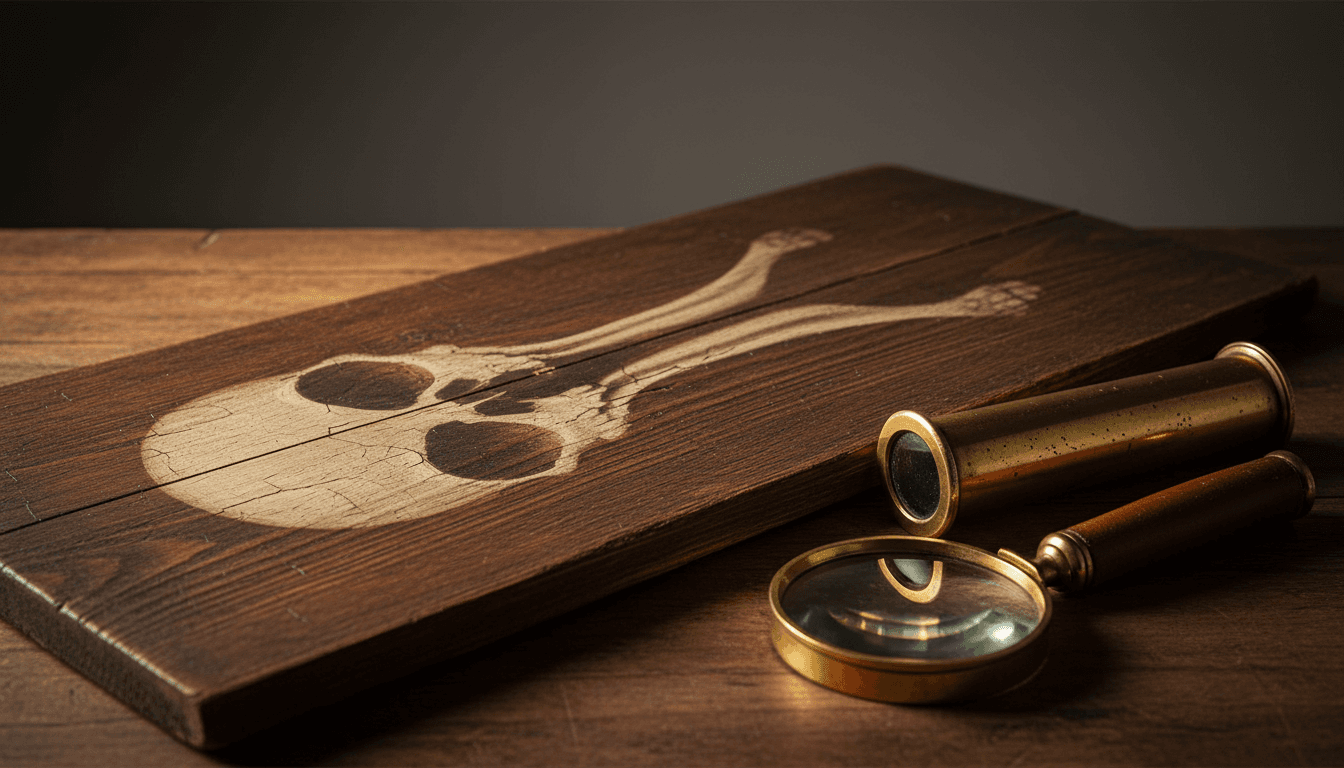
Look at Hans Holbein's The Ambassadors head-on and there's a strange grey smear stretched diagonally across the bottom of the canvas, floating between the two richly dressed men like a smudge the restorer missed. It isn't damage, and it isn't a mistake. Walk to the far right of the painting and look back at it from a steep, oblique angle, and the smear resolves instantly into a photorealistic human skull.
At a glance
- Painting
- The Ambassadors, Hans Holbein the Younger
- Year
- 1533
- Medium
- Oil on oak panel
- Location
- National Gallery, London (since 1890)
- Technique
- Anamorphosis (a deliberately distorted, angle-dependent image)
- Known uses by Holbein
- This is his only documented use of the technique
What anamorphosis actually is
Anamorphosis is a deliberately distorted image, constructed using the same geometric rules as ordinary linear perspective but pointed at an oblique viewing angle instead of a straight-on one. The artist calculates exactly how a recognisable shape would need to warp to look correct from one specific, off-centre position, then paints that warped version directly onto the canvas. Viewed from the "wrong" angle — straight on, the way most of the painting is meant to be read — it looks like an abstract streak. Viewed from the one correct angle, the distortion cancels out and the real image snaps into focus.
How Holbein actually built it
Technical analysis of the panel shows the skull was constructed through a precise sequence of geometric transformations: the underlying image was rotated roughly 25 degrees, compressed along one axis and stretched along the other, and the whole shape tilted again — the mathematical equivalent of viewing an ordinary skull from a steep, raking angle and then flattening that view back onto the canvas. It isn't a rough trick. It's a calculated exercise in the same perspective mathematics that governs the rest of the painting, deliberately misapplied so that only one specific viewpoint restores it.
Why a skull, and why here
The Ambassadors depicts Jean de Dinteville, a French ambassador to the English court, and his friend Georges de Selve, a bishop, surrounded by a table of instruments — globes, a lute, astronomical devices, a hymnal — representing the height of contemporary knowledge and worldly achievement. The skull is a memento mori, a reminder of death dropped directly into the middle of that display of learning and status, and its distortion means it can't be taken in in the same glance as everything else: a viewer has to physically move, deliberately choosing to confront mortality rather than stumbling on it by accident. Two smaller details reinforce the theme quietly: a lute with one visibly broken string, generally read as a symbol of discord (likely a reference to the religious rupture of the Reformation), and a small silver crucifix, half-hidden behind a curtain in the painting's top left corner, easy to miss entirely on a casual look.
Advertisement
The bottom line
The skull in The Ambassadors isn't a flaw in the painting or a puzzle Holbein left unsolved — it's the single point in the composition where the viewer is forced to stop looking passively and start actively working to see. Everything else in the painting rewards a straight-on glance. The skull rewards only the person willing to walk to the edge of the room and look back.
FAQ
What is the blurry object in Holbein's The Ambassadors?
A human skull, painted using anamorphosis — a distortion technique that only resolves into a recognisable image when viewed from a specific, extreme angle rather than head-on.
How do you actually see the skull correctly?
Stand to the right of the painting and look back at it from a steep, oblique angle; the National Gallery displays it in a way that makes this viewing position achievable.
Did Holbein use anamorphosis in other paintings?
No — this is his only documented use of the technique in his surviving body of work.
What does the skull mean in the painting?
It's a memento mori, a reminder of death and mortality placed deliberately among the ambassadors' instruments of worldly knowledge and status.
When was the painting made and where is it now?
It was painted in 1533 and has been in London's National Gallery since the museum purchased it in 1890.