The Grey Painting Technique Born From a Ban on Color
A 1134 monastic ban on colored church art gave us grisaille — grey painting that later learned to impersonate carved stone on the outside of Flemish altarpieces, then quietly became oil painting's own underpainting method.
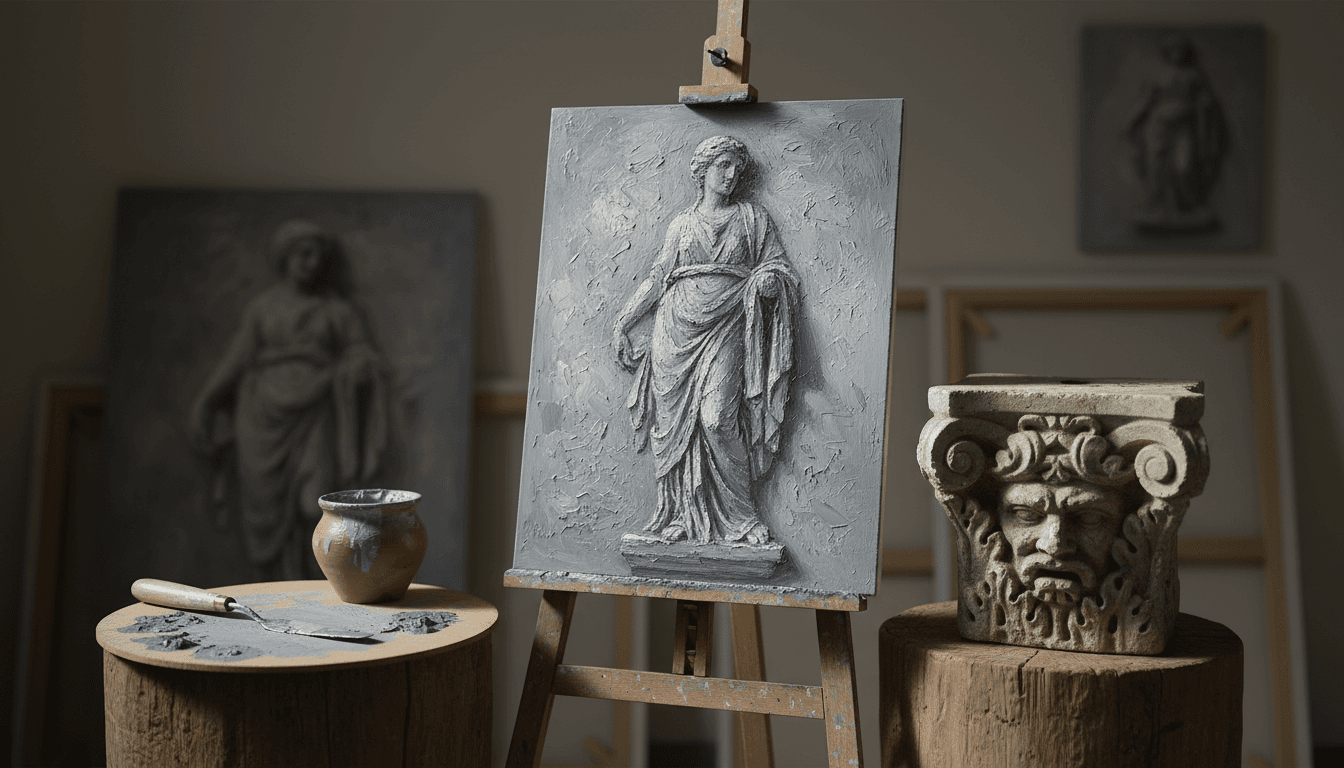
Open a fifteenth-century Flemish altarpiece and the outside of its folding wings shows no colour at all — just grey figures that look, at a glance, exactly like carved stone statues standing in shallow niches. It's a painting pretending to be sculpture, and the pretence exists because of a monastic rule laid down three centuries earlier, in a church that wasn't allowed to have colour at all.
Birth: a rule against colour
In 1134, the Cistercian monastic order banned coloured art and figurative imagery from its churches, in keeping with the order's broader emphasis on austerity — no gold, no elaborate colour, nothing to distract from prayer. Stained-glass workshops serving Cistercian monasteries responded with a compliant alternative: windows glazed almost entirely in plain, colourless glass, joined by lead and shaded only in tones of grey, a style that became closely associated with the order — though the monks themselves were known as the "White Monks," after their habits of undyed, greyish-white wool, not after their windows. The technique took its name directly from that grey palette — grisaille, from the French gris.
Growing up: grey as its own genre
Grisaille didn't stay confined to stained glass or to monastic austerity. Around 1304, Giotto used it in the lower registers of his frescoes in Padua's Scrovegni Chapel, painting a sequence of personified Vices and Virtues in flat, sculptural grey directly beneath his full-colour biblical scenes — a deliberate visual hierarchy, placing abstract moral concepts in a register one step removed from the vivid, living colour of the sacred narrative above them.
Middle life: painting that pretends to be sculpture
Grisaille found its most famous role in the fifteenth century, on the exterior wings of Northern European altarpieces. Jan van Eyck and his contemporaries — working in the same decades oil paint was displacing egg tempera as the default medium — painted these closed, everyday-facing panels in restrained grey specifically to imitate carved stone statuary standing in niches, a deliberate illusion, since actual sculpture was more expensive to commission than even a painting by an acknowledged master, and the grisaille exterior let a patron project that level of luxury cheaply. The most celebrated example is the Ghent Altarpiece, where van Eyck's grisaille figures of John the Baptist and John the Evangelist stand on the closed exterior wings, giving way to the full, overwhelming colour of the interior only when the altarpiece was opened for feast days.
What else it was used for, quietly
Grisaille had a second, far less showy life as a working tool rather than a finished statement. Oil painters used it as an underpainting layer — a monochrome "dead colouring" stage establishing the full value structure of a composition before any colour glazes went on top, since getting the light and shadow right in grey first made the subsequent colour decisions far more reliable. Engravers, including those working in Rubens's workshop, used finished grisaille paintings as direct working models, since a print reproduces value and line far more naturally than it reproduces colour — grisaille and engraving were, in a sense, already speaking the same visual language.
Advertisement
Where it stands now
Grisaille outlived both the religious austerity that produced it and the specific illusion of stone it was built to sustain. It survives today as a recognised technique in its own right — in illustration, in restrained decorative painting, and in contemporary artists' occasional return to monochrome as a deliberate formal choice rather than a constraint imposed from outside. What began as a rule about what a church wasn't allowed to have became, centuries later, something artists chose freely: a way of painting that still reads, at a glance, as something more solid and permanent than paint.