Why Painters Discovered Perspective Only Once
Around 1415, Brunelleschi proved a trick worked. In 1435, Alberti wrote down the math behind it. Together they gave Western painting a system it never had before — and every camera lens still uses the same geometry.
Sometime around 1415, the architect Filippo Brunelleschi stood just inside the doors of Florence Cathedral, holding a small painted panel up to a mirror. On the panel was a picture of the Baptistery across the square, painted with such geometric precision that when a viewer looked through a peephole drilled in its back, then held a mirror up in front of it, the reflected painting lined up exactly with the real building behind them. It was a magic trick built entirely out of mathematics, and it gave European painting a tool it had never systematically possessed before: a reliable way to make a flat surface look like it had depth.
Before 1415: depth by instinct
Painters had been suggesting three-dimensional space for centuries before Brunelleschi — overlapping figures, shrinking distant objects, the modelling of form with light and shadow that artists like Giotto had already developed in the early 1300s. What none of them had was a system: a repeatable, geometric method that would produce the same convincing illusion every time, regardless of the artist's individual eye. Depth was suggested. It wasn't yet calculated.
Circa 1415–1420: the demonstration
Brunelleschi's experiment, known today only through later written accounts since both original panels are lost, worked by fixing a single vanishing point — the spot on the horizon where the building's edges should converge — and painting every line in the scene to recede toward it with exact geometric consistency. The peephole-and-mirror setup wasn't decoration; it forced the viewer to look from the exact single point the perspective had been calculated for, which is what made the illusion snap into place so convincingly. He is said to have followed it with a second panel showing the Piazza della Signoria, refining the same principle.
1435: the trick becomes a method
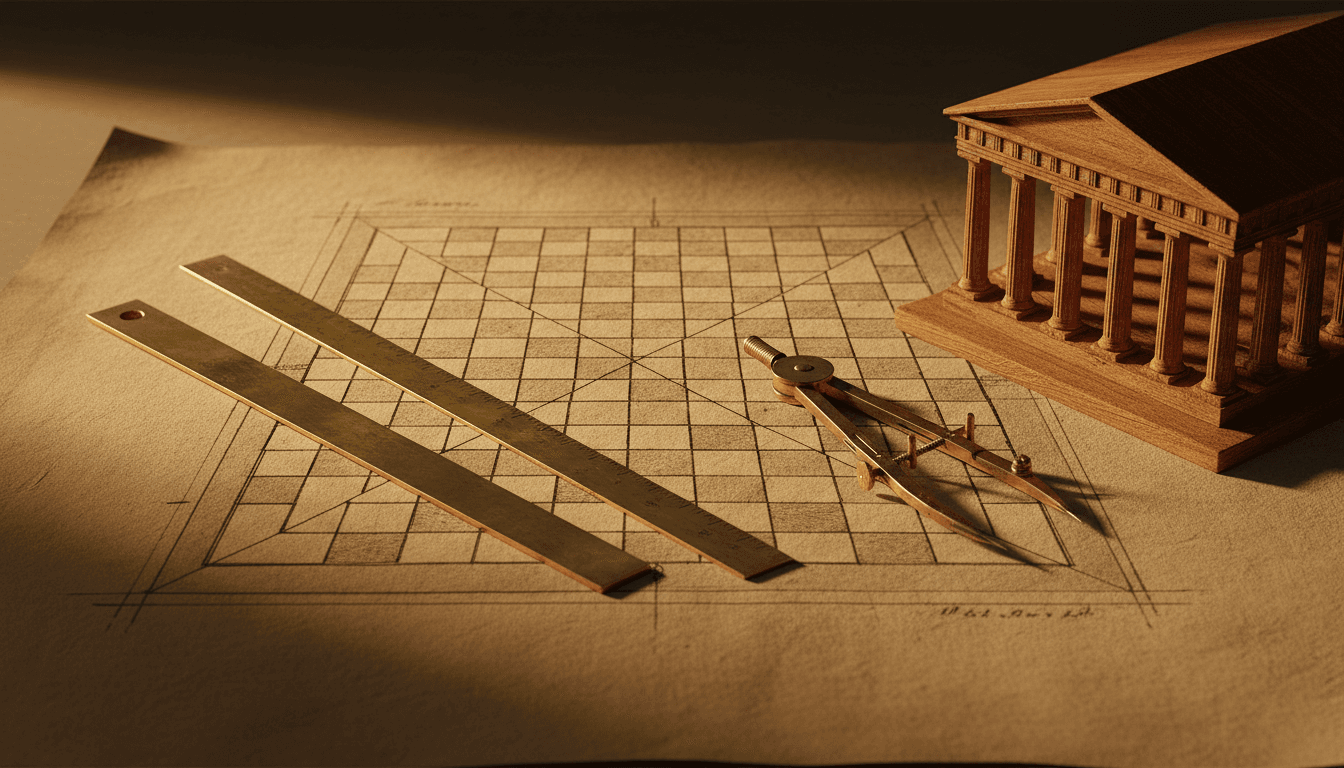
Brunelleschi demonstrated that the system worked. It was the architect and theorist Leon Battista Alberti who, in his 1435 treatise Della Pittura ("On Painting"), wrote the geometry down as instructions any painter could follow — establishing the horizon line, the single vanishing point, and the grid of orthogonal lines receding toward it. That's the real hinge point in the story: a trick performed once by one man became a teachable, repeatable technique available to an entire generation of painters who never saw Brunelleschi's actual panels.
The 15th century: the technique spreads and hardens
Within a decade, painters were building entire compositions around Alberti's system. Masaccio's fresco The Holy Trinity, painted around 1427 in Florence's Santa Maria Novella, uses a single-point perspective so convincing that it was reported to make the wall appear to open into an actual architectural space. Piero della Francesca went further still, writing his own mathematical treatises on perspective and treating painting almost as a branch of geometry. By the end of the century, single-point linear perspective wasn't an innovation anymore — it was simply what a serious painter was expected to know.
Advertisement
Where it stands now
Linear perspective went on to govern Western picture-making for roughly four and a half centuries, right up until artists in the early twentieth century — Cubists chief among them — deliberately broke it apart to show that a single, fixed vanishing point was a choice, not a law of vision, leaning instead on compositional tools closer to the deliberate emptiness of a Song-dynasty landscape than to anything Alberti wrote down. The same geometry now runs quietly underneath video game engines, architectural renderings, and every camera lens on earth, which use the identical mathematics Alberti wrote down in 1435 to convert a three-dimensional scene into a flat image. A viewer standing in the right spot in front of a modern 3D render is, mathematically, doing exactly what a Florentine looking through Brunelleschi's peephole did six hundred years earlier — checking that a picture's geometry matches the world it claims to represent.