Sculpture From Ice, Wax, and Other Materials Designed to Transform
Ice melts, wax flows, chocolate rots—materials hovering between solid and liquid states make impermanence visible. Temperature-sensitive sculpture embraces transformation that stable materials can't address.
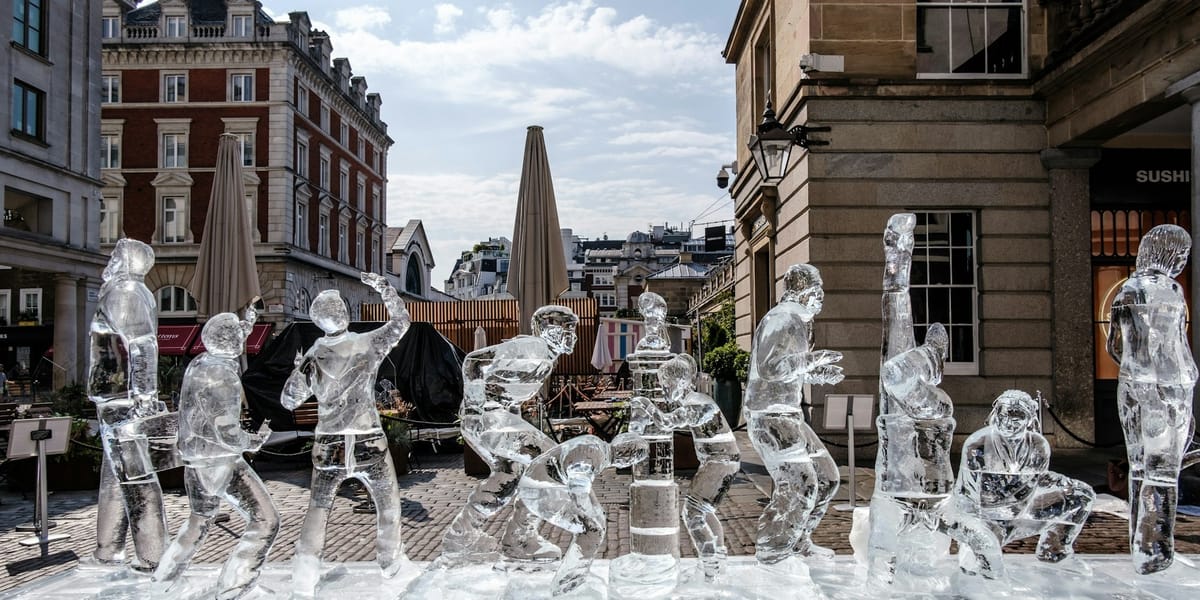
Most sculpture aims for permanence. Bronze lasts millennia. Stone endures geological time. Even wood can survive centuries with care. But some sculptural materials exist in fundamentally temporary states, hovering between solid and liquid, designed to melt, drip, flow, or disappear entirely. Working with ice, wax, and other temperature-sensitive materials means accepting—or embracing—that the work will transform, that its final form might be documentation or memory rather than the object itself.
This isn't just about technical challenges of working with difficult materials. It's about what transformation as inherent property brings conceptually. Ice sculpture that melts addresses impermanence, time, and environmental conditions in ways bronze never can. Encaustic wax that can be remelted questions the finality of artistic decisions. Materials hovering at their melting point create tension between states that stable materials don't offer.
Understanding how to work with materials defined by their thermal instability requires different thinking than traditional sculpture. The material's tendency to change state isn't flaw to overcome but characteristic to engage. Whether fighting transformation through environmental control or designing work around inevitable melting, artists working with these materials operate in territory where process and time become visible in ways solid, stable materials conceal.
Ice: Sculpture That Guarantees Its Own Destruction
Ice is sculpture with built-in timer. From the moment it's carved, it begins melting, returning to water at rates determined by ambient temperature, humidity, and air movement.
Traditional ice sculpture for events and competitions accepts this ephemerality pragmatically. The work exists for hours or days, serves its purpose, then melts. The temporality isn't conceptual content; it's just the material's nature.
But artists working with ice conceptually make the melting essential to meaning. The transformation from solid to liquid, the visible evidence of time passing, the environmental responsiveness all become content rather than just practical limitations.
Andy Goldsworthy's ice works—frozen arrangements of icicles, snow sculptures, frozen leaves—exist briefly before melting, disappearing, leaving only photographic documentation. The work is explicitly about time, impermanence, seasonal cycles, natural processes. The ice's temporary nature is the point.
Olafur Eliasson's large-scale ice installations bring glacial ice into gallery contexts where it melts over exhibition duration. "Your waste of time" (2006) placed massive blocks of glacial ice in warehouse spaces where visitors watched them slowly melt over months. The melting made climate change and geological time visceral and immediate.
Working ice technically requires understanding its structural properties. Ice is brittle, prone to cracking, sensitive to internal stress. Carving ice uses saws, chisels, and chainsaws removing material to reveal form, similar to stone carving but much faster and with different resistance.
Clear ice blocks for carving require slow, directional freezing that prevents air bubbles. Commercial ice sculpture suppliers provide crystal-clear blocks. Artists making their own need controlled freezing conditions and patience. Cloudy ice from fast freezing or trapped air looks less impressive than clear ice.
Ice freezes from outside in, creating internal stresses as expansion occurs. These stresses can cause spontaneous cracking. Understanding ice's freeze patterns prevents designing forms that will crack inevitably.
Colored ice uses dyes or pigments frozen into water. The color distribution can be even throughout or deliberately varied creating patterns. Layering different colored ice creates striations visible after carving.
Attaching ice pieces uses freezing rather than adhesives. Wetting contact surfaces and pressing together while freezing creates strong bonds. Ice to ice joins are strongest; ice to other materials requires mechanical attachment.
Temperature control determines how long ice survives. Keeping ice sculpture below freezing preserves it indefinitely. Above freezing, melting rate depends on temperature, humidity, air movement, and surface area. Large masses melt slower than thin sections.
Indoor ice sculpture requires climate control or acceptance of rapid melting. Outdoor ice sculpture in winter climates can last weeks. Summer outdoor ice melts within hours or days depending on size and conditions.
Lighting ice creates beautiful effects. Light transmits through clear ice creating internal glow. Colored lights make ice appear colored without dyeing it. The translucency creates effects impossible with opaque materials.
Documentation becomes essential because ice work's existence is temporary by nature. High-quality photography captures the work at its peak before melting begins. Time-lapse photography documents the melting process itself.
Some ice artists design work specifically to be documented, treating the sculpture as performance for the camera rather than object for direct viewing. The photograph becomes the permanent artwork; the ice is temporary means of creating it.
The environmental politics of ice sculpture are worth considering. Making ice requires energy for freezing. Large ice sculptures have significant carbon footprint. Artists addressing climate or environmental themes through melting ice face questions about the energy used creating the work.
Encaustic: Wax as Painting and Sculpture Medium
Encaustic uses pigmented beeswax and damar resin as painting medium, creating surfaces unlike any other paint. But wax also functions as sculptural material with unique properties.
Hot wax flows and can be poured, dripped, molded, or carved. It cools and solidifies quickly but can be reheated and reworked indefinitely. This reversibility distinguishes it from most sculpture materials.
Beeswax melts around 145°F (63°C), low enough to work with simple heat sources but high enough to remain solid under normal conditions. The working temperature affects viscosity—hotter wax flows more readily, cooler wax is thicker and more paste-like.
Damar resin added to beeswax raises melting point slightly and increases hardness. The typical ratio is 8:1 beeswax to damar, though artists adjust proportions for different characteristics.
Encaustic painting builds surfaces through layers of pigmented wax applied hot and fused together with heat. Each layer partially melts into previous layers creating unified surface rather than distinct strata.
The fusing process using heat gun, torch, or heated tools partially remelts previous layers integrating new applications. Inadequately fused layers can separate. Over-fusing creates unwanted flow and loss of marks.
Encaustic depth comes from translucency allowing light to penetrate multiple layers. Unlike opaque paint where only surface layer is visible, encaustic's translucency creates glowing depth as light travels through layers.
Pigment load affects translucency. Heavily pigmented wax is more opaque. Lightly pigmented or pure unpigmented wax is quite transparent. Varying pigment density across layers creates different optical effects.
Encaustic accepts mixed media embedding. Paper, fabric, found objects, photographs all can be embedded in wax layers. The wax encases materials preserving and displaying them simultaneously.
Texture in encaustic ranges from glass-smooth polished surfaces to rough, built-up impasto. Polishing with soft cloth creates sheen. Leaving surfaces unpolished creates matte texture. Scraping and carving creates texture through removal.
Sculptural encaustic goes beyond painting into three-dimensional form. Wax can be cast, molded, carved, assembled, creating sculpture that remains reworkable unlike bronze or stone.
Lynda Benglis's poured wax sculptures from the 1960s and 70s used pigmented wax poured in flowing, organic forms. The wax puddles and flows captured in solid form create frozen movement.
Casting in wax for lost-wax bronze casting is ancient technique but wax can also be final material rather than expendable pattern. Wax castings have different surface quality and presence than bronze.
Microcrystalline wax (refined petroleum wax) has different properties than beeswax. It's harder, higher melting point, and available in various formulations. Some artists prefer it for sculptural work requiring greater strength.
Paraffin wax is cheap and available but softer and more brittle than beeswax or microcrystalline wax. It yellows and deteriorates over time. It's acceptable for temporary work or experimentation but not archival.
Temperature sensitivity means wax sculpture can deform in heat. Works must be kept below the wax's melting point. Shipping in summer or to hot climates risks deformation. Installation near heat sources causes problems.
The advantage of wax's thermal sensitivity is reworkability. Unsatisfactory passages can be reheated and reworked. Mistakes aren't permanent. This forgiveness is unusual in sculpture where errors often require starting over.
Direct carving in solid wax blocks creates subtractive sculpture similar to stone carving but much easier. Wax cuts cleanly with knives, heated tools, or regular carving implements. The ease enables complex detailed work.
Ancient encaustic includes Egyptian mummy portraits and Greek painted sculpture. The technique nearly disappeared until 20th century revival. Contemporary encaustic connects to this long history while developing new approaches.
Candle Wax and Fire: Sculpture That Consumes Itself
Candles are wax sculptures designed to be destroyed through burning. Artists working with candles engage both the object and its consumption.
Urs Fischer's large-scale candle sculptures cast from figures or objects burn during exhibitions, slowly melting and deforming over weeks or months. The original form gradually disappears as wax pools and drips.
These burning sculptures document their own destruction. Visitors seeing the work at different times see different stages of melting. The work exists as process, not static object.
Safety concerns with burning sculpture are significant. Open flames in galleries require fire marshal approval, sprinkler considerations, insurance, constant monitoring. Not all venues allow it.
Drip containment becomes design consideration. Melting wax must go somewhere. Pools, pans, or designed catchments contain the wax. The accumulated drips can become part of the composition or be removed.
Wick placement in sculptural candles affects burning pattern. Central wicks create even melting. Multiple wicks create complex burning. Wick position determines which areas melt first.
Burn time calculations allow estimating how long sculpture will last. Larger masses burn longer. Thin sections disappear quickly. The sculpture's lifespan can be somewhat predicted and controlled through form and wick placement.
Some artists cast candles in molds of specific objects or figures. As the candle burns, the replicated form gradually disappears, creating memento mori about impermanence and destruction.
Wolfgang Laib's wax rooms—entire interior spaces lined with beeswax—engage the material's sensory properties. The smell, the warm color, the slight translucency create immersive environments. The wax isn't destroyed but its thermal and olfactory properties are essential.
Beeswax candles smell distinct from paraffin. The honey-sweet scent becomes atmospheric element. Scent is often overlooked in visual art but wax makes it unavoidable.
The ritual and symbolic associations of candles—prayer, memorial, celebration—attach to sculptural use. Working with burning candles invokes these associations whether intended or not.
Votive candle installations using hundreds or thousands of small candles create temporary light environments. The individual candles are mass-produced but their arrangement and collective effect constitute the artwork.
Butter, Fat, and Organic Waxes
Joseph Beuys famously used fat and felt extensively in his work, giving these materials symbolic weight related to his personal mythology and concepts of social sculpture.
Beuys's fat sculptures—wedges, corners, chairs covered with fat—use lard or tallow, animal fats with low melting points. These works are temperature-sensitive and require climate control to prevent melting or rancidity.
The fat's organic origin, its association with nourishment, its transformability between states all carried meaning for Beuys related to energy, healing, and transformation. The material choice wasn't arbitrary but symbolically loaded.
Butter sculptures at state fairs are folk art tradition, especially in Midwest. Butter carved into cows, figures, or scenes sits in refrigerated displays. Like ice sculpture, it's accepted temporary art form.
Butter melts around 90-95°F, requiring constant refrigeration for preservation. Serious art institutions rarely show butter sculpture due to preservation challenges and the material's associations with kitsch fair art.
But some contemporary artists use food materials including butter for their cultural associations and built-in impermanence. The challenge is distinguishing conceptual use from novelty.
Lard, tallow, and other animal fats have different melting points and consistencies. Lard is softer, tallow harder. Understanding specific fats' properties enables choosing appropriate material for intended effects.
Vegetable-based waxes like soy wax, palm wax, or carnauba wax offer alternatives to animal products. Each has distinct properties, melting points, and handling characteristics.
Carnauba wax from palm leaves is very hard with high melting point around 180°F. It's used in polishes and coatings. As sculpture material it's more durable than beeswax but harder to work.
The ethics and politics of animal-derived materials are worth considering. Some artists avoid animal products on principle. Others see the organic origin as essential to material meaning.
Rancidity in organic fats and waxes occurs over time, especially with improper storage. Antioxidants can slow this but can't prevent it indefinitely. Old fat smells terrible and deteriorates structurally.
Museums conserving Beuys's fat works face challenges. The works must be kept cool but not frozen. They age and change despite best conservation efforts. The materials' instability is conceptually significant but practically problematic.
Chocolate and Sugar: Edible Sculpture Materials
Chocolate and sugar are professional pastry materials with sophisticated traditions but also serious artistic media.
Dieter Roth's chocolate sculptures intentionally invited decay. He made sculptures and installations from chocolate, allowed them to deteriorate, be eaten by mice and insects, mold, and rot. The decay was the point, addressing impermanence and disgust.
Museums showing Roth's chocolate works initially struggled with his insistence that decay continue. Preserving rotting chocolate contradicts the work's concept. Eventually institutions accepted that these works transform and deteriorate as part of their nature.
Chocolate melts between 86-90°F for dark chocolate, slightly lower for milk chocolate. It must be kept cool to maintain form. Chocolate also blooms—developing white surface discoloration from fat or sugar crystallization when temperature-cycled.
Tempering chocolate through controlled heating and cooling creates stable crystalline structure that's shiny, hard, and less prone to blooming. Pastry chefs temper chocolate for professional work. Artists might temper for durability or avoid it for different aesthetic.
Modeling chocolate, mixture of chocolate and corn syrup, is more plastic and moldable than pure chocolate. It holds shape better and can be worked like clay before firming.
Sugar work in pastry includes pulled sugar, blown sugar, cast sugar, and poured sugar creating delicate forms. These techniques transfer to art contexts though crossing from pastry to fine art raises institutional questions.
Pulled sugar, heated and stretched like taffy, creates translucent ribbons and shapes. Blown sugar uses air to inflate molten sugar into hollow forms. Both require skill and speed before sugar cools.
Cast sugar poured into molds creates clear or colored forms. Sugar can achieve glass-like clarity when properly handled. The brittleness and water-solubility create preservation challenges.
Sugar is hygroscopic, absorbing moisture from air. In humid conditions, sugar work weeps and deteriorates. It must be kept dry for preservation. This severely limits where and when sugar sculpture can be displayed.
The edibility of chocolate and sugar creates interaction possibilities. Some artists invite consumption. Others prohibit it but the potential remains, affecting how viewers relate to work they could theoretically eat.
Janine Antoni's "Lick and Lather" self-portrait busts in chocolate and soap were shaped by her licking and washing them. The edible chocolate invited consumption while documenting the artist's interaction with her own image.
The associations—candy, celebration, indulgence, childhood—come with chocolate and sugar. These can be engaged conceptually or can overwhelm other intentions if not carefully handled.
Gelatin and Agar: Biological Gels
Gelatin from animal collagen and agar from seaweed create temperature-reversible gels useful for casting and sculptural purposes.
Gelatin melts around 95°F, below body temperature, making it thermally unstable. It sets when cooled, can be remelted indefinitely, and is optically clear when properly prepared.
Ballistics gelatin used for testing ammunition creates firm, clear blocks that can be carved or cast. Artists have used it for body-related work given its flesh-like properties.
Agar sets at higher temperature than gelatin and remains stable until around 185°F. This makes it more stable at room temperature and suitable for different applications.
Both materials are water-based, susceptible to drying out and dehydration. They shrink as they dry, creating distortion. Keeping them hydrated is essential for dimensional stability.
Mold growth is concern with biological gels. They support bacterial and fungal growth readily. Refrigeration slows this but doesn't prevent it. Adding preservatives helps but doesn't eliminate the problem.
The transparency and flesh-like quality of gelatin makes it conceptually rich for body-related work. It jiggles, it's vulnerable, it suggests biological material without being explicitly representational.
Casting in gelatin or agar creates flexible, transparent replicas. The material fills detail well and releases from molds easily when properly formulated.
Some artists use the instability as content. Work designed to dry, shrink, and distort over time makes material behavior visible as transformation process.
The edibility—gelatin is food—creates similar consumption questions as chocolate work. The potential to eat the work affects how it's perceived even when consumption isn't intended.
Soap: Carved, Cast, and Degraded
Soap is soft enough to carve easily but firm enough to hold detail. It has long history as beginner sculpture material but contemporary artists use it conceptually.
Janine Antoni carved self-portrait busts from soap then washed herself with them, abrading the features through use. The soap accumulated meaning through its use, transforming from portrait to used object.
Casting soap creates multiples or forms impossible to carve. Melt and pour soap bases allow casting without making soap from scratch. These bases set quickly and release from silicone molds cleanly.
Soap from scratch through saponification of fats requires chemical knowledge and safety precautions. The lye used is caustic and dangerous. Commercial soap bases avoid these hazards while remaining workable.
Carved soap takes fine detail better than many materials. It cuts cleanly, doesn't require special tools, and is forgiving of mistakes. The ease makes it accessible but the associations with hobbyist craft can be problematic.
Soap's purpose—cleaning, hygiene, removing dirt—carries conceptual weight. Working with soap invokes these associations of purity, cleansing, ritual, domesticity.
The gradual erosion through use or water exposure creates temporal dimension. Soap sculptures can be designed to slowly dissolve or erode, documenting their own deterioration.
Scent in soap is unavoidable. Unscented soap still smells like soap. Scented soap adds another sensory dimension. The smell affects how work is experienced beyond visual perception.
The slipperiness when wet, the way soap feels, its solubility in water, all are material characteristics that can be engaged or must be accounted for.
Petroleum Jelly, Grease, and Semi-Solid Materials
Materials that aren't quite solid and aren't quite liquid occupy interesting territory between states.
Petroleum jelly (Vaseline) is translucent semi-solid that never fully hardens. It's moldable, spreadable, and indefinitely reworkable. Its intermediate state is permanent characteristic.
Wolfgang Laib's pollen works, while using dry material, share sensibility with works using semi-solid materials. The preciousness, the sensory immediacy, the material's inherent qualities as content.
Grease and lubricants have industrial associations and unpleasant tactility. These negative associations can be conceptual assets when addressing labor, industry, pollution, or degradation.
The staining potential—these materials don't dry or set so they continue marking anything they contact—creates installation challenges. Containment and protection of surroundings becomes necessary.
The non-drying nature means work remains perpetually wet or tacky. This prevents dust-free surfaces and creates conservation challenges. Museums struggle with maintaining works using these materials.
Axle grease, bearing grease, other industrial lubricants each have specific consistencies and properties. The industrial origin carries different associations than cosmetic petroleum jelly.
The difficulty of removing these materials completely—they resist water, they spread, they penetrate—mirrors their persistence as materials. This permanence despite semi-solid state creates conceptual tension.
Designing for Transformation
When working with materials that inevitably change state, the transformation can be fought against, designed around, or embraced as content.
Environmental control through temperature and humidity regulation preserves ice, chocolate, and other sensitive materials. Refrigerated display cases, climate-controlled galleries, and isolation from heat sources all fight against transformation.
This preservation approach treats transformation as problem to solve. The goal is maintaining original form as long as possible. Success means minimal visible change during exhibition.
Time-limited exhibition accepts that work exists temporarily, designed for specific duration knowing transformation will occur. Opening night might present the work at its peak with planned deterioration over exhibition period.
This approach makes the viewing timeline part of the work's structure. Early viewers see different work than late viewers. The change over time becomes content everyone understands.
Documentation as primary artwork treats the physical object as means of creating permanent photographic or video record. The sculpture's impermanence doesn't matter because documentation preserves it.
This elevates documentation from record to artwork itself. The sculpture becomes performance for camera rather than object for direct viewing.
Embracing transformation makes the melting, deforming, deteriorating process the primary content. Goldsworthy's ice works exist as transformation from solid to liquid. The melting is the point.
This approach requires accepting complete destruction of physical object. What remains is documentation and memory. The work's existence as object is genuinely temporary.
Process documentation through time-lapse, sequential photography, or video captures transformation that's too slow or too fast to perceive directly. The documentation creates different temporal experience than real-time observation.
Viewer interaction with melting/transforming work creates relationship impossible with stable materials. Seeing ice sculpture at different melting stages, watching wax deform, witnessing decay all make time and change visible and immediate.
The anticipation and memory become part of experience. Viewers knowing work will melt differently view it than if permanence was expected. The temporal dimension affects perception beyond physical properties.
Conservation Impossibility and Documentation
Museums and collectors face profound challenges with works made from inherently unstable materials.
Conservation ethics say preserve original materials and maintain artist's intent. But what when artist's intent is degradation? Preserving rotting chocolate contradicts the concept.
This creates institutional crisis. Museums preserve. Artists working with intentionally temporary materials reject preservation as goal. The conflict is fundamental.
Some institutions refuse to acquire works with built-in obsolescence. Others acquire with understanding that the work will deteriorate or transform. This requires different institutional thinking.
Documentation becomes critical preservation strategy. High-quality photography, video, artist interviews, technical specifications, all create record even when physical object no longer exists.
But documentation isn't equivalent to the work. Photographs of ice sculpture don't give the experience of seeing it melt. Video of chocolate rotting doesn't smell. The documentation is partial substitute.
Artist instructions sometimes allow remaking. If ice sculpture melts completely, can it be remade following original instructions? This questions what makes the work authentic—original object or repeatable process.
Some artists provide recipes or instructions treating the work as repeatable performance. Others insist original material object is unique even if it disappears.
The edition question arises. If work can be remade, is each version separate piece or part of edition? How does this affect value and ownership?
Museums acquiring self-destructing works need clear agreements about whether remaking is permitted, who can remake it, what constitutes authentic recreation versus copy.
Material Meaning Beyond Technique
Materials that exist in precarious thermal states carry meanings beyond their physical properties.
Impermanence made visible through melting, degrading, transforming materials addresses mortality, time, change in ways stable materials can't. The visible transformation is memento mori.
Buddhist concepts of impermanence find material expression in work designed to disappear. The acknowledgment that nothing lasts becomes physically manifest.
Environmental awareness surfaces in ice sculpture that melts, addressing climate change and melting glaciers. The personal, small-scale melting mirrors global glacial melting.
Control and release tension emerges when working with materials hovering between states. The artist controls form temporarily but must eventually release control as material transforms.
This negotiation between control and surrender shapes meaning. Fighting transformation versus accepting it creates different conceptual positions.
Luxury and waste intersect in chocolate sculpture or other edible materials. Using food as art while people starve, wasting expensive materials for temporary effect, both raise ethical questions.
The transformation from valuable material to waste, from carefully crafted form to melted puddle, addresses value and transience. What's precious becomes trash through natural process.
Physical vulnerability in soft, meltable, fragile materials that can't defend themselves against temperature, time, or touch. This vulnerability becomes metaphor for human vulnerability.
Materials that can't survive normal conditions without protection or care parallel bodies, relationships, environments requiring protection. The material's neediness becomes content.
Working with ice, wax, and materials that transform through temperature requires accepting fundamental impermanence. Whether fighting this transformation through environmental control or designing work around inevitable change, artists using these materials engage time and process directly. The materials' thermal instability isn't flaw but characteristic enabling approaches impossible with stable materials. Bronze conveys permanence. Ice, wax, chocolate, and other melting materials convey transformation, impermanence, and time made visible. Understanding these materials means understanding not just technique but what transformation as inherent property brings conceptually to sculpture.