Impressionism and the Chemistry of Light
Impressionism was not only a way of seeing. It was enabled by collapsible paint tubes, new synthetic pigments, and a scientific interest in how light behaves.
Impressionism is usually taught as a way of seeing — looser brushwork, brighter light, a break from the academy. It was also, just as much, a way of making, and the making depended on things that simply hadn't existed a generation earlier: a metal tube that kept paint wet, a wave of new chemical pigments, and a color theory that came out of a dye workshop rather than an art school.
At a glance
| Enabler | What changed |
|---|---|
| Collapsible metal paint tube (1841) | Painting outdoors ("en plein air") became practical |
| New synthetic pigments | Brighter, more varied, more affordable color |
| Chevreul's color theory (1839) | Justified broken brushwork and optical mixing |
| Rebuilt Paris and the railway | New subjects: boulevards, suburbs, leisure |
| Photography | New ideas about cropping and framing |
| Rejection by the Salon (1874) | Forced an independent market and identity |
The tube that made plein air possible
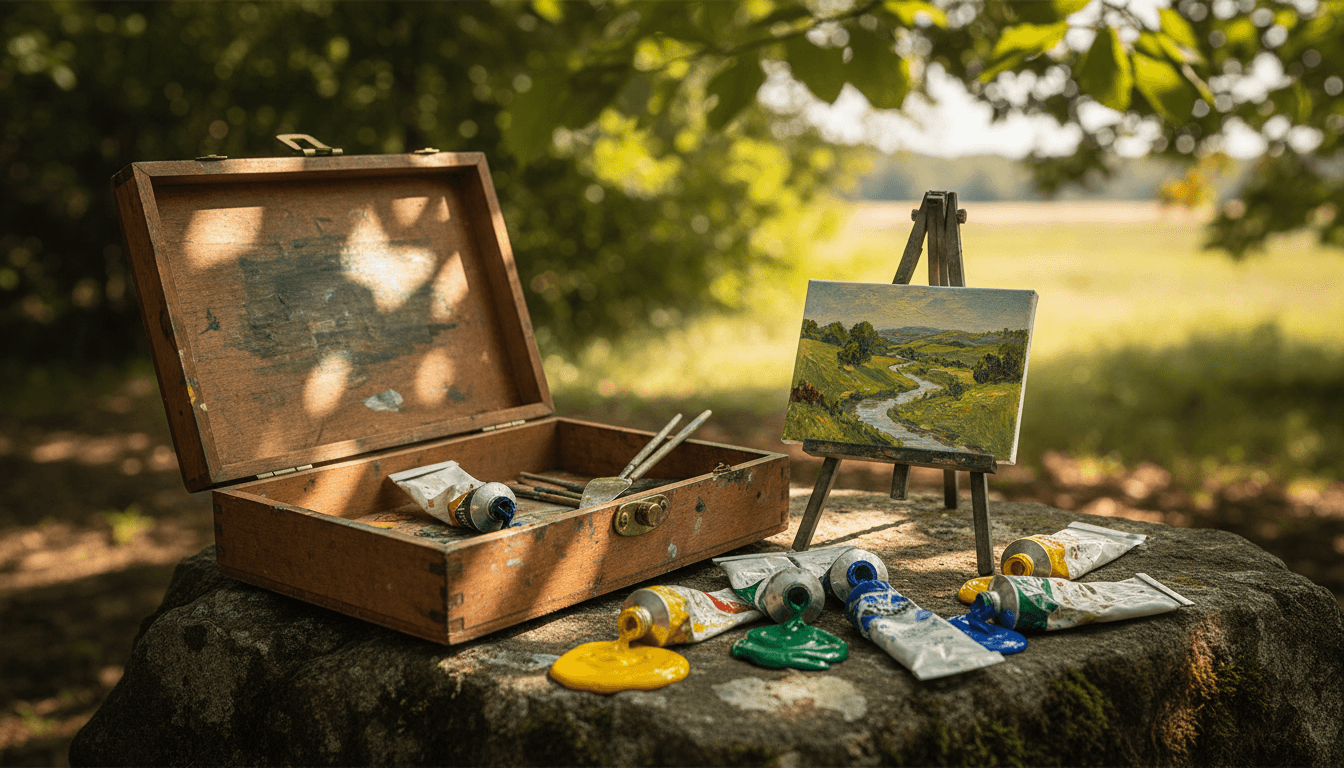
Before 1841, an artist who wanted to paint outdoors had a genuine logistics problem. Paint was stored in pig bladders pierced with a tack, or in glass syringes — both slow to refill and impossible to fully reseal, so paint that wasn't used that day was often paint that dried out and went to waste. Studio work was, to a real extent, dictated by this constraint.
The fix came from John Goffe Rand, an American portrait painter working in London, who patented a collapsible metal tube — sealed at one end, with a screwable nozzle at the other — in Britain in March 1841 and in the United States that September. Winsor & Newton picked it up almost immediately, and within a decade "Rand's Patent Collapsible Tube" was standard equipment in art-supply catalogs on both sides of the Atlantic. Renoir, later in life, put it more bluntly than any art historian has managed since:
"Without the tube of paint, there would have been no Cézanne, no Monet, no Sisley, no Pissarro, nothing of what the journalists were later to call Impressionism." >— attributed to Pierre-Auguste Renoir
Paint that stayed workable for weeks, not hours, meant an artist could load a satchel and go stand in a field. That single, unglamorous packaging innovation is arguably the precondition for everything else on this list.
A new palette to go with the new habit
The nineteenth century's chemists were, by coincidence, solving a second problem for painters at almost exactly the same moment, part of a much broader shift in how newly available synthetic pigments changed the economics of colour itself. Synthetic ultramarine — a lab-made version of a pigment once literally more expensive than gold, when it had to be ground from lapis lazuli — reached the market in the late 1820s after a French chemist, Jean-Baptiste Guimet, won a national prize for manufacturing it cheaply. Cobalt blue, cadmium yellow, viridian, and chrome yellow all arrived across the following decades, each one giving painters a colour with no earth-toned, muddy natural equivalent.
Advertisement
This is easy to understate. A painter working in 1800 had a genuinely narrower, duller range of pigments to choose from than a painter working in 1870. The Impressionists' famous brightness isn't only a stylistic choice — it's also a materials story, and not every choice aged well. Chrome yellow is now known to darken over time, and several early synthetic pigments have shifted or faded, which is one reason some Impressionist canvases look a little different today than they did fresh off the easel.
Chevreul's accidental theory of color
The scientific rationale behind broken brushwork came from an unlikely source: a chemist trying to solve a manufacturing complaint. In 1824, Michel-Eugène Chevreul was appointed director of the dye works at the Gobelins tapestry manufactory in Paris, where weavers kept complaining that their black wool looked inconsistent — sometimes rich, sometimes washed out. Chevreul tested the dye chemically and found nothing wrong with it. The blacks only looked different depending on which colours were woven next to them.
He'd stumbled onto simultaneous contrast: the eye doesn't perceive a colour in isolation, it perceives it relative to its neighbours, and the brain does a certain amount of blending on its own. Chevreul published the finding in 1839 as De la loi du contraste simultané des couleurs. Painters read it as license: if the eye does some of the mixing itself, you don't have to premix every tone on the palette. You can lay small, separate touches of pure colour side by side and let the viewer's eye do the rest at a distance — a principle later pushed to its logical extreme by how Pointillism exploits optical mixing over pigment mixing, but already present in looser form in ordinary Impressionist brushwork.
Light was the actual subject
Once artists had the materials and the theory, what they mostly chose to paint with them was light itself — the same haystack, cathedral facade, or row of poplars, recorded at different hours to catch how colour shifts with the changing temperature of the light falling on it. That's less a subject than an experiment repeated under controlled conditions, and it lines up with how seriously the era took the science of optics and perception generally. Monet's series paintings, in particular, function almost like a set of timed exposures: same composition, different light, no other variable changed.
Monet's series: the experiment made explicit
Claude Monet turned this idea into an actual method later in his career, painting the same subject dozens of times under different light rather than once. His grain-stack paintings (1890–91) and his views of Rouen Cathedral's west facade (1892–94) are the clearest examples: same haystack, same stone porch, repeated in canvas after canvas, with nothing changing except the hour and the weather. Seen together, a series like this reads less like a set of finished pictures and more like timed data — a controlled experiment in how much a single object can visually change without physically changing at all.
New subjects, courtesy of new infrastructure
The railway and the rebuilding of Paris under Baron Haussmann gave Impressionist painters somewhere to point their easels that hadn't existed a generation earlier. Trains put the Seine's riverside towns, the Normandy coast, and weekend leisure within reach of a day trip from the city; wide new boulevards and public parks created stages for the emerging middle class to be seen strolling on. Café terraces, train stations, regattas, dance halls — this is not a neutral, timeless catalogue of pretty scenes, it's a fairly precise inventory of what modern urban leisure looked like in the 1870s and 1880s, painted by people who were living inside it.
What photography lent the movement
Photography was maturing at the same time, and its habits of seeing bled into painting: an off-centre crop, a figure sliced by the frame's edge, a composition that looks caught rather than arranged. Painters didn't copy photographs so much as absorb the idea that a picture could be a fragment of a moment rather than a fully composed tableau — which suited an art movement already committed to capturing something fleeting.
Rejected by the Salon — and named by a critic who hated them
The official Paris Salon controlled access to exhibition space, critical attention, and sales, and it rejected this generation's work often enough that a group of them, calling themselves the Société Anonyme Coopérative des Artistes Peintres, Sculpteurs, Graveurs, organised their own show instead. It opened on 15 April 1874, in the photographer Nadar's former studio at 35 Boulevard des Capucines: thirty artists, 165 works, roughly 3,500 visitors.
Ten days later, the critic Louis Leroy reviewed it for the satirical paper Le Charivari under the title "The Exhibition of the Impressionists" — a jab built directly off the title of one Monet canvas, Impression, Sunrise. Leroy meant it as an insult:
"Wallpaper in its embryonic state is more finished than that seascape." >— Louis Leroy, Le Charivari, 25 April 1874
Advertisement
The artists kept the name anyway. Within a year, "Impressionism" had gone from a punchline to a label the painters used themselves — a rare case of a movement being named by an enemy and adopting the insult as a flag.
Women in the frame
The core group included women artists at a moment when most academies and Salons made that difficult by design. Berthe Morisot exhibited in the first show in 1874 and in nearly every one after; Mary Cassatt, an American who'd settled in Paris, joined at Degas's invitation in 1879. Both painted the domestic and social interiors — nurseries, gardens, theatre boxes — that were more available to them than the cafés and street scenes their male colleagues could wander into freely, and both are now considered central to the movement rather than a footnote to it.
Building a market that didn't yet exist
Rejected by the institutional pipeline, the group had to construct its own commercial one — through independent exhibitions, sympathetic dealers like Paul Durand-Ruel, and private collectors willing to take a chance on unfashionable work. Durand-Ruel in particular bought and stockpiled Impressionist paintings for years with almost no buyers in France, then found an unexpectedly receptive market for them in the United States in the 1880s, which is a large part of why so many major Impressionist canvases now hang in American museums rather than French ones.
It took decades either way. What had sold for a few hundred francs in the 1870s now anchors some of the highest prices in the entire auction market, which says more about the eventual size of the audience than about any change in the paintings themselves.
The bottom line
Impressionism gets taught as a revolution in seeing, but it was equally a product of a portable tube, a wider palette, and a color theory borrowed from a tapestry workshop. Take away any one of those three, and the paintings we know would have been made differently, later, or not at all.
FAQ
What made Impressionism possible, materially?
Three things arriving together: the collapsible paint tube (1841), a wave of new synthetic pigments, and Chevreul's 1839 theory of simultaneous colour contrast.
Why does the name "Impressionism" come from an insult?
Critic Louis Leroy coined it mockingly in an 1874 review, using the title of Monet's Impression, Sunrise to dismiss the whole show as unfinished. The artists adopted the label anyway.
Were Impressionist pigments stable?
Not all of them. Chrome yellow is known to darken over time, and several early synthetic colours have shifted or faded, which is one reason some period paintings look different today than when they were made.
Who were the women in the Impressionist group?
Berthe Morisot, part of the group from its first 1874 exhibition, and Mary Cassatt, who joined at Edgar Degas's invitation in 1879.
Why do Impressionist paintings sell for so much today?
Scarcity and demand: the major works are mostly in museums, the market for the movement is one of the deepest in art history, and what sold for very little in the 1870s now anchors record auction prices.