How Artists Use Interference Patterns and Wave Physics in Optical Art
How optical artists use interference patterns from wave physics to create visual effects. The science behind moiré patterns, diffraction, and perceptual illusions.
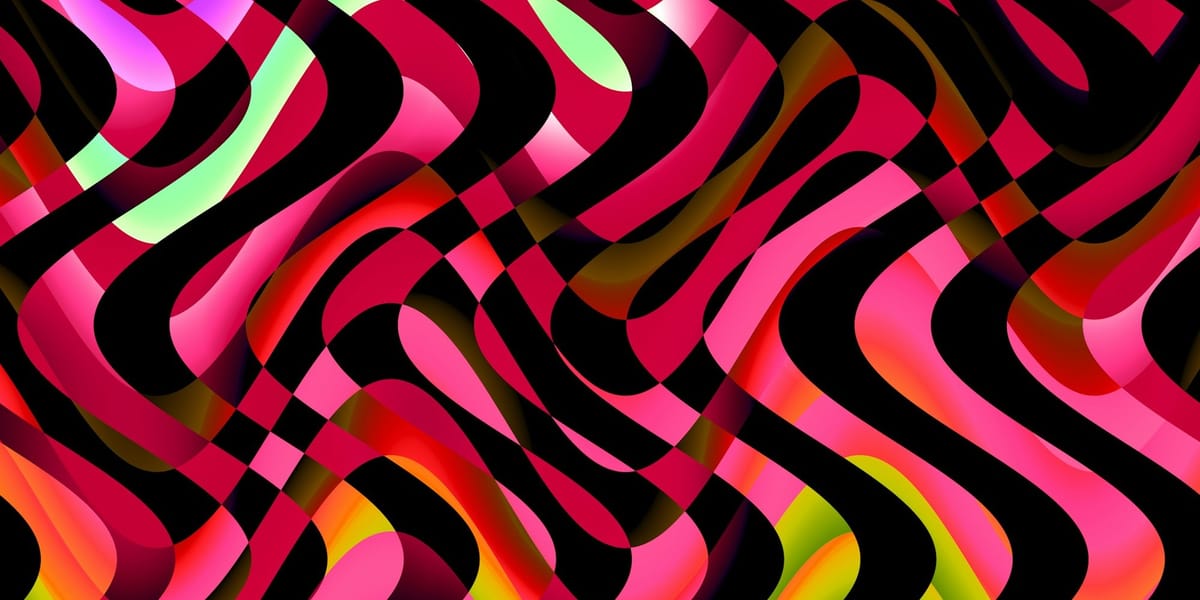
When two sets of parallel lines overlap at slight angles, they create moiré patterns that appear to shimmer and move despite being static printed ink on paper. The visual movement isn't illusion in the psychological sense. It's actual optical interference happening in the physical world according to wave mechanics.
This distinction matters.
Optical art often gets dismissed as retinal trickery or perceptual gimmicks. But artists working with interference patterns aren't manipulating perception through psychological suggestion. They're engineering physical situations where light waves interact according to fundamental physics, creating effects that happen before the brain processes visual information.
The shimmer in Bridget Riley's paintings results from optical interference between closely spaced parallel elements. The rainbow colors in holographic art come from light waves interfering constructively and destructively at specific wavelengths. The moiré patterns in kinetic sculpture arise from mathematical relationships between overlapping periodic structures.
Understanding how artists deploy wave physics requires examining the actual science of interference, how it manifests visually, what materials and techniques create specific effects, and how artists discovered these phenomena through studio experimentation that parallels scientific investigation.
The history involves artists working without formal physics training who nonetheless arrived at sophisticated understanding of wave interference through systematic observation and technical refinement. They developed empirical knowledge of optical phenomena that physics can explain but which they discovered through artistic practice.
Contemporary optical artists often collaborate with physicists, engineers, and materials scientists to create effects impossible through traditional studio techniques alone. This interdisciplinary work blurs boundaries between scientific research and artistic practice in ways that challenge institutional categories separating art from science.
The Physics of Interference
Wave interference occurs when two or more waves meet and combine according to the principle of superposition. Where wave peaks align, they add constructively, creating increased amplitude. Where peaks meet troughs, they cancel destructively, creating decreased amplitude.
This fundamental physics applies to all wave phenomena including light, sound, water waves, and electromagnetic radiation. The visual effects artists exploit result specifically from light wave interference creating patterns of brightness and darkness or color separation.
The mathematical relationship governing interference depends on wavelength, phase difference, and amplitude of the combining waves. When two waves with identical wavelength meet exactly in phase (peaks aligned with peaks), they interfere constructively, doubling the amplitude. When they meet exactly out of phase (peaks aligned with troughs), they interfere destructively, canceling completely.
Partial interference occurs when the phase relationship falls between these extremes, creating graduated series of bright and dark bands called interference fringes. The spacing and intensity of these fringes depends on the precise phase relationship between the waves.
For visible light, the wavelength ranges from roughly 380 nanometers (violet) to 750 nanometers (red). Different wavelengths interfere at different spatial frequencies, which is why interference can separate white light into component colors.
The classic double-slit experiment demonstrates interference principles: light passing through two narrow slits creates interference pattern of bright and dark bands on screen behind the slits. Where light waves from the two slits arrive in phase, bright bands appear. Where they arrive out of phase, darkness results.
Artists working with interference patterns essentially create variations on this double-slit setup using different geometries, materials, and light sources to generate specific visual effects.
Moiré Patterns as Interference
Moiré patterns represent the most accessible form of interference artists can create without specialized equipment or materials. They arise when two periodic structures (grids, parallel lines, concentric circles) overlay with slight offset in spacing, angle, or phase.
The mathematics involves beat frequencies similar to acoustic interference. When two slightly different frequencies combine, they create beating pattern at frequency equal to their difference. Visual moiré patterns work identically: two sets of lines with slightly different spacing create pattern with much larger apparent spacing.
The moiré frequency equals the difference between the two source frequencies. If one grid has lines every 1mm and the other every 1.1mm, the moiré pattern repeats every 10mm. This mathematical relationship allows precise prediction and control of pattern characteristics.
The patterns appear to move with small changes in viewing angle or position because the phase relationship between the overlaid structures changes continuously. This creates kinetic effects from static images through purely optical means.
Artists discovered moiré patterns empirically through printmaking, textile design, and architectural applications long before mathematical analysis explained them. The visual effects were exploited aesthetically before their physical basis was understood.
Bridget Riley's black and white paintings from the 1960s systematically explored moiré phenomena through variations in line spacing, curvature, and angular relationships. The visual vibration and apparent movement resulted from interference between closely spaced parallel elements.
The technique requires extreme precision in execution. Small variations in line spacing or straightness create unintended interference patterns that disrupt the intended effect. Riley worked with assistants who could execute her designs with mechanical accuracy.
Contemporary digital tools allow precise calculation and rendering of moiré patterns that would be extremely difficult to achieve manually. Artists can design interference effects mathematically, then fabricate them through digital printing or CNC manufacturing.
The patterns also appear unintentionally in digital imaging when photographing or scanning images containing periodic structures like fabric weaves or halftone printing. Understanding the physics helps artists either avoid unwanted moiré or deliberately create it.
Thin Film Interference and Iridescence
Thin film interference creates the rainbow colors visible in soap bubbles, oil slicks, and butterfly wings. Artists have exploited this phenomenon through various materials and techniques producing iridescent effects without pigments.
The physics involves light reflecting from both the top and bottom surfaces of a thin transparent film. The two reflected beams interfere based on the film thickness and viewing angle. When film thickness equals quarter-wavelength of a particular color, that wavelength interferes constructively and appears bright.
Different wavelengths interfere constructively at different thicknesses, so varying the film thickness creates color separation. The color also changes with viewing angle because the path length difference between the two reflected beams depends on the angle of observation.
Soap bubble colors demonstrate this perfectly. The bubble wall starts thick (showing broad interference bands) and thins as it drains, creating increasingly narrow color bands. Eventually it becomes too thin to create interference and appears black before bursting.
Artists working with thin film interference use materials like interference pigments (mica flakes coated with precise titanium dioxide layers), metallic films, and specially prepared surfaces that create controlled thickness variations.
The automotive paint industry developed interference pigments creating color-shift effects that change hue with viewing angle. Contemporary artists use these industrial materials to create surfaces that can't be accurately photographed because the color depends on viewpoint.
Holographic materials work through similar principles but use surface relief patterns rather than thickness variations to create the path length differences needed for interference. The microscopic grooves diffract light at angles determined by wavelength, separating colors while creating three-dimensional visual effects.
Traditional artistic materials occasionally produce thin film interference accidentally. Glazes in ceramics, certain varnishes in painting, and metallic leaf applications can create iridescent effects through unintended film formation.
Diffraction Gratings and Spectral Separation
Diffraction gratings consist of closely spaced parallel lines that diffract light at angles dependent on wavelength, creating spectral separation through interference between waves emerging from adjacent lines.
The grating equation relates the line spacing, wavelength, diffraction angle, and interference order. For visible light and typical grating spacings (hundreds of lines per millimeter), different wavelengths diffract at noticeably different angles, separating white light into rainbow spectrum.
Artists use diffraction gratings to create rainbow effects from white light without prisms or filters. The commercial holographic stickers and security features on credit cards employ diffraction gratings creating their characteristic rainbow appearance.
The precision required for effective diffraction gratings means artists typically use manufactured materials rather than creating gratings directly. Photographic film, commercially produced diffraction films, and ruled metal gratings all serve artistic purposes.
Larry Bell's glass cube sculptures sometimes incorporate interference coatings that diffract light, creating color effects that change dramatically with viewing position. The technical execution requires materials science expertise beyond traditional studio practice.
The distinction between interference and diffraction is somewhat artificial. Diffraction represents interference between multiple waves emerging from an array of sources (the grating lines). The phenomena involve the same wave physics applied to different geometric arrangements.
Contemporary LED and laser light sources create interference effects impossible with traditional lighting because of their coherence properties. The waves maintain consistent phase relationships over longer distances, enabling interference across larger spatial scales.
Bridget Riley and Systematic Optical Investigation
Riley's work represents the most thorough artistic investigation of interference and optical effects through systematic variation of geometric parameters.
Her early black and white paintings explored moiré patterns created by curved lines with varying spacing. The works titled "Movement in Squares" and "Current" create powerful kinetic effects through precise manipulation of line spacing and curvature.
The paintings require viewing from specific distances for optimal effect. Too close and the individual lines dominate. Too far and the interference patterns collapse. Riley calculated the optimal viewing distance based on the spatial frequency of her patterns and typical gallery sight lines.
The technical execution involved creating precise mechanical drawings that assistants then transferred to canvas. The uniformity required for clean interference effects exceeds what hand-painting typically achieves.
Riley's transition to color work applied similar principles using chromatic interactions rather than purely achromatic interference. The color stripe paintings create optical mixing and vibration through juxtaposition of specific hue relationships at specific spatial frequencies.
The relationship between Riley's work and physics remained indirect. She discovered optical effects through studio experimentation rather than applying physics principles. But her systematic approach and precise parameter control paralleled scientific methodology.
The paintings function as experiments investigating how specific geometric variations affect perception. Each work tests particular relationships between line spacing, curvature, orientation, and viewer response.
Contemporary analysis can describe Riley's effects using wave physics and Fourier analysis, revealing that her intuitive approach arrived at configurations that physics explains mathematically. The artistic discovery preceded the scientific explanation.
Kinetic Sculpture and Dynamic Interference
Artists working with movement can create interference patterns that change over time as overlapping elements shift their relative positions.
Carlos Cruz-Diez's "Physichromies" use parallel colored strips at carefully calculated angles. As viewers move past the works, the interference between the strips creates color mixing and apparent motion that couldn't exist in static images.
The technique exploits the fact that interference patterns shift dramatically with small changes in viewing angle or element position. Movement transforms interference from spatial pattern into temporal experience.
Jesús Rafael Soto's suspended wire installations create moiré patterns between foreground and background elements. Moving around the sculptures reveals continuously changing interference as the alignment between layers shifts.
The engineering challenges involve creating structures that permit movement while maintaining the precision required for clean interference effects. The wire spacing and suspension systems must accommodate motion without excessive vibration that would blur the patterns.
Some kinetic works use motor-driven elements to create programmed interference variations over time. The rotation rates and phase relationships between moving parts determine the interference patterns viewers experience.
The perceptual effects differ fundamentally from static interference because the temporal dimension introduces additional variables. The brain processes changing patterns differently than fixed images, creating psychological effects beyond the pure physics of interference.
Contemporary digital displays enable precise control of interference over time through programmatically generated patterns. Artists can create interference effects impossible through mechanical means alone.
Holography as Interference Art
Holography represents interference photography where the interference pattern itself becomes the recorded image rather than incidental phenomenon.
The process involves splitting laser light into reference and object beams. The object beam reflects from the subject and combines with the reference beam on photographic film. The interference pattern between these two beams encodes both the amplitude and phase information necessary to reconstruct three-dimensional image.
Viewing the developed hologram recreates the original interference pattern, which then diffracts light to reconstruct the wavefront that originally came from the object. The result is genuine three-dimensional image, not stereoscopic illusion.
The physics requires coherent light source (laser) because ordinary light lacks the phase stability needed for stable interference. The wavelength-scale precision required for recording interference patterns demands vibration isolation and temperature control during exposure.
Artists working with holography must master both optical physics and photochemistry. The technical barriers mean holographic art requires specialized laboratory facilities rather than conventional studio equipment.
Harriet Casdin-Silver created holographic portraits and abstract works exploring the medium's unique properties. The holograms reveal different aspects of the subject from different viewing angles, creating images that exist in time as well as space.
The limitation of holography for artistic purposes involves display requirements. Holograms need coherent light or specific illumination angles to work properly. Museum and gallery lighting often doesn't provide optimal conditions for holographic viewing.
Contemporary digital holography uses computation to generate interference patterns that LCD screens or laser projectors can display. This removes some technical barriers while introducing new ones around resolution and display technology.
The rainbow holograms commonly used for security features and decorative purposes represent simplified holography sacrificing true three-dimensional reconstruction for ease of viewing under white light. These serve commercial purposes but limit artistic potential.
Fractal Interference and Self-Similarity
Fractal patterns, while not strictly interference phenomena, create optical effects through self-similar structures at multiple scales that interact visually in ways similar to interference.
The mathematical relationship involves nested repetition of patterns at decreasing scales. When viewed, these nested structures create visual beating between different spatial frequencies similar to moiré interference.
Jackson Pollock's drip paintings contain fractal characteristics that some researchers argue create optical effects through interference between patterns at different scales. The layered drips create overlapping structures that interact visually.
Contemporary fractal art uses computer generation to create precise self-similar patterns impossible to achieve manually. The mathematical control allows exploration of specific fractal dimensions and their perceptual effects.
The relationship to wave interference is analogous rather than direct. Fractals don't involve wave superposition, but the visual effects arise from similar principles of interaction between periodic or quasi-periodic structures.
Some artists combine fractal geometry with actual interference by creating fractal diffraction gratings or holographic fractals. These hybrid approaches exploit both mathematical pattern and physical wave interaction.
Materials Science and Contemporary Practice
Contemporary artists increasingly use engineered materials designed for specific optical interference properties rather than traditional artistic media.
Structural color materials use microscopic surface patterns to create color through interference rather than pigment absorption. These materials maintain color brilliance that doesn't fade because the effect derives from physical structure rather than chemical compounds.
Metamaterials with engineered electromagnetic properties create interference effects impossible with natural materials. Artists collaborating with materials scientists access optical phenomena unavailable through conventional means.
The photonic crystals that produce structural color in nature (butterfly wings, beetle shells, opals) inspire artificial materials with controlled interference properties. Artists use these materials to create effects that shift with angle, lighting, or environmental conditions.
Liquid crystal technology enables interference effects that respond to electric fields, temperature, or mechanical stress. Interactive installations can use these materials to create optical effects that viewers influence directly.
The nanotechnology required for many advanced interference materials means artists depend on industrial fabrication or scientific collaboration rather than studio production. This changes the relationship between artistic conception and material execution.
The Perceptual Layer Beyond Physics
While interference creates physical optical effects before brain processing, the perceptual response to these effects involves neural mechanisms that add complexity beyond pure physics.
The visual cortex contains neurons sensitive to specific spatial frequencies. Interference patterns often engage these neurons at frequencies that create physiological responses including discomfort, fascination, or induced motion perception.
The moiré patterns in optical art can trigger visual stress because they engage spatial frequency channels at levels that cause neural fatigue. Some viewers experience headaches or nausea from extended exposure to certain interference patterns.
The apparent motion in static interference patterns results from microsaccades (tiny involuntary eye movements) causing phase shifts in the retinal image. The interference pattern itself doesn't move, but the shifting retinal projection creates motion signals in visual processing.
The color effects from interference also involve perceptual interpretation. The physical interference might separate white light into spectral components, but the brain's color constancy mechanisms try to interpret these colors as surface properties despite their angular dependence.
Understanding both the physics and the perception allows artists to create effects that engage viewers at multiple levels. The work operates through physical interference while also manipulating neural response to create experiences beyond what the physics alone would predict.
Teaching Interference to Artists
Art schools typically don't teach wave physics, creating knowledge gap that limits artists' ability to work intentionally with interference effects.
The pedagogical challenge involves presenting physics concepts in ways accessible to students without strong math backgrounds while maintaining enough rigor for practical application.
Hands-on demonstrations work better than theoretical explanation. Students creating moiré patterns from overlaid grids immediately understand the relationship between pattern spacing and interference frequency in ways that equations don't communicate.
The historical approach (showing how Riley, Soto, and others discovered interference through studio practice) validates empirical investigation while suggesting that formal physics knowledge, though helpful, isn't strictly necessary.
Contemporary digital tools allow experimentation with interference parameters that would be laborious to explore manually. Students can vary line spacing, angles, and curvatures while immediately seeing resulting interference effects.
The collaboration model where artists work with physicists on specific projects offers alternative to requiring artists to master physics independently. Each brings domain expertise to create work neither could achieve alone.
The Intersection With Digital Technology
Digital displays and fabrication technologies create new possibilities for interference-based art while introducing technical constraints different from physical media.
LED and LCD screens create interference effects through pixel patterns, refresh rates, and the periodic structure of display technologies themselves. Artists can exploit these inherent characteristics or work to avoid unwanted interference.
Digital projection mapping onto physical surfaces creates interference between projected light and surface geometry. The interaction produces effects that depend on viewing position and projection angle in ways similar to traditional optical art.
3D printing enables fabrication of microscopic surface structures that create interference through controlled diffraction. Artists can design interference effects computationally, then manufacture them with precision impossible through traditional craft.
Laser cutting and CNC milling allow creation of precisely spaced gratings and moiré-generating structures with accuracy that manual production can't achieve. The tools enable effects that earlier artists could only approximate.
The limitations involve resolution, color gamut, and the interaction between digital and physical interference. Photographing or digitally reproducing interference effects often fails because the camera's periodic sensor structure interferes with the artwork's periodic patterns, creating unintended moiré.
When Artists Get the Physics Wrong
Some optical art claims to employ interference when the effects actually result from other phenomena, revealing gaps between artistic intention and physical reality.
Certain "holographic" artworks use lenticular printing or other techniques that create depth effects through parallax rather than wave interference. The commercial use of "holographic" to describe any iridescent effect creates confusion.
Some artists claim their work exploits quantum interference when the scales and conditions involved make quantum effects negligible. The quantum terminology serves rhetorical rather than descriptive purposes.
The distinction matters because understanding the actual physics enables better control of the effects. Misidentifying the mechanism limits the artist's ability to refine and develop the work.
The collaboration between artists and scientists helps identify when claimed interference effects actually result from pigment mixing, psychological perception, or other non-interference phenomena.
The artistic success doesn't necessarily depend on physical accuracy. Work can be aesthetically powerful while the artist's explanation of how it works is scientifically incorrect. But the understanding matters for technical development and teaching.
Future Directions and Emerging Technologies
Emerging technologies create new possibilities for interference-based art that earlier artists couldn't access.
Programmable matter and smart materials that change optical properties in response to stimuli could create dynamic interference effects controlled in real-time.
Augmented reality enables virtual interference patterns overlaid on physical spaces, creating effects that exist only through mediated viewing but which follow genuine interference physics in the simulation.
The quantum computing and quantum optics research creates opportunities for artists to work with interference at quantum scales, though the technical barriers remain enormous.
The biomimetic materials inspired by structural color in nature become increasingly sophisticated, allowing artists to create effects that rival or exceed natural examples.
The democratization of nanofabrication through university access and commercial services means more artists can create engineered interference effects without requiring dedicated laboratory facilities.
Wave interference represents fundamental physics that artists discovered could create powerful visual effects through systematic exploration of materials and geometry. The practice developed largely independent of scientific understanding, with artists arriving at sophisticated optical phenomena through empirical studio investigation.
Contemporary practice increasingly involves collaboration between artists, physicists, and engineers to create interference effects impossible through traditional methods. This interdisciplinary work challenges institutional boundaries between art and science while producing results neither discipline could achieve independently.
The fundamental physics constrains but doesn't determine the artistic possibilities. Understanding interference enables artists to work intentionally toward specific effects while the creative application of that knowledge produces results that transcend pure physics demonstration.