Why Painters Abandoned Wood for Canvas
Venice's humidity and sailcloth industry are the textbook explanation for why painters abandoned wood panels. Recent scholarship says the real story is more tangled than that.
For most of the Middle Ages and early Renaissance, a serious painting meant a wood panel — oak in the north, poplar in Italy, carefully joined, primed, and sanded before a brush ever touched it. By the seventeenth century, canvas had taken over almost entirely. The reasons usually given for the switch are true as far as they go. They're also, according to recent scholarship, only part of the actual story.
Before the switch: wood, and its limits
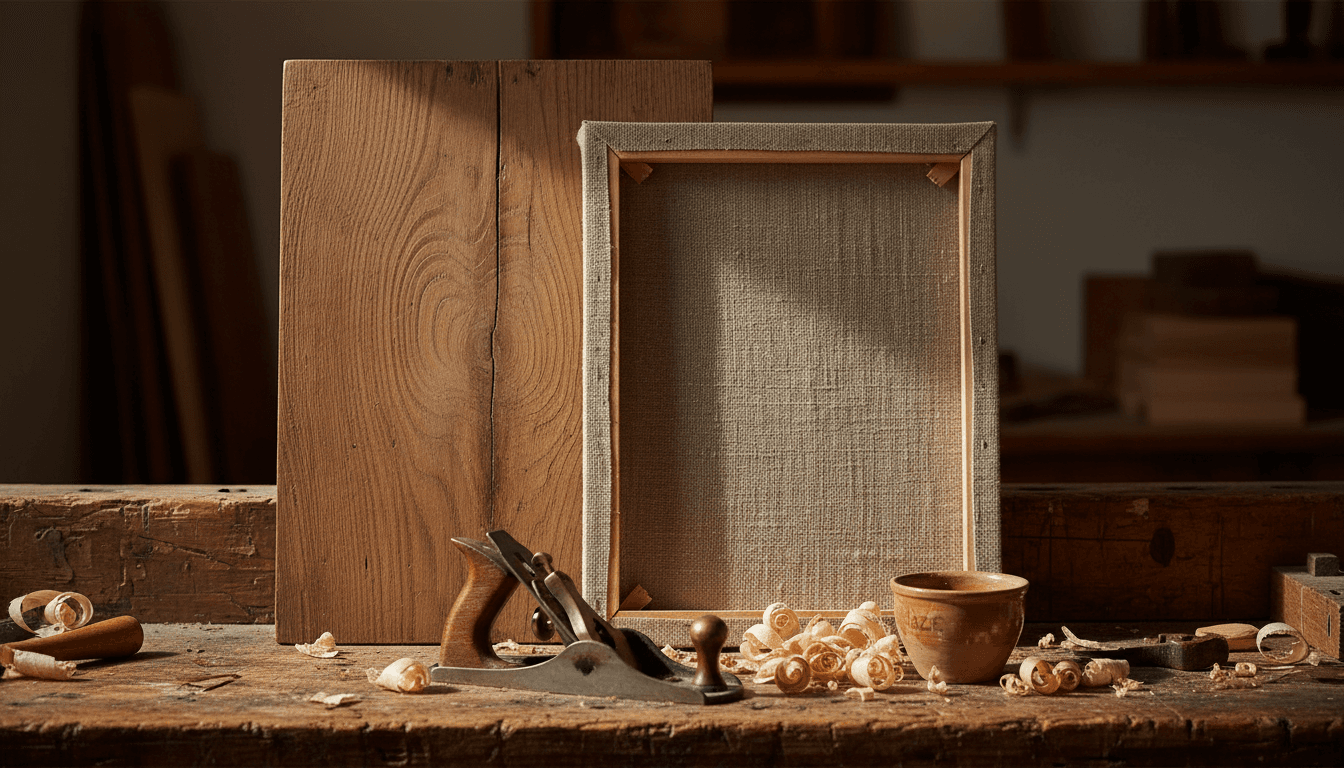
Panel painting demanded skilled joinery before any artistic decision got made — planks glued and braced to resist warping, then built up with a chalk-and-glue ground that could take days to prepare properly. It produced a smooth, stable surface well suited to the thin, exacting layers of egg tempera. It was also heavy, size-limited by the width of available timber, and, in a genuinely humid environment, prone to swelling, warping, and eventually the kind of cracking along its joins that no amount of careful joinery could fully prevent.
The 16th century: Venice makes the shift
Venice is where canvas took over first and most decisively, and the traditional explanation points to the lagoon city's own climate: constant humidity that made both fresco and wood panels perform poorly, warping timber and keeping plaster from curing properly. Canvas, primed with a flexible glue-and-gypsum ground rather than a rigid one, could flex with humidity instead of fighting it. It also had a practical local supply chain — Venice's shipyards already needed enormous quantities of woven hemp sailcloth for its naval fleet, and the same material, in a lighter weave, worked as a painting surface. And a canvas, once dry, could be rolled — a real advantage in a city where every route on foot crosses a bridge and every painting's final destination might be a church, palace, or trading post reached only by boat.
Titian, Tintoretto, and Veronese make canvas the Venetian style
Titian in particular is closely associated with the shift — sixteenth-century critics had already started treating canvas as a specifically Venetian material, a connection that persisted long enough to become one of the standing clichés of Venetian art history. Alongside Tintoretto and Veronese, Titian used canvas's rougher texture deliberately, leaving visible, textured brushwork that a glassy panel surface never allowed — a stylistic freedom that came directly from the material itself, not despite it.
A complication recent scholarship has raised
The tidy climate-and-portability story, though, appears to be an oversimplification of a more tangled process. Recent research into Venetian painting practice has argued that no single explanation — not humidity, not sailcloth supply, not ease of transport — can stand alone as the cause; canvas was adopted at different moments for different types of painting, for a mix of overlapping practical and aesthetic reasons rather than one clean turning point. The traditional story isn't wrong, exactly. It's just doing the work of several separate, interacting decisions compressed into a single, satisfying explanation.
Advertisement
Where it spread, and where it stands now
Once Venice had proven canvas at scale, the material moved outward with Venetian influence — Spanish painters took it up following the Italian example, and by the mid-seventeenth century Diego Velázquez was using a large canvas as a compositional device within Las Meninas itself. Today canvas is so completely the default painting surface that panel painting reads as the historical exception rather than the rule it once was — a reversal driven, in the end, by a lagoon city's shipyards and its weather working together in ways no single cause fully explains.