Was "Monkey Christ" Actually a Disaster?
An 81-year-old's botched fresco touch-up became a worldwide punchline within days. It also generated over €600,000 for her small town. Both things are true, and neither cancels the other out.
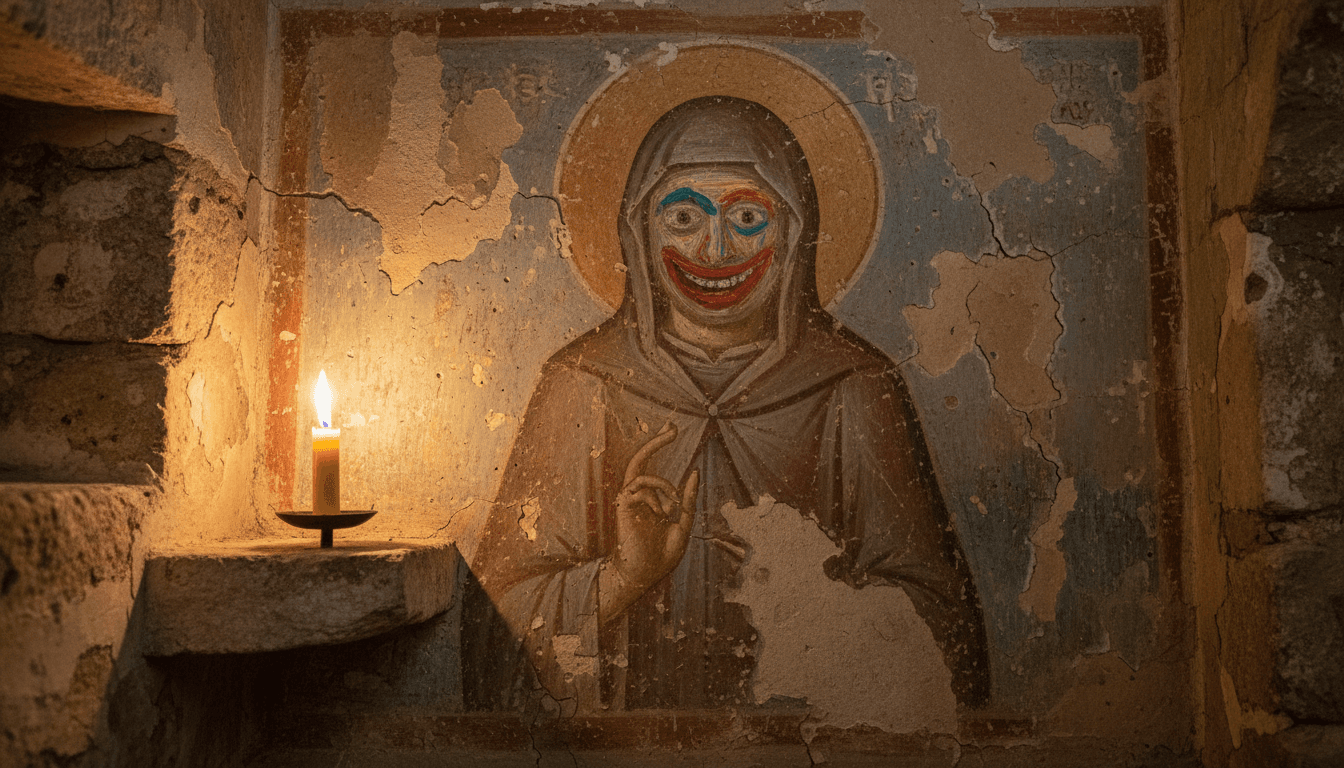
Was the most famous restoration disaster in modern art history actually a disaster at all? In 2012, an elderly parishioner's amateur touch-up of a fading church fresco went viral worldwide as a punchline — nicknamed "Monkey Christ" within days. What happened to the small Spanish town afterward complicates that verdict considerably.
The claim
In the summer of 2012, Cecilia Giménez, then 81, took it upon herself to touch up Ecce Homo, a 1930 fresco of Christ by the local artist Elías García Martínez, painted on a wall of the Santuario de Misericordia church in Borja, a small town near Zaragoza in northern Spain. Moisture damage had left the century-old image badly flaking, and Giménez, a devout, longtime parishioner who had touched up other works at the church before, attempted a restoration without professional training. The result transformed a sensitive depiction of a suffering Christ into a cartoonish, wide-eyed figure with a smudged mouth and a furry, indistinct beard — an image social media almost immediately redubbed Ecce Mono, "Behold the Monkey." Town officials initially suspected vandalism and reportedly considered legal action against her; Giménez herself, according to later reporting, lost significant weight from the stress of the backlash.
The evidence against calling it a simple disaster
Within months, the story's arc reversed. The church began charging a small admission fee to view the fresco, and by later counts the resulting foundation had generated more than €600,000 for the community — funding local charities and civic projects in a town of roughly five thousand people that had essentially no other reason for outside visitors to come. Reported visitor numbers in just the five months following the story breaking topped 45,000, later settling into a steady annual flow in the thousands, and local restaurants and businesses saw a real, sustained boost in trade that outside coverage directly credited to the fresco's new, improbable fame. Giménez herself went from town pariah to, in the words of her own local council's later tribute, a figure held in genuine "affection, esteem, and appreciation" by her fellow citizens.
What the case doesn't resolve
None of that economic and reputational reversal changes the more straightforward, conservation-focused half of the story: García Martínez's original 1930 fresco is, in any meaningful art-historical sense, gone, painted over by a well-intentioned amateur with no training in reversible restoration technique. The initial instinct — that this was a loss, possibly even something to prosecute — wasn't an overreaction born of internet pile-on; it reflected a real and legitimate concern about damage to a piece of local cultural heritage, however modest that heritage was to begin with. A genuine tourism windfall for a town doesn't retroactively make the original artwork's disappearance any less real.
Advertisement
Where the investigation stands
The honest answer sits in the gap between those two facts rather than resolving cleanly into either one. As an act of art conservation, Giménez's restoration was an unambiguous failure — an original work effectively destroyed by an untrained hand. As an economic and social event for the town that hosted it, it was an unambiguous, measurable success, the kind of sustained tourism boost most small towns spend years and real budgets trying and failing to manufacture. Cecilia Giménez died in early 2026, having lived to see her hometown's own account of her settle firmly on the second half of that story rather than the first — proof, if nothing else, that how a "disaster" gets remembered often has very little to do with how it looked in the first week, in much the same way a painting's reputation can hinge on a single detail most viewers never even notice at first glance.