Additive vs. Subtractive Color, Explained Simply
Additive and subtractive colour are two different physics. One adds light, the other absorbs it — and that difference explains why screens glow and paint goes muddy.
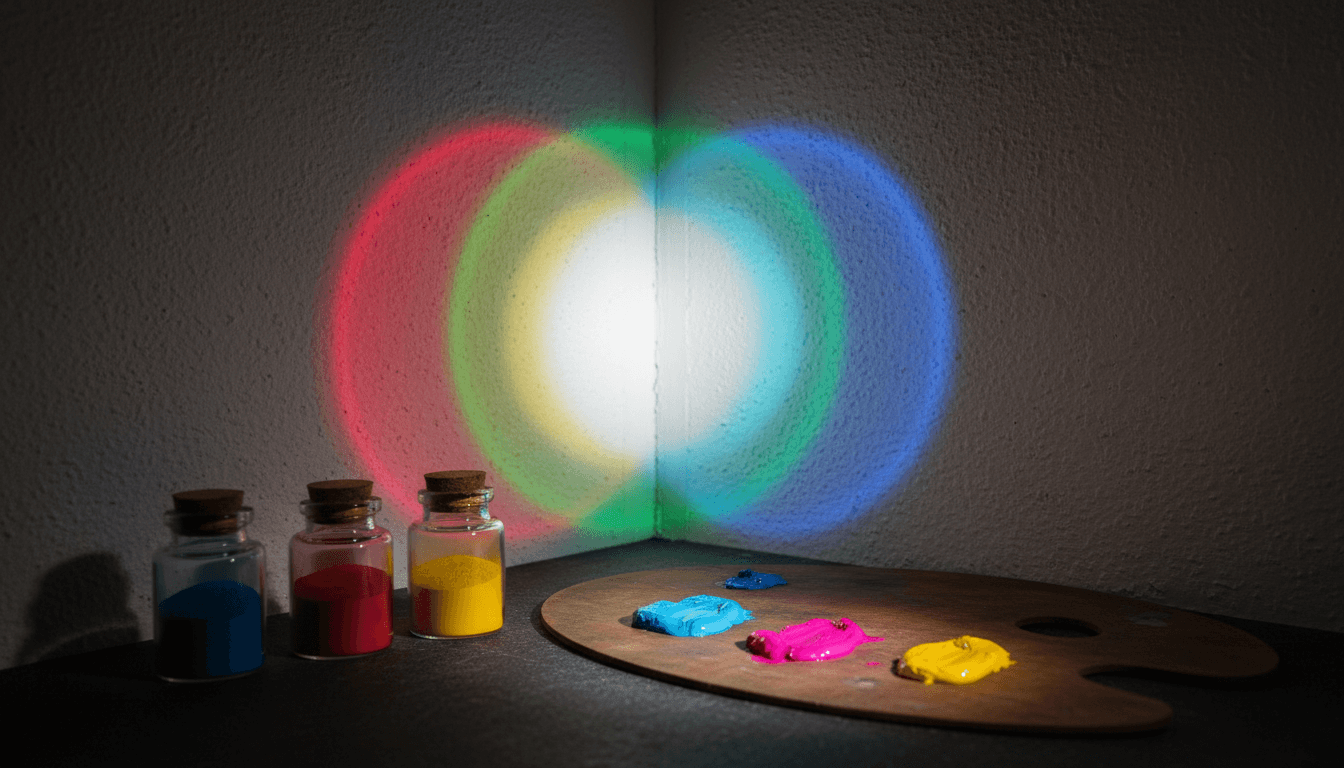
Additive and subtractive colour get treated as two dialects of the same idea — mix your primaries and you get everything else, whichever system you're in. They're not the same idea at all. One system starts from darkness and adds light; the other starts from white light and takes it away. Confuse the two and you get the single most common source of colour frustration: expecting a screen and a print, or a screen and a painting, to ever match exactly.
At a glance
| Additive | Subtractive | |
|---|---|---|
| Mixes | light | pigments, inks, dyes |
| Primaries | red, green, blue | cyan, magenta, yellow |
| Mixing all three moves toward | white | black |
| Found in | screens, stage lighting | paint, print, textile dye |
| Physical basis | three cone types in the eye | absorption of wavelengths |
Additive: starting from black and adding
A screen has no colour of its own sitting there in the dark, in much the same way black on a canvas is never really the absence of colour so much as a starting point — it emits red, green, and blue light in varying intensities, and the eye combines them. Add red and green light together and you get yellow; push all three to full intensity and you get white; turn them all off and you get black. This is why a screen can produce colours brighter than any pigment ever will: it's genuinely emitting light rather than reflecting whatever light happens to be in the room, and emitted light can simply be brighter than anything bounced off a surface.
The demonstration that made this principle famous predates screens by over a century. On 17 May 1861, the physicist James Clerk Maxwell presented the first durable colour photograph at London's Royal Institution — an image of a tartan ribbon, photographed three separate times by Thomas Sutton through red, green, and blue-violet filters, then projected back through matching filters and recombined on a screen into a single full-colour image. Maxwell wasn't demonstrating a photography trick; he was proving that any colour the eye can perceive can be reconstructed from just three lights, because the eye itself only has three types of colour receptor to fool.
Subtractive: starting from white and removing
A pigment does the opposite: it absorbs some wavelengths of the light falling on it and reflects the rest, and what you see is whatever survives the absorption. Mix two pigments and the result reflects only the wavelengths that both of them still let through — which means every pigment you add can only remove more light, never add any back. This is why paint mixing moves toward mud rather than toward brightness, and why the real subtractive primaries are cyan, magenta, and yellow rather than the red, yellow, and blue taught in most art classes — they're the three colours that, together, absorb the broadest possible range of the spectrum with the least overlap and waste. It's also exactly why your printer uses CMYK: ink on white paper is a subtractive system from the ground up, with the paper itself supplying all the brightness the ink can only take away from.
Advertisement
Why three, in both cases
The reason three primaries work for either system, rather than four or seven, traces back to human vision rather than to any convention about colour itself. The eye contains three types of cone cell, each tuned to a different, overlapping range of wavelengths, and the brain reconstructs every colour it perceives from the ratio of signals across just those three channels. Any system — additive or subtractive — that can independently control three well-chosen primaries can, in principle, trigger the same ratio of cone responses as almost any colour a person can actually see. This is also part of why certain colours simply can't be mixed from primaries no matter which three you start with, and why metamerism happens: two completely different mixtures of wavelengths can trigger an identical set of cone responses and look, to the eye, like exactly the same colour, even though the physical light hitting the retina is nothing alike.
What this means in practice
- A vivid screen colour often can't be printed or painted. The screen is adding light; the print or painting can only subtract from what's already there, and the two gamuts — the full ranges of colour each system can reach — simply don't overlap completely.
- Mixing paint always costs brightness. Every pigment added to a mixture absorbs more of the spectrum, so the fewer pigments in a mixture, the cleaner and brighter the result.
- Printers use CMYK, not RGB, because printing is inherently subtractive. Feeding a printer more "light" isn't an option; it can only lay down more ink, which only takes more light away.
- Colour management can approximate across systems, but never eliminate the gap. Profiles and standards can predict how a colour will shift between a screen and a page, but they can't manufacture light a printed page was never going to reflect.
The bottom line
Additive and subtractive colour aren't competing theories of the same phenomenon; they're two different physical processes that happen to both be describable with three primaries, because both are ultimately aimed at the same three-channel eye. A screen adds light and climbs toward white; a painting or a print subtracts it and sinks toward black. Once you know which direction you're working in, most of what seems mysterious about colour — why a photo never prints quite right, why paint turns to mud, why your printer needs four inks instead of three — stops being mysterious at all.
FAQ
What's the actual difference between additive and subtractive colour?
Additive mixes light and moves toward white as you add more; subtractive mixes pigments or ink that absorb light, moving toward black as you add more.
Why can't a printer reproduce every colour I see on my screen?
Because a screen adds light and a printer can only subtract it from what the paper already reflects — the two systems' gamuts, the total ranges of colour each can produce, don't fully overlap.
Why does mixing paint make mud?
Because each pigment added to a mixture absorbs more of the light spectrum, so the reflected light — and the resulting colour's brightness — only ever shrinks.
What are the true subtractive primaries?
Cyan, magenta, and yellow — the basis of CMYK printing — not the red, yellow, and blue most people learn first, which are a workable approximation rather than the underlying physical primaries.
Who first demonstrated additive colour mixing?
James Clerk Maxwell, in an 1861 demonstration at London's Royal Institution, using three photographs of a tartan ribbon taken through red, green, and blue filters and recombined by projection.