Building a Sustainable Art Career: Galleries, Documentation, and Getting Paid
A sustainable art career isn't one lucky break — it's a set of learnable professional systems most artists never get taught. Here's the complete path, from a first gallery approach to pricing, shipping, and staying in the work for the long run.

Most advice aimed at artists concentrates entirely on the moment of discovery — the show that gets noticed, the studio visit that changes everything — and skips almost all of the unglamorous infrastructure that decides whether discovery actually turns into a career. Bios, documentation, pricing, shipping, contracts: none of it is inspiring to talk about, and all of it is what separates an artist who gets one good show from an artist still working, and still selling, twenty years later. This is the complete path, in the order it actually happens, from the first approach to a gallery through to building a practice that doesn't depend on any single one of these things going perfectly.
<!-- IMAGE PLACEHOLDER: alt="An artist's studio mid-session with work in progress and reference materials" | prompt: "A lived-in painter's studio interior, canvases in progress leaning against a wall, a worktable with brushes and reference photos, natural window light, documentary photography style, no visible text or logos" -->
At a glance
| Career stage | What matters most | Where to focus first |
|---|---|---|
| Just starting out | Building a coherent body of work | Documentation and a real artist statement |
| Getting seen locally | Visibility without gatekeepers | Regional group shows, open calls |
| First gallery relationships | Trust before transaction | Studio visits, referrals, a real approach |
| Selling consistently | Protecting the work and the income | Consignment terms, accurate pricing |
| Sustaining it long-term | Not depending on any one channel | Direct sales, teaching, a paced practice |
Small galleries are where careers actually start, not museums
The instinct to aim straight for the biggest, most prestigious venue available gets the order of operations backward. Museums exist to confirm reputations that have already been built elsewhere — their acquisitions committees, trustees, and permanent collections all pull toward consensus, which makes them structurally cautious about anything genuinely unproven. Small galleries have no such ballast, and that's precisely why they matter more to an emerging artist than any institution with a bigger name: the entire history of Pop Art and Minimalism in New York can be traced back to Leo Castelli giving Jasper Johns his first solo show in 1958, in a gallery Castelli was running out of a converted townhouse living room. A museum picks up an artist's work after someone smaller already took the actual risk.
Knowing that doesn't make the approach itself any easier, and most artists get the mechanics of a gallery approach wrong before they've even sent anything. A cold email with an attached portfolio is close to the least effective method available, because it asks a dealer to evaluate a total stranger with no context for fit — and fit, not raw talent, is usually what a gallery is actually screening for. What works instead is visibility before the ask: entering open calls and juried shows, building relationships with artists a gallery already represents, and being present at openings and fairs long enough that an eventual approach feels like a continuation of something rather than a cold introduction. None of this is fast. Most artists who do get gallery representation have spent years building exactly this kind of visibility before any single approach "worked."
<!-- IMAGE PLACEHOLDER: alt="Exterior of a small independent art gallery storefront" | prompt: "The exterior storefront of a small independent contemporary art gallery on a city street, large glass windows showing artwork inside, evening light with warm interior glow, documentary street photography style" -->
What actually happens at a studio visit
A studio visit is where most real gallery relationships actually get decided, and it runs on different rules than a formal pitch does. A dealer, curator, or established artist visiting a studio is evaluating far more than the finished pieces on the wall: they're reading the working process itself, looking at what's half-finished, what's been set aside, and what the surrounding sketches and material tests suggest about where the work might go next, since a body of work's future direction matters as much to most galleries as what already exists. Preparing for one isn't about staging a flawless showroom; an overly tidied, gallery-ready studio can actually read as less convincing than a working space that shows genuine process, since part of what a visitor is judging is whether there's a real, sustained practice underneath the finished objects rather than a handful of successful pieces with nothing behind them.
Advertisement
The conversation during a visit matters as much as the work itself. Being able to talk plainly about the work — what problem it's solving, why a specific material or approach, what's changed since an earlier body of work — carries real weight, since it's evidence the artist understands their own practice rather than having stumbled into a good result once. A visitor who asks difficult or skeptical questions isn't necessarily unconvinced; probing questions are often a sign of serious engagement rather than a customer being talked out of a purchase, and treating them as such, rather than getting defensive, tends to leave a considerably better impression than a purely rehearsed pitch would.
Building a body of work before you build a pitch
Visibility only helps if there's something coherent behind it, and a scattered handful of unrelated pieces reads very differently from an actual body of work — a dozen pieces that clearly belong together make a far stronger case to a gallery, a grant panel, or a curator than fifty pieces that don't. This is where most artists' self-presentation actually starts to matter, and it's also where the two documents artists most often confuse with each other need to be pulled apart. A bio and an artist statement are answering two completely different questions: a bio, written in the third person, establishes who you are — location, training, exhibition history, chosen concretely rather than padded with adjectives; a statement, written in the first person, explains what the work is actually about, and it fails the moment it reaches for borrowed art-world language instead of describing the specific process and material choices behind the work. Keep several lengths of each ready, because every venue that asks for one will ask for a different word count, and writing the short version first makes it far easier to expand than to cut a padded one down later.
A body of work also has a natural lifespan worth planning around rather than discovering by accident: most working artists eventually notice a given series or approach has said what it set out to say, and pushing well past that point tends to produce diminishing, repetitive work rather than genuine development. Recognizing that moment — and treating the transition into a new body of work as a deliberate decision rather than something that happens to a career passively — is part of what separates an evolving practice from one that simply repeats its first success indefinitely because it once worked and nobody examined why. A useful, low-pressure test is whether a new piece in the series is teaching the artist anything they didn't already know from the last one; once the answer is reliably no, the series has usually done its job and it's worth beginning to look toward what comes after it, even before a gallery or a market signal forces the question.
Grants, residencies, and funding beyond a sale
Sales aren't the only way money enters a working practice, and grants and residencies run on an entirely different logic than a gallery relationship does. A grant application is judged almost entirely on the strength of the same materials this guide has already covered — a coherent body of work, a clear artist statement, a professional bio — plus a project proposal explaining specifically what the funding will let the artist make that they couldn't otherwise, which is a different writing task from describing existing work and deserves its own careful draft rather than a recycled statement. Panels reviewing dozens or hundreds of applications tend to reward specificity over ambition: a modest, clearly achievable project with a realistic budget and timeline generally reads as more fundable than a sweeping proposal with no concrete plan attached to it.
Residencies add a second, less financial kind of value: dedicated time and space away from the ordinary demands of a studio practice, sometimes with a small stipend attached and sometimes not, in exchange for a period of focused, often experimental work. The application logic is similar to a grant's — a specific proposal beats a general one — but the actual benefit is different, and it's worth applying for residencies even without funding attached if the uninterrupted time and change of environment would genuinely move a body of work forward. Both grants and residencies compound the same way regional shows do: each one adds a credential and a line to a bio, and each successful application makes the next one slightly more competitive to win.
Documentation is the infrastructure nobody teaches
Long before a gallery, a grant panel, or a buyer ever encounters a piece in person, they encounter a photograph of it — which makes documentation one of the single highest-leverage skills an artist can actually learn, and one almost nobody teaches directly. Good documentation doesn't require expensive equipment; it requires soft, even light from both sides at roughly a 45-degree angle, a camera square to the work rather than at an angle, and a colour reference shot at the start of every session so white balance can be corrected accurately afterward rather than guessed at by eye. The single most damaging mistake is editing for impact instead of accuracy — boosting saturation or contrast to make a photo look more impressive is exactly how a buyer ends up disappointed the moment the actual piece arrives, and that kind of gap in trust doesn't fully recover once it's been noticed.
Advertisement
<!-- IMAGE PLACEHOLDER: alt="Diagram of a two-light setup for photographing artwork" | prompt: "A simple technical diagram showing an artwork on an easel photographed with two softbox lights positioned at 45-degree angles on either side, a tripod-mounted camera centered in front, clean minimal instructional illustration style, no text" -->
A repeatable setup — the same wall, the same light position, the same camera settings every time — matters more than any single piece of gear, because it turns documentation from a small project into a five-minute routine, which is the only way it actually gets done consistently rather than abandoned after the first attempt. Keep a full-resolution, minimally processed master of every image, back the whole archive up somewhere other than the device it lives on day to day, and name files consistently enough that a hundred images are still searchable five years later.
A presence online, sized to what it actually needs to do
A website and a social media presence serve a narrower purpose than they're often given credit for: they're where someone who already has a reason to look — a gallery researching a submission, a collector who saw work at a fair, a journalist following up after a studio visit — goes to confirm what they already suspect, not usually where a career gets discovered cold. A simple, current website with clean, accurately color-corrected images of recent work, a bio, a statement, and a way to make contact covers most of what that confirmation actually requires; elaborate design or constant new content matters far less than making sure what's already there is accurate and not years out of date. Social media works on a different, slower logic — consistent presence over years builds a following gradually, and the platforms that reward an artist's actual work (rather than performing a persona around it) tend to serve a practice better than chasing whatever format is trending in a given month. Neither a website nor a social account substitutes for the in-person visibility this guide has already described; they extend it and make it easy to verify, but they very rarely replace the studio visits, open calls, and referrals that actually start a relationship.
The business layer: proofs, pricing, and consignment
Once documentation and a body of work exist, the paperwork side of selling becomes unavoidable, and it starts with understanding what's actually being sold. An "artist's proof" is a genuine historical category — originally prints pulled outside a numbered edition so the artist and printer could check the plate before committing to the full run — but the label has drifted loosely enough that it's stopped being a reliable value signal on its own. A print's real value rests on the artist's reputation, the edition size, physical condition, and whether it's an original work or a reproduction; proof status is a secondary modifier on top of those factors, not a substitute for them.
Pricing runs on a similarly unglamorous logic. An original's price reflects scarcity by default — there's one, and there will never be another — while a print is a manufactured multiple whose price has to survive direct comparison with every other multiple on the market. The reliable starting method is cost-plus: total the real production cost, then apply a multiplier of three to five times for open editions and more for limited ones, since scarcity and a genuine signature carry value the materials alone don't. Raising prices afterward should follow evidence, not mood — a small edition selling out quickly is a clear signal the price sat below the market, not a fluke to shrug off. Keeping a price consistent across every venue a work is sold through matters just as much as setting it correctly in the first place: a collector who discovers the identical piece sold cheaper through a different channel loses trust in every price they're quoted afterward, which is precisely why serious galleries expect an artist's direct sale prices to match, not undercut, what the gallery is asking.
<!-- IMAGE PLACEHOLDER: alt="Flat-lay of a signed consignment agreement with a pen and gallery paperwork" | prompt: "Overhead flat-lay photograph of a signed consignment agreement document, a fountain pen resting across it, a small stack of gallery paperwork and a business card nearby, warm natural desk lighting, editorial still-life style" -->
Consignment is where the paperwork stops being optional. A gallery holding and selling an artist's work as an agent needs six specific terms nailed down in writing before anything ships: the commission split, who actually sets the retail price, a defined consignment period rather than an open-ended one, confirmed insurance coverage, clear payment timing, and an explicit return process for unsold work. Ownership never transfers to the gallery under a real consignment — that single fact is what protects an artist's work if a gallery closes or runs into financial trouble, but only if the agreement documents the arrangement as consignment clearly enough to hold up in a dispute. Red flags worth walking away from cluster together rather than appearing alone: no written agreement at all, unauthorized discounting, blanket exclusivity across an entire practice rather than one body of work, or a refusal to produce an insurance certificate on request.
Working directly with a client: commissions
Commissioned work runs on a business logic all its own, separate from consignment or open-market sales, because the client is paying for a specific outcome before it exists rather than choosing from finished work already on a wall. A commission agreement worth having in writing covers scope (size, medium, subject, and how many revision rounds are included before additional changes cost extra), a deposit taken before work begins (protecting the artist's time if a client changes their mind partway through), a payment schedule tied to actual milestones rather than one lump sum at the very end, and — a detail many first-time commission agreements miss entirely — a clear statement of what happens to preliminary sketches and studies once the final piece is delivered, since a client who commissioned one specific final work has not automatically purchased every study that led to it. A realistic timeline, communicated up front rather than discovered under pressure, protects the relationship as much as the payment terms do; commissioned work has a way of expanding in scope after the fact if expectations weren't pinned down clearly at the start.
Advertisement
A brief note on copyright and licensing
Selling an original work and selling the right to reproduce it are two separate transactions, and conflating them is one of the more common, avoidable mistakes in a young career. Under the default assumption in most jurisdictions, an artist retains copyright — the right to reproduce, license, and create derivative works — even after selling the physical original, unless a contract specifically transfers those additional rights, which means a buyer who purchases a painting generally hasn't purchased the right to print it on merchandise, use it in advertising, or reproduce it commercially without a separate, explicit agreement. Licensing that reproduction right out separately — for a book cover, a product line, an institutional publication — can become a meaningful secondary income stream once a body of work has some public visibility, entirely apart from what the same works sell for as physical objects. None of this is legal advice, and the specifics vary by country and by the exact language in any given sale or licensing agreement, but knowing that ownership of the object and ownership of the image are two different things, by default, is worth understanding before signing anything that touches on either one.
Getting the work where it needs to go, intact
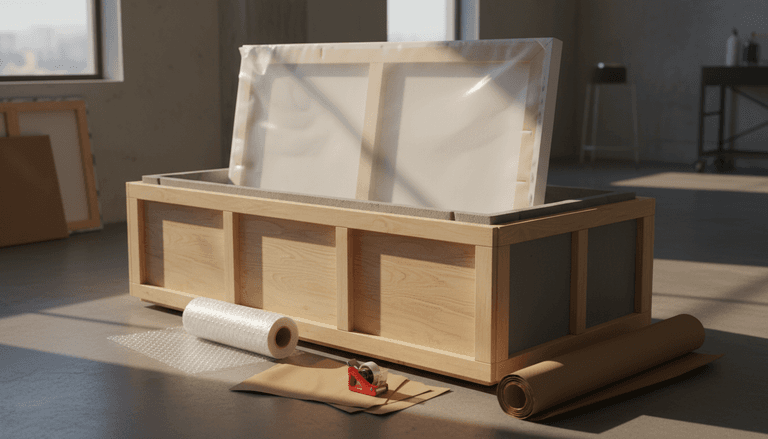
None of the preceding work matters if a sold piece arrives damaged, and shipping failures trace almost entirely back to the same three preventable causes: the work shifting inside its box and striking the sides, the surface touching packing material directly, or an outer box with no rigid structure simply crushing inward. A stretched canvas needs glassine directly over the painted face, a rigid foam-board sandwich larger than the piece itself, and at least two inches of cushioning inside a properly sized outer box; works on paper are the most vulnerable of all, since a crease is permanent, which is why they should never be shipped rolled unless there's genuinely no alternative. Insurance and documentation close the loop — photograph the packed box and the work immediately before sealing it, keep the tracking number and receipt, and check what the carrier's standard policy actually excludes, since many cap fine art coverage low by default or exclude it outright.
<!-- IMAGE PLACEHOLDER: alt="A carefully packed wooden art shipping crate ready for transport" | prompt: "A wooden art shipping crate, lid partially open showing foam padding and a wrapped painting inside, fragile stickers on the exterior, warehouse or loading dock setting, documentary photography style" -->
Building visibility beyond the gallery system entirely
Gallery representation is one path through this whole process, not the only one, and treating it as the sole measure of a career is itself a common reason artists burn out or stall. Regional and local group shows outside the major art-market cities build a real, visible exhibition history without requiring gallery representation first — juried shows, artist-run spaces, and open studios all compound over years into exactly the kind of track record that eventually makes a gallery approach land differently. None of this requires living in a handful of recognized art capitals; it requires showing up consistently to whatever venues are actually available, and treating each one as a legitimate rung rather than a consolation prize.
Artist-run collectives and co-ops offer a further model worth understanding on its own terms: a group of artists sharing exhibition space, costs, and administrative work, splitting the burden that a solo career otherwise carries alone. These spaces trade some individual visibility for shared risk and shared resources, and they can be a genuinely useful stage in a career — a lower-stakes place to test new work publicly, build community with peers facing the same business questions this guide covers, and share hard-won practical knowledge about everything from framing vendors to which regional juried shows are actually worth the entry fee.
The other half of sustaining a career for decades rather than a few intense years is pacing the work itself
Building a practice that survives contact with the actual demands of a career means treating the business tasks in this guide — documentation, pricing, consignment paperwork, shipping — as a recurring system rather than a burst of effort done once and forgotten, since almost every one of them needs revisiting as a body of work grows and changes. Diversifying income sources — direct sales, teaching, licensing, a mix of gallery and non-gallery venues — reduces how much any single relationship or single sale actually has to carry, which is usually what keeps an artist working through the inevitable stretches when nothing in particular is selling. Recognizing which of the many available opportunities are actually worth pursuing at a given career stage — and which are a distraction from work that isn't ready yet — is itself a skill most artists develop slowly, through the accumulated experience of having said yes to the wrong thing at least once.
Teaching deserves a specific mention as an income source many artists undervalue: workshops, private lessons, and adjunct or continuing-education positions can provide the kind of predictable, recurring income a sales-dependent practice otherwise lacks entirely, and the discipline of explaining technique or process clearly enough for a student to actually learn it often sharpens an artist's own understanding of their own working method as a side effect, rather than simply draining time away from the studio.
Advertisement
A practical sequence, if you're starting from nothing
- Build a coherent body of work first. A dozen related pieces beat fifty unrelated ones in every context that matters.
- Document everything properly, and keep doing it. This is infrastructure, not a one-time task.
- Write a real bio and statement, in the correct voice for each, and keep several lengths of both on hand.
- Get visible locally before approaching anyone. Open calls, group shows, and studio visits all count.
- Approach galleries through fit and relationship, not cold emails. Research the actual roster before reaching out.
- Get every consignment, commission, and sale in writing, even with a gallery or client you trust completely.
- Price with real arithmetic, not guesswork, and raise prices only on evidence — and keep that price consistent everywhere the work is sold.
- Protect the work in transit the same way you'd protect it on the wall.
- Understand what you're actually selling — the object, not automatically the right to reproduce it.
- Diversify beyond any single gallery relationship before you actually need to.
FAQ
Do I need gallery representation to have a real art career?
No — regional shows, artist-run spaces, direct sales, and teaching all build a legitimate, sustainable practice, and many working artists combine several of these without ever relying on one gallery exclusively.
What's the single most common mistake artists make when approaching galleries?
Leading with a cold, unsolicited email instead of building visibility and relationships first — dealers are mainly screening for fit, which a stranger's inbox submission can't demonstrate.
How is a bio different from an artist statement, in practice?
A bio is factual and third-person, establishing who you are; a statement is a first-person argument explaining what the work is about and why, and confusing the two makes both read worse.
What actually determines how much to charge for a print?
Real production cost multiplied three to five times for open editions, adjusted upward for limited editions, and raised afterward only when a small run sells out quickly — not by comparing against unrelated famous names.
What's the biggest risk in a consignment agreement?
Vague or missing terms on commission split, pricing authority, and what happens to the work if the gallery closes — all six core terms should be in writing before anything ships.
Does selling a painting mean the buyer can reproduce it?
Not by default in most jurisdictions — copyright, including the right to reproduce or license the image, generally stays with the artist unless a contract specifically transfers it separately from the physical object.
What should a commission agreement cover that a consignment agreement doesn't?
Scope and revision limits, a deposit before work begins, a milestone-based payment schedule, and an explicit statement of who owns any preliminary sketches once the final piece is delivered.
Is a website necessary if I already have social media?
A simple, accurate, current website still matters — it's usually where someone who already has a reason to look (a gallery, a journalist, a collector) goes to confirm the work and get in touch, independent of whatever social platform they found it through.
What is a gallery or dealer actually evaluating during a studio visit?
Evaluating far more than the finished work on the wall — a visitor is reading the working process itself, including what's unfinished, and probing questions during the visit are usually a sign of serious engagement rather than skepticism to be defended against.
How is a grant application different from an artist statement?
A grant proposal explains what new work the funding will let you make that you couldn't otherwise, judged on specificity and feasibility; a general artist statement describes your existing practice as a whole. Recycling one for the other usually reads as unfocused to a review panel.
The bottom line
None of the steps in this guide are individually glamorous, and that's exactly why so many artists skip past them looking for the one break that will make the rest unnecessary. It doesn't work that way. The artists still selling steadily a decade or two into a career are, almost without exception, the ones who treated documentation, pricing, contracts, and shipping as seriously as the work itself — not because the paperwork matters more than the art, but because good work with bad infrastructure underneath it disappears just as easily as no work at all.