Cochineal: The Insect That Made Red
Cochineal is a red dye made from a tiny cactus insect — about 70,000 of them per pound. For three centuries it was one of the most valuable commodities on earth.
Long before Europeans ever saw it, cochineal was already a tribute good in Mesoamerica — a red so vivid that Aztec and Maya rulers taxed it from conquered provinces the way they taxed gold and cacao. The dye comes from an insect barely a few millimetres long, and turning it into one of the most valuable commodities in the early modern world took a cultivation system nobody in Europe had ever encountered before 1520.
Before contact: an empire's red
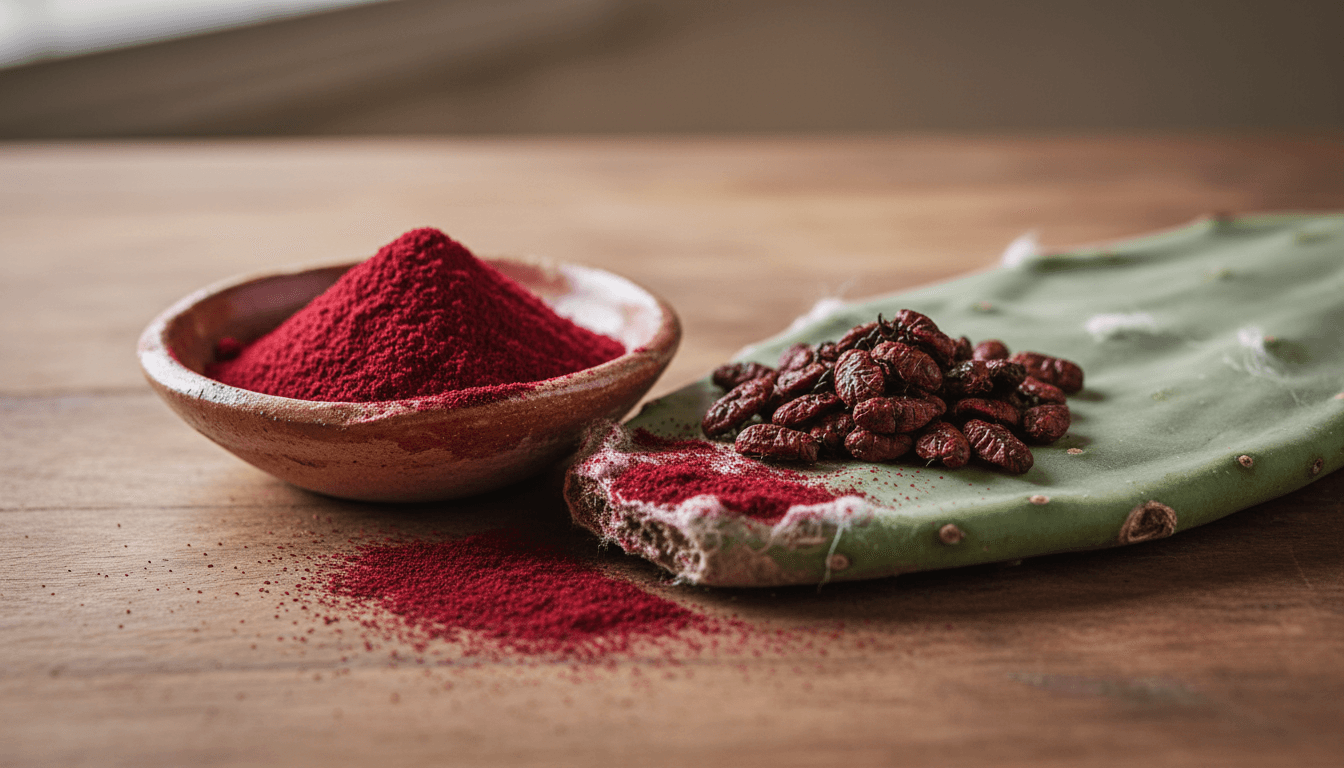
Dactylopius coccus is a scale insect that lives its entire life attached to the pads of the prickly pear cactus, feeding on its sap. The females, defending themselves chemically, produce carminic acid — a deep red compound that has nothing to do with why the insect makes it and everything to do with why humans wanted it. Farmers in Mexico and Central America had been cultivating the insect and its cactus host together for centuries before the Spanish arrived, harvesting the mature females, drying them, and trading the dried bodies through networks that reached the temples and courts where red signalled status and the sacred.
The chemistry behind the colour
Carminic acid makes up a substantial fraction of the dried insect's body weight, which is what made cochineal so efficient compared with plant-based reds that needed far more raw material per unit of dye. Its colour is not fixed: it shifts with acidity, running orange-red in acidic conditions and toward purple in alkaline ones, which gave dyers real control over the final shade long before anyone understood why the shift happened. The same molecule, treated differently, could yield a scarlet military coat or a deep crimson cardinal's robe.
1520s–1600s: a colonial monopoly
After the Spanish conquest, cochineal became one of New Spain's most valuable exports, tightly controlled to protect the crown's revenue — a colonial cash crop with as complicated an origin story as Indian yellow would later have on the other side of the world. The dried insects, which resembled small grey seeds, were called grana — grain — and shipped from Veracruz to Seville in quantities that made cochineal, by some measures, the second most valuable export of the Spanish Americas after silver. Spain guarded the source as closely as it could, because the dye's economics were extraordinary: it took roughly 70,000 dried insects to produce a single pound, and no European rival could work out how to replicate the cultivation without access to the insect, the cactus, and generations of accumulated technique.
Advertisement
1600s–1800s: the colour of power
Cochineal dyed the red coats of the British army and the scarlet robes of Catholic cardinals, and it entered painters' studios as carmine — a transparent lake pigment made by binding the dye onto a base, prized for glazes and the warm depths of flesh tones, in much the same status-signalling role mineral vermilion had played in earlier centuries. It was expensive enough that using it was itself a statement, though not always a lasting one. On wool and silk, cochineal held its colour about as well as madder; ground into a lake for the easel, it did not. Light-ageing tests at the National Gallery found the insect-derived lakes more fugitive than madder lakes — as writers of the late eighteenth and early nineteenth centuries had already warned when they recommended madder as the more permanent red — and faded cochineal has been identified in paintings by Reynolds and Gainsborough.
1868: the synthetic red arrives
Cochineal's decline began not with a better red dye but with a cheaper one that came from an entirely different source. In 1868, the German chemists Carl Graebe and Carl Liebermann worked out how to synthesise alizarin — the red colourant naturally found in the madder root — from coal-tar anthracene, and filed a patent in 1869 a single day ahead of a competing claim from the British chemist William Perkin. Alizarin could be manufactured in a factory rather than farmed one insect at a time, following the same synthetic logic that had already turned Prussian blue into Europe's first mass-produced pigment more than a century earlier. It undercut both madder and cochineal within a generation, and the aniline dyes that followed in the later nineteenth century finished the job — by the early twentieth century, the trade that had once rivalled silver had lost almost its entire market.
Where cochineal stands now
The insect never stopped being farmed. Production continues today, concentrated in Peru, Mexico, and the Canary Islands, at a fraction of its colonial scale — carminic acid is still used in food and cosmetics, listed on labels as E120, precisely because no synthetic red has ever matched its particular colour and its natural-origin appeal to modern buyers. A commodity that once built empire revenue now occupies a niche market, kept alive by consumers who want a natural red and are willing to accept where it comes from — which is, still, roughly 70,000 insects a pound.