Gesso, Grounds, and Surface Preparation
The ground is the invisible layer that decides whether a painting holds together. Gesso, oil grounds, and acrylic grounds each behave differently — and the choice matters.
A ground is the layer between paint and support, and it's the part of a painting almost nobody looks at directly — which is exactly why getting it wrong is so easy to do invisibly, and why the failures show up months or years later as cracking, sinking colour, or paint that simply won't hold.
At a glance
| Ground | Made from | Best suited to |
|---|---|---|
| Traditional gesso | Rabbit-skin glue + chalk or gypsum | Rigid panels, egg tempera |
| Oil ground | Lead or titanium white in oil | Oil painting on canvas |
| Acrylic gesso | Acrylic polymer + filler | Almost any support, flexible |
| Half-chalk ground | Chalk plus a measure of oil | A middle point between absorbent and sealed |
The three jobs a ground actually does
A ground seals the support so it doesn't drink up the binder above it, gives the surface a texture the paint can actually grip, and isolates the paint from whatever chemistry the raw support brings with it. Unsealed canvas, for instance, is acidic and absorbent — oil painted directly onto it sinks into the fibres and can rot them over time. A rigid wood panel doesn't have that particular problem, but it's smooth and needs a ground purely to give the paint some tooth to hold on to.
Cennini's recipe, six hundred years old
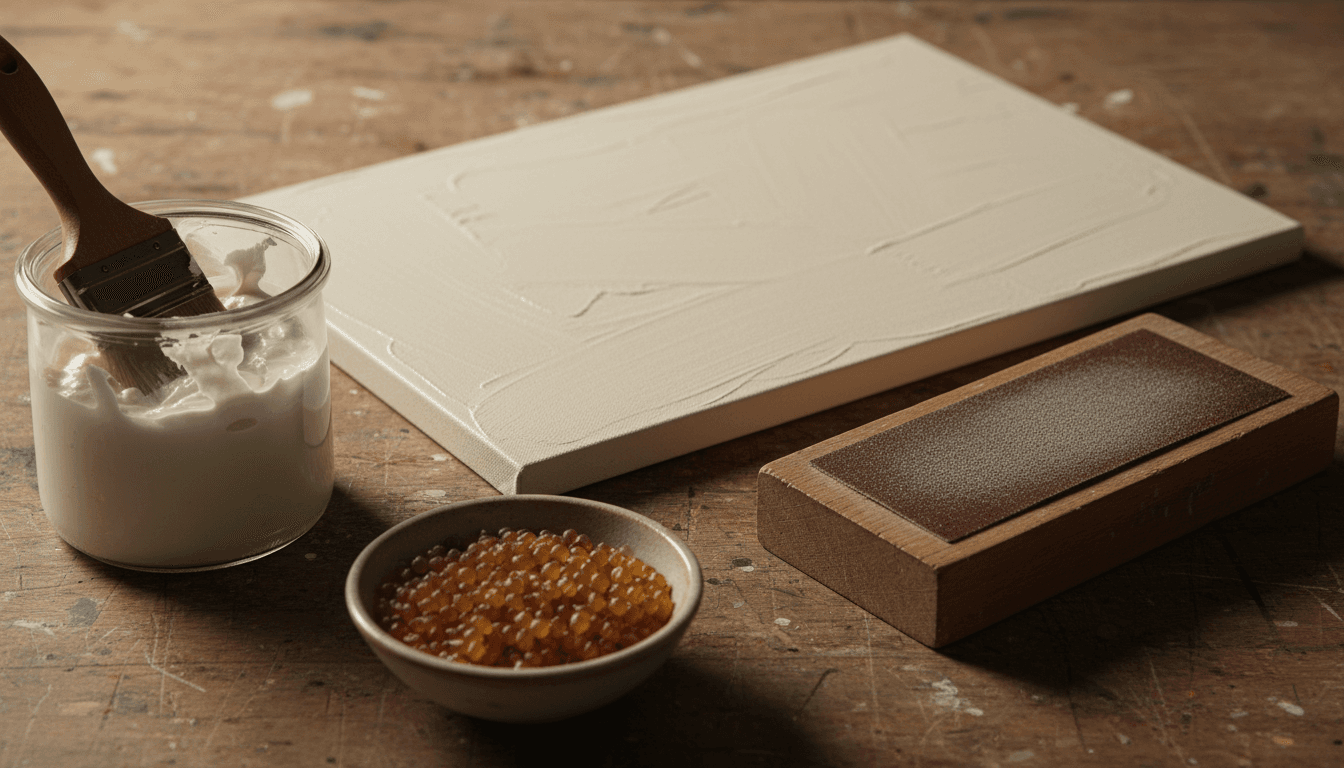
The clearest historical record of how this was done comes from the Italian painter Cennino Cennini, who trained under Agnolo Gaddi — himself trained by his father Taddeo Gaddi, who had trained under Giotto — and wrote it all down around 1390–1400 in Il Libro dell'Arte ("The Craftsman's Handbook"), the earliest surviving Italian treatise on painting technique. Cennini's gesso was chalk or gypsum bound in rabbit-skin glue, applied to a wood panel in many thin coats and sanded smooth between them; he compared getting the consistency right to preparing a smooth batter, and warned that letting the mixture boil would ruin it entirely. That level of specificity, six centuries on, is still basically correct technique for a traditional chalk ground on panel.
The brittleness of that traditional gesso is also its limit: it cracks the moment a flexible support moves under it, which is exactly why it stayed a panel-painting ground and never successfully migrated to canvas, which does nothing but move — the same underlying vulnerability behind most of the ways paint eventually cracks once a rigid layer sits on a surface that won't stop moving.
Why canvas needed a different answer entirely
Canvas flexes with every change in humidity, so a ground for canvas has to flex with it or crack away from the surface. That's the whole reason modern acrylic gesso exists and has become the default: it's a dispersion of acrylic polymer with a filler like calcium carbonate or titanium dioxide, genuinely flexible, and it adheres to canvas as well as panel. It shares Cennini's name by historical accident rather than by shared chemistry — "gesso" here describes a role, not a formula, and the two products behave quite differently on the brush.
Advertisement
Also from Beyond Every Art
The Alchemical Canvas: Unveiling the Deep Chemistry of Oil PaintsAbsorbent versus sealed: a real choice, not a defect
An absorbent ground (traditional chalk gesso, for instance) pulls some of the binder out of the paint applied on top of it, which produces a matte finish and can make colour sink slightly as it dries. A sealed ground (an oil ground, for instance) keeps the paint sitting on the surface, producing a glossier, more saturated result. Neither is a better ground in the abstract — they simply produce different paintings, and the choice should be made on purpose rather than by default. A quick, practical test: a drop of water either beads on a sealed ground or soaks straight in on an absorbent one, which tells you immediately which kind you're looking at.
Matching the ground to the medium, not just the support
- Egg tempera wants a genuinely absorbent ground, because the medium depends on absorption to bond properly — this is Cennini's traditional chalk gesso territory almost exactly.
- Oil paint wants a ground compatible with how the oil itself cures, whether that's a traditional oil ground or a properly sealed modern acrylic gesso; oil directly onto a chalk ground with no sealing layer risks the paint sinking unevenly.
- Acrylic paint tolerates a wide range of grounds, which is part of why it's forgiving for beginners.
- Watercolour isn't painted onto a gessoed panel at all — it wants sized paper, a completely different preparation built for an entirely water-based medium.
Priming canvas: two steps, historically and still
Priming a fabric support is really two separate operations: sizing, which seals the raw fibre so the ground doesn't soak straight through it, and priming, which applies the actual painting surface on top. Traditionally that meant rabbit-skin glue as the size and an oil ground (commonly lead white) as the primer; modern acrylic gesso often collapses both steps into one product, which is part of its convenience and part of why some painters find it produces a slightly different, more plastic-feeling surface than the two-step traditional method.
An isolation layer solves the interactions the ground alone can't
Occasionally two layers in the stack would react badly if put directly in contact — an oil ground over a water-based size, for instance — and an isolation layer, a simple sealing coat, sits between them to prevent it. It's an invisible fix, and it's exactly the kind of unglamorous step that separates a ground that quietly protects a painting for a century from one that quietly undermines it from month one.
The ground is also a visual decision, not just a technical one
A white ground brightens whatever colour sits on top of it, since light passes through thin or transparent paint and bounces back off the ground underneath; a mid-toned or coloured ground does the opposite, unifying and slightly muting the palette above it — which is exactly why some painters tone their ground deliberately rather than leaving it white, using it as a mid-value they can push both lighter and darker from. Texture works the same way: a smooth, sanded ground favours fine detail and crisp edges, while a rougher, unsanded one catches the brush and breaks colour up as it's dragged across, producing a more textured mark almost automatically.
The bottom line
The ground disappears completely once the painting is finished, which is precisely why it's tempting to rush or skip. Match the ground to the support (flexible for canvas, rigid-only for traditional chalk gesso), decide deliberately between absorbent and sealed rather than by default, and the six-hundred-year-old logic in Cennini's handbook — seal, then prime, then paint — still holds up as the basic sequence worth following.
FAQ
What is gesso, exactly?
A ground layer applied before painting. Traditional gesso is chalk or gypsum bound in rabbit-skin glue; modern acrylic gesso is a flexible acrylic polymer with a filler, and shares the name but not the chemistry.
Can I use traditional gesso on canvas?
No — it's too brittle for a support that flexes, and it will crack away from the surface. It belongs on rigid panels.
Why does unsealed canvas damage oil paint over time?
Canvas is acidic and absorbent; oil painted directly onto it soaks into the fibres and can cause them to rot, which is exactly what a ground and a size are there to prevent.
How do I know if a ground is absorbent or sealed?
Apply a drop of water. It soaks in quickly on an absorbent ground and beads up on a sealed one.
Who wrote down the traditional recipe for gesso?
The Italian painter Cennino Cennini, in Il Libro dell'Arte, written around 1390–1400 — the earliest surviving Italian treatise on painting technique.