Guggenheim Jeune: The London Gallery That Lost Money and Made a Collector
Peggy Guggenheim's London gallery lost money for eighteen months and taught her to collect. The story behind the Royal Academy show opening 21 November 2026.
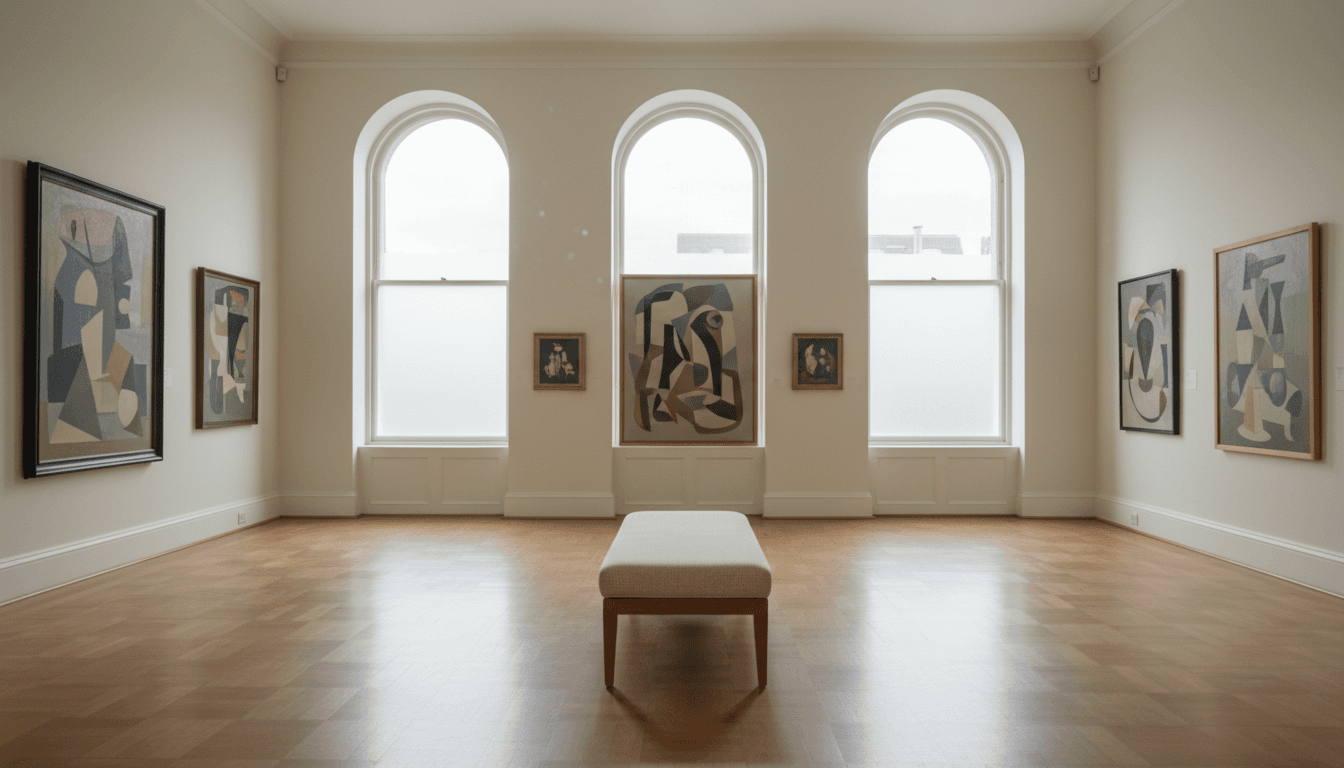
On 22 June 1939, Peggy Guggenheim closed her London gallery with a party at which colour portrait photographs by Gisèle Freund were projected onto the walls. Guggenheim Jeune had been open for eighteen months and had staged more than twenty exhibitions. It had lost money the whole time — £600 in its first year alone — and it had done something harder to price: it had turned an heiress with a taste for modern art into the collector whose paintings now hang in Venice. On 21 November 2026 the Royal Academy, just around the corner from the old premises, opens an exhibition about how that happened.
The show: Venice's version of London comes to Burlington House
- Exhibition
- Peggy Guggenheim in London: The Making of a Collector
- Venue
- Royal Academy, Sackler Wing, Burlington House
- Dates
- 21 November 2026 – 14 March 2027
- Organised by
- Peggy Guggenheim Collection, Venice
- Curators
- Gražina Subelytė and Simon Grant
- Next stop
- Guggenheim New York, 16 April – 12 September 2027
Peggy Guggenheim in London: The Making of a Collector is organised by the Peggy Guggenheim Collection in Venice in collaboration with the Royal Academy. The Venice museum credits its curator Gražina Subelytė and the guest curator Simon Grant with organising it, and describes it as the first large-scale museum exhibition celebrating her years in the United Kingdom. It ran in Venice from 25 April to 19 October 2026, runs in the Royal Academy's Sackler Wing from 21 November 2026 to 14 March 2027, and moves on to the Guggenheim in New York from 16 April to 12 September 2027.
Finestre sull'Arte counts some 100 works from institutions and private collections — paintings, sculpture, works on paper, photographs, puppets and archives — arranged around the gallery's own shows: Kandinsky's and Marie Vassilieff's, the 1938 sculpture exhibition, Cedric Morris, the collage and Surrealist shows, and a tribute to Freund. The Royal Academy's exhibition page names Eileen Agar, Salvador Dalí, Barbara Hepworth, Rita Kernn-Larsen, Henry Moore, Piet Mondrian, Cedric Morris and Sophie Taeuber-Arp alongside Kandinsky, and lists works including Kandinsky's Dominant Curve (April 1936), Moore's Reclining Figure (1938, cast 1946), Tanguy's The Sun in its Jewel Case (1937), André Masson's Ondine (1937) and Agar's Collage Head (1937). The Venice museum adds archive material, including Freund's 1939 photograph of Herbert Read and Peggy Guggenheim. The Kandinsky comes from the family side of the ledger: Dominant Curve is credited to the Solomon R. Guggenheim Museum in New York, the institution that grew out of her uncle's foundation.
The exhibition's argument is that London was where she learned to collect. The dealer Pilar Ordovas, who gave the gallery its own exhibition at her Savile Row space in 2019, put the gap plainly: "No one has really paid much attention to what the London experiment meant to her as a collector and as a gallerist." Finestre sull'Arte adds that Guggenheim considered England a spiritual homeland; in a 1976 interview she said that, had she not lived in Venice, she would have chosen the English countryside. A show about a gallery that lost money fills a wing of the Royal Academy because the gallery's real product was a collection. To see how, start before Cork Street opened.
Advertisement
Before Cork Street: a Titanic, a bequest and a Paris education
Guggenheim was born in New York on 26 August 1898. Her father, Benjamin, had left the family firm in 1901 and died in the sinking of the Titanic in April 1912. She came into her inheritance at 21, in 1919 — accounts of the amount differ — and moved to Paris the following year. In 1922 she married Laurence Vail, and through him entered the Paris bohemia in which, the Venice museum says, her acquaintances included Constantin Brancusi, Djuna Barnes and Marcel Duchamp.
Her mother, Florette, died in November 1937, two months before the gallery opened; the New York Review of Books, reviewing Anton Gill's biography, says she left Peggy $500,000 in trust. Duchamp did the rest of the preparing. At his suggestion Guggenheim spent several days that autumn at the Paris International Exposition to get an overview of the avant-garde, and he taught her, as she put it, "the difference between Abstract and Surrealist Art." Ordovas says he was effectively "doing her programme." His advice also shaped her first acquisition: Jean Arp's Head and Shell, bought directly from the artist's studio in 1937 on Duchamp's recommendation, before the gallery existed.
She was not the only Guggenheim collecting. Her uncle Solomon had collected Old Masters since the 1890s and turned to non-objective art after meeting the artist Hilla von Rebay in 1926. He established the Solomon R. Guggenheim Foundation in 1937, and his Museum of Non-Objective Painting opened in Manhattan in 1939, under Rebay's direction — the year Peggy's own plans for a London museum collapsed. Two Guggenheims were assembling modern-art museums at the same moment on opposite sides of the Atlantic: his devoted to non-objective painting, hers, in the end, to Surrealism and abstraction alike.
London in 1938: Cork Street had already met the Surrealists
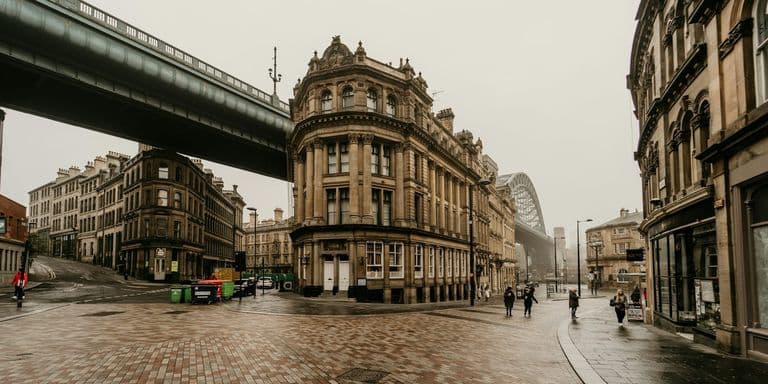
By January 1938 Cork Street had a modern-art history of its own. Freddie Mayor was the first dealer to arrive, in 1925, and in July 1933 his gallery at number 18 staged Joan Miró's first UK solo exhibition. The Redfern moved to number 20 in 1936, and the same year the London Gallery opened at number 28 under E. L. T. Mesens, the Belgian Surrealist, becoming the movement's British base. All of that comes from Louisa Buck's history of the street.
The movement had announced itself in the summer of 1936. The International Surrealist Exhibition ran at the New Burlington Galleries from 11 June to 4 July, with about 390 paintings, sculptures, objects and drawings and an English committee that included Henry Moore, Roland Penrose and Herbert Read — three names that return in Guggenheim's story. Buck puts attendance above 25,000. Salvador Dalí lectured in a deep-sea diving suit and nearly suffocated until the poet David Gascoyne freed him with a spanner, and Dylan Thomas offered visitors cups of boiled string, asking whether they wanted it "weak or strong." British customs had confiscated Wilhelm Freddie's entries as pornographic; they were sent back to Denmark at the last minute rather than destroyed, as the law required.
In November 1937 the London Gallery followed with Surrealist Objects and Poems, whose opening reportedly began at midnight with sausages and whiskey, and at which Julian Trevelyan made a speech dressed as a blind explorer. Read called the exhibits "angels of anarchy and machines for making clouds." Two months later Guggenheim opened next door.
January 1938: a former pawnbroker's shop on Cork Street
Guggenheim opened the gallery in January 1938, at 39, in a former pawnbroker's shop at 30 Cork Street. It was her first gallery, and she did not run it alone. According to ArtDaily's report on Ordovas's 2019 exhibition, Winifred "Wyn" Henderson, a friend from publishing, became its "chief steward"; Finestre sull'Arte's account of the Venice show calls her a key collaborator who managed the space and built the network of contacts that sustained it. Henderson found the site, which Guggenheim described in a letter to her friend Emily Coleman as "a bargain lease at half price in Cork Street for 1-1/2 years" — and the gallery lasted exactly that long. She also named it: "Guggenheim Jeune" punned on Peggy as the younger Guggenheim, her uncle Solomon being the elder, and on the Paris dealers Bernheim-Jeune. That firm had staged the first major Van Gogh exhibition in Paris in 1901 and had been showing Bonnard, Vuillard, Cézanne and Matisse since 1906, when the critic Félix Fénéon became its director, a post he held until 1925.
The opening show was Jean Cocteau's drawings, with a catalogue essay translated by Samuel Beckett, and it came wrapped in scandal. British customs objected to the nudity, detaining two of the drawings at Croydon Airport and releasing them only on condition that they hung in a back room, according to Buck.
1938: Kandinsky, and a programme with no business plan
Cocteau was followed by Vasily Kandinsky, the first solo exhibition of his work in Britain. Kandinsky had taught at the Bauhaus from 1922 until the Nazis closed it in 1933 and had settled in Paris; he became a French citizen in 1939 and died in Neuilly-sur-Seine in December 1944. Her uncle was buying him too: Solomon had bought a Kandinsky directly from the artist in 1936.
Advertisement
Over the next year and a half the programme ran from Surrealism to abstraction: Tanguy, Arp, Brâncuși and Henry Moore among the names, with Barbara Hepworth, Alexander Calder, Salvador Dalí and Piet Mondrian among the "greats" the Art Biogs directory lists; the first exhibition of collage in Britain, which included Max Ernst, later her husband; and a contemporary sculpture show that, the Royal Academy says, "became a national scandal." Arp's work appeared in almost a quarter of the gallery's shows, according to ArtDaily. A call for papers for a 2023 conference on the gallery adds first UK solo shows for Wolfgang Paalen, Rita Kernn-Larsen, Grace Pailthorpe and Reuben Mednikoff, and the directory's table of exhibitors runs on through Eileen Agar, Stanley William Hayter, Heinz Henghes, Charles Howard, Conroy Maddox, Cedric Morris, Dolf Rieser and John Tunnard. In October 1938 a children's exhibition included Lucian Freud's Old Man Running (1936), described by The Art Newspaper as the first work he showed in a public gallery. He was 15, and Grant says almost no archive material on the show survives.
The sculpture show, which included Arp, Calder, Sophie Taeuber-Arp and Brâncuși, was selected by Duchamp and held in April 1938; it made trouble before it opened. Customs refused to treat the works as art and proposed duties on what it called large pieces of metal, wood and stone. J. B. Manson, the director of the Tate, said the sculptures were "not art" and "all the sort of stuff I would like to leave out." A petition organised by Henry Moore and Herbert Read took the question to the House of Commons, which overruled him and declared the pieces works of art. Manson gave up his post soon afterwards.
Sales weren't the point. The Art Biogs directory notes that Guggenheim's wealth let her buy from every show, and those purchases form the core of the Venice collection. The clearest case was Yves Tanguy's first London solo exhibition, which ran for eleven days from 6 July 1938: 25 paintings and five gouaches, record attendance and numerous sales. The Times called the paintings a "moon landscape peopled with osseous and mechanical forms." Guggenheim bought three works herself — two paintings and a small gouache — and offered the four remaining major pieces to the Tate, which declined; its first Tanguy arrived in 1964. In Ordovas's account of the gallery, Samuel Beckett insisted that she show contemporary art because it was "a living thing." Finestre sull'Arte lists Duchamp, Beckett, Roland Penrose, Herbert Read and Mary Reynolds as the circle that shaped her cultural outlook.
June 1939: a farewell party and a museum that never opened
The gallery lost £600 in its first year and, as Art Biogs puts it, "lost money throughout its existence." Shows in 1939 included John Tunnard, Heinz Henghes and Charles Howard; the last event, the farewell party on 22 June, belonged to Freund, whose colour portraits were projected onto the walls. Freund was a German Jewish photographer who had fled to Paris in 1933 and pioneered colour portraiture on Kodachrome and Agfacolor film; she had photographed James Joyce in 1938 and Virginia Woolf in 1939, and her parents fled to Britain in February 1939. Guggenheim closed the gallery that night and turned to something bigger. With the critic Herbert Read, whom she hired as her adviser, she began planning a Museum of Modern Art in London, setting aside $40,000 for its operating expenses; the money was soon overstretched. In August 1939 she left for Paris to negotiate loans for the first exhibition. War broke out shortly afterwards, and the London museum never opened. In September the commercial galleries of Cork Street closed along with the rest of London's.
1939–41: "one picture a day"
She kept buying anyway. In her own words, "I put myself on a regime to buy one picture a day." The haul included ten Picassos, forty Ernsts, eight Mirós, four Magrittes, three Man Rays and three Dalís, with a Klee, a Paalen and a Chagall besides. The Venice museum says she bought Fernand Léger's Men in the City on the day Hitler invaded Norway, 9 April 1940. That month she rented a large space in the Place Vendôme as a home for a museum of her own.
As the German army approached Paris she left for the south. The Louvre, according to Encyclopedia.com's biography, did not think her collection worth saving; it followed her instead, packed at Grenoble by René Lefebvre-Foinet and sent on as "household goods," according to the New York Review of Books. On 13 July 1941 she flew out of Lisbon on a Boeing 314 flying boat with Max Ernst, Laurence Vail, Kay Boyle and their children; Ernst was held on Ellis Island for three days after they reached New York. She married him on 30 December 1941. Her gallery's Paris namesake did not come through the war intact: the occupation's ERR taskforce seized its property, and in 1941 its paintings were confiscated and its buildings sold.
Advertisement
1942–79: New York, then Venice
Art of This Century opened on 20 October 1942 at 30 West 57th Street, in rooms designed by Frederick Kiesler. Three of its four galleries were given to Cubist and abstract art, Surrealism and kinetic art, with ultramarine canvas walls in the Abstract Gallery and curving wall units in the Surrealist one; the fourth, at the front, was a commercial gallery. In January 1943 it staged Exhibition by 31 Women, described as the first documented all-women art exhibition in the United States. In November 1943 it gave Jackson Pollock his first solo show, under a contract that paid him $1,800 a year, and she commissioned his Mural that year. Mark Rothko, Clyfford Still, Robert Motherwell and William Baziotes also showed there. She divorced Ernst in 1946, and the gallery closed in May 1947; Clement Greenberg called her departure "a serious loss to living American art."
Venice came next. She exhibited in the Greek pavilion at the 1948 Biennale, and in 1949 she settled in the Palazzo Venier dei Leoni on the Grand Canal, reportedly paying $60,000 for it. From 1951 she opened it to the public on afternoons; in 1962 Venice made her an honorary citizen. In 1970 she donated the palazzo to the Solomon R. Guggenheim Foundation, and in 1976 her collection. She died on 23 December 1979, aged 81.
Where it stands: a museum on the Grand Canal
The palazzo is now the Peggy Guggenheim Collection, the museum that sent the show to London. Guggenheim is quoted as saying, "I am not an art collector. I am a museum." Set the figures side by side — $500,000 in trust from her mother, £600 lost in a year at Cork Street, $40,000 set aside for the London museum, $1,800 a year for Pollock, a reported $60,000 for the palazzo — and the arithmetic of the Cork Street years doesn't describe a business: a gallery that lost money, run by someone who bought from its shows. It describes an apprenticeship done in public — Duchamp on one side, Beckett on the other — whose product was a collection. The woman who lost £600 on a year of exhibitions was, by 1941, buying a picture a day.
For a working artist the story is a useful corrective: a small gallery that loses money can still be doing its job. Why Small Galleries Matter More Than Museums makes the wider case, and How to Approach a Gallery Without a Cold Pitch covers the practical side.