Did Renaissance Painters Really Use the Golden Ratio?
The Parthenon, the pyramids, the Mona Lisa — all supposedly built on the golden ratio. Measure them and the claim mostly falls apart. One case, involving a violin maker, actually holds up.
Did the ancient Greeks and Renaissance masters really build their most famous works around the golden ratio — the "divine" proportion said to explain why the Parthenon, the Mona Lisa, and a thousand other masterpieces feel so perfectly balanced? It's one of the most repeated claims in popular art history. It's also, once you actually check the numbers, almost entirely unsupported.
The claim
The golden ratio — roughly 1.618, sometimes written as phi — is presented in countless books, design courses, and social media posts as the secret mathematical code behind beauty itself: the Parthenon's facade fits a golden rectangle, the Great Pyramid of Giza was built to its proportions, Leonardo da Vinci composed the Mona Lisa around it, and artists ever since have quietly followed the same formula because the human eye is hardwired to prefer it.
The evidence against it
Measure the actual buildings and paintings, and the claim mostly collapses. The Parthenon's real width-to-height ratio is close to 2.25:1, nowhere near 1.618:1 — the popular golden-rectangle overlay depends entirely on which points of the building you choose to measure from, and archaeological surveys don't support a precise golden relationship at all. The Pyramid claim traces back to a widely repeated but inaccurate 1859 translation of the Greek historian Herodotus, not to anything the Egyptians themselves recorded. And the golden-rectangle grid frequently overlaid on the Mona Lisa's face in online diagrams is a modern construction — nothing in Leonardo's own notes describes composing the painting that way.
The name itself is younger than most people assume. Euclid described the underlying ratio around 300 BCE in his Elements, but called it simply the "extreme and mean ratio" — a piece of geometry, not an aesthetic principle, and certainly not something he called golden or divine. The mathematician Luca Pacioli gave it a grander name in his 1509 book De Divina Proportione ("On the Divine Proportion"), which Leonardo illustrated — but even this documents philosophical and geometric fascination with the ratio, not proof that Leonardo or anyone else used it as a working formula for laying out a painting. The Greek letter phi wasn't even attached to the ratio until the American mathematician Mark Barr proposed it in the early twentieth century, which means "the golden ratio" as a named, mythologised concept is largely a product of the last 150 years, retrofitted onto centuries of older art and architecture that never mentioned it.
The one case that actually holds up
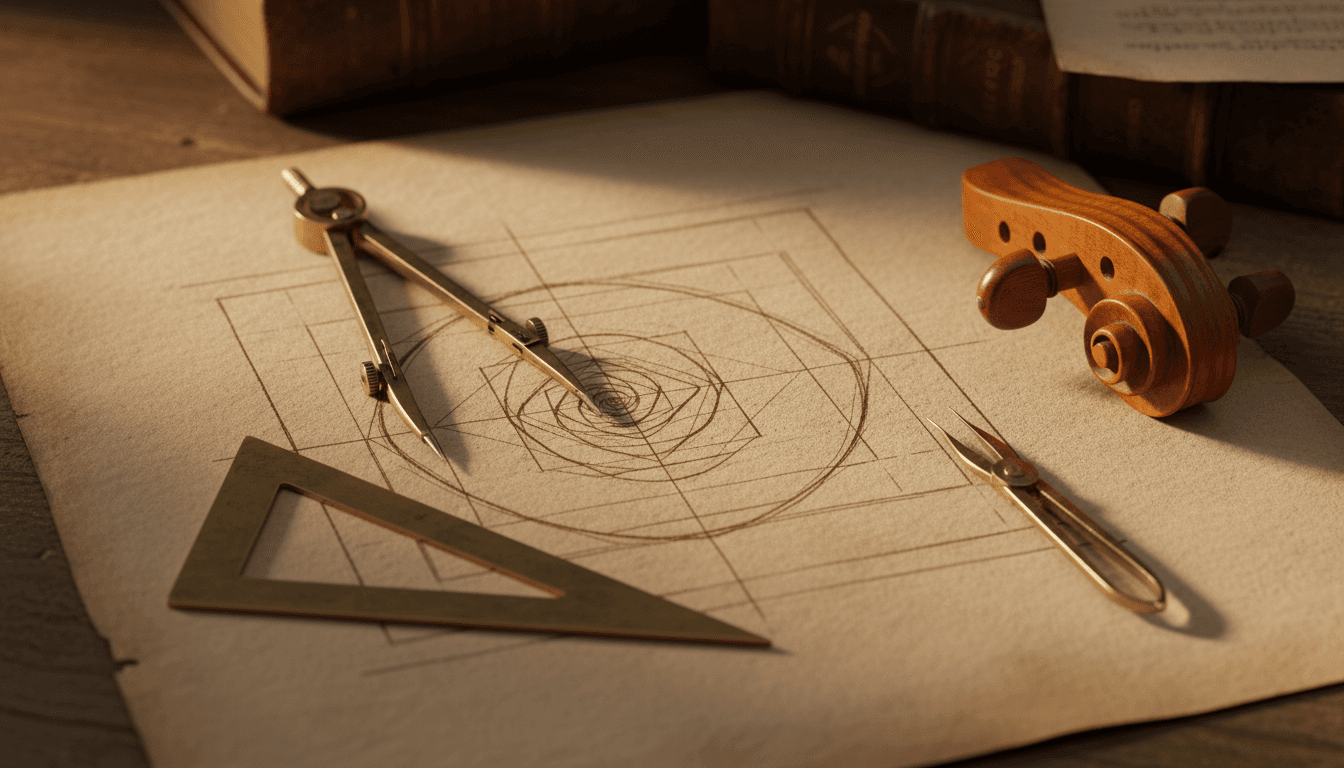
The investigation isn't a total bust. Original workshop drawings show that Antonio Stradivari really did place the f-holes on his violins at positions matching the golden ratio — a rare instance where the historical documentation genuinely supports deliberate use. Even here, though, instrument experts don't believe this placement is what makes a Stradivarius sound the way it does; the proportion appears to have been an aesthetic or organisational choice on the maker's part, not an acoustic secret.
Advertisement
What's still unresolved
Even the ratio's celebrated appearances in nature are shakier than the popular version suggests: nautilus shells and the arms of spiral galaxies do form logarithmic spirals, but their specific growth rates vary widely and don't reliably match the golden spiral's particular proportion — a case of a genuinely elegant piece of mathematics getting stretched to cover phenomena it doesn't actually describe. Psychological studies asking people to pick their preferred rectangle shape, meanwhile, have produced inconsistent results and don't show a strong universal preference for the golden ratio's proportions over others people simply see more often, like standard paper or screen sizes.
Where the investigation stands
The golden ratio is real mathematics with a genuine, if narrow, footprint in documented art history — Pacioli and Leonardo's shared fascination with it, and Stradivari's measurable use of it, are both real. What isn't supported is the sweeping version of the claim: that the Parthenon, the pyramids, and the Mona Lisa were deliberately built around it, or that human beings are hardwired to find its proportions more beautiful than any other. That version is a much newer story, assembled largely after the ratio got its famous name, and projected backward onto works whose actual makers never mentioned it at all — not unlike how confidently the traditional red-yellow-blue colour wheel still gets taught as complete physics rather than the useful approximation it actually is.