The Optical Trick Byzantine Mosaic Makers Took a Thousand Years to Master
Byzantine gold mosaics seem to flicker as you move beneath them. That's not old glass aging unevenly — it's individual gold tesserae deliberately tilted at different angles, a trick a thousand years in the making.
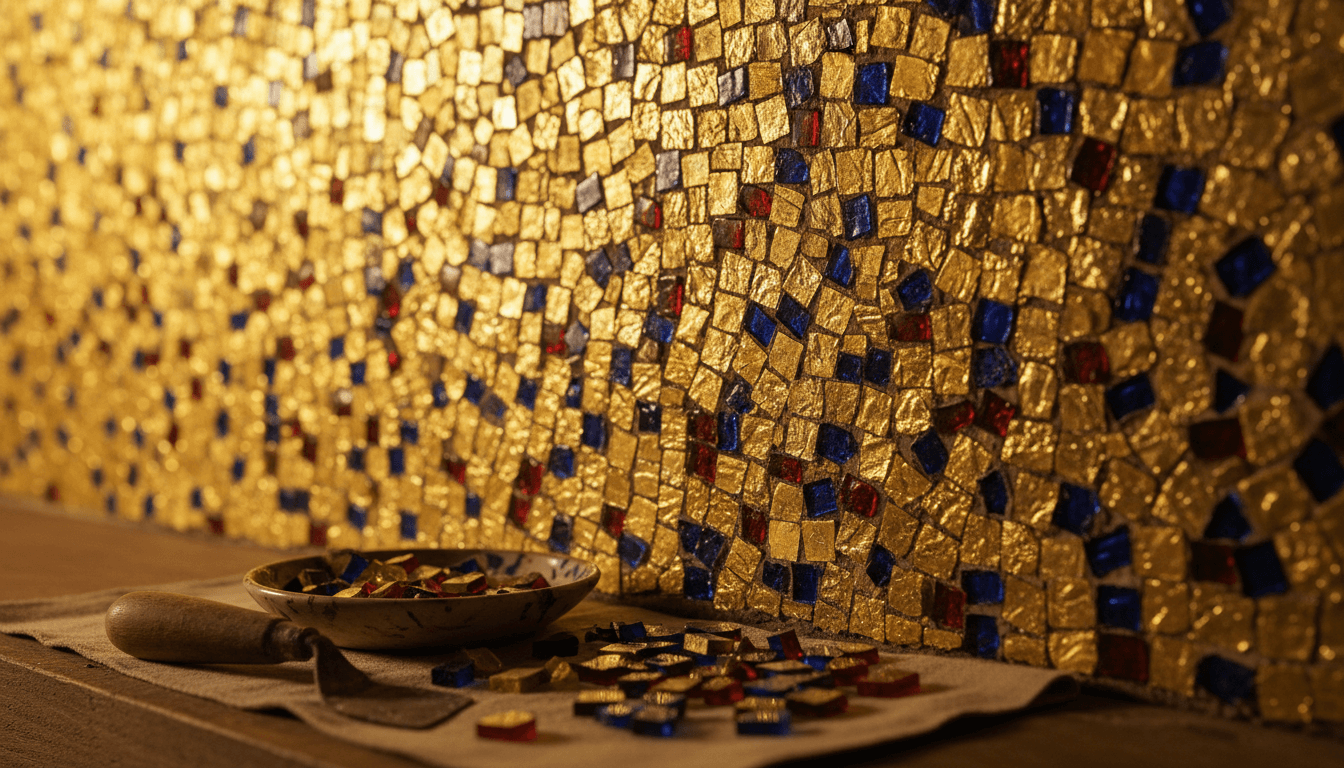
Stand underneath a Byzantine mosaic ceiling and shift your position, and the gold background seems to shimmer and change, almost as if it were lit from somewhere other than the visible windows. That's not an accident of old glass ageing unevenly. It's a deliberate optical trick, built tile by tile, that took mosaic makers over a thousand years to fully develop.
Ancient origins: pebbles and clay
Mosaic's earliest form used whatever small, durable material was on hand. Mesopotamian builders pressed painted clay cones into wet plaster to decorate walls as early as the third millennium BCE, and by the fifth and fourth centuries BCE, Greek craftsmen at sites like Pella were laying elaborate figurative floors from naturally rounded river pebbles, sorted carefully by colour and size. This pebble technique was resourceful but limited — natural stones only came in the shapes and colours nature provided.
Rome: the tessera makes precision possible
Roman craftsmen solved that limitation by manufacturing their own material. Rather than searching for the right pebble, they cut stone, and later glass, into small, regular cubes called tesserae — uniform units that could be laid in precise grids, curved to follow any contour, and combined at a density fine enough to render genuinely detailed figures and scenes. This single innovation, the manufactured tessera rather than the found pebble, turned mosaic from a decorative floor covering into a medium capable of real pictorial ambition, and Roman floors and walls across the empire used it at enormous scale.
Byzantium: gold learns to flicker
The technique's most consequential development came under the Byzantine Empire, applied not to floors but to the curved walls and domed ceilings of churches. Byzantine workshops developed gold tesserae by sandwiching a wafer-thin sheet of real gold leaf between two layers of glass, fused together and then cut into individual tiles — a manufacturing process considerably more involved than simply gilding a flat surface. Crucially, setters didn't lay these gold tesserae perfectly flush and flat the way a floor mosaic would be. They tilted individual tiles at slightly different angles, deliberately, so that light striking the surface at any given moment reflected off only some of them at full brightness while others caught it obliquely or not at all. The result is the shimmering, uneven glow so characteristic of Byzantine church interiors — light that seems to move and change as the viewer does, engineered directly into the surface rather than left to chance.
Advertisement
Where it reached, and what came after
The style reached its fullest expression at sites like the Basilica of San Vitale in Ravenna, completed in 547 CE, and spread with Byzantine influence to Venice's St Mark's Basilica and the Sicilian churches at Monreale and Palermo. Mosaic's dominance faded after the Byzantine period for a straightforward practical reason: setting thousands of individually cut and placed tesserae by hand is vastly slower and more expensive than painting fresco or panel, and as large-scale church decoration shifted west and south into the Italian Renaissance, faster painted media took over most of that territory — the same shift in priorities that let a monochrome technique like grisaille stand in for expensive sculpture, cheaply, once a patron could no longer justify mosaic's enormous labour cost either.
Where it stands now
Mosaic never disappeared entirely — it persisted in more modest, decorative forms and found new life through unlikely modern channels: the Catalan architect Antoni Gaudí's trencadís technique, covering Barcelona's Park Güell in mosaics built from broken, repurposed ceramic tile rather than manufactured tesserae, and the mosaic murals that still decorate transit stations and public buildings around the world today. The specific, tilted-gold trick Byzantine craftsmen perfected over a millennium ago, though, remains essentially unmatched — a lighting effect built directly into a wall's own material, rather than added by any fixture standing in front of it.