Gold in Art: Why It Never Reads as Just Yellow
Gold is not yellow paint. It is a material with its own physics and its own history, and in art it has always meant more than colour — it has meant value and the divine.
In 1925, when Howard Carter's team finally lifted the innermost coffin lid in Tutankhamun's tomb, they found a face that had been waiting in the dark for over three thousand years, still catching the torchlight exactly as it had the day it was sealed. The funerary mask is just over ten kilograms of gold, worked in two layers and inlaid with lapis lazuli and coloured glass, and unlike almost everything else in that tomb, it hadn't dulled, tarnished, or changed colour at all. Gold doesn't age. That single fact — a material that simply refuses to participate in time the way everything else does — is the reason it has meant the same handful of things, in wildly different cultures, for as long as humans have been working it.
What makes it different, physically
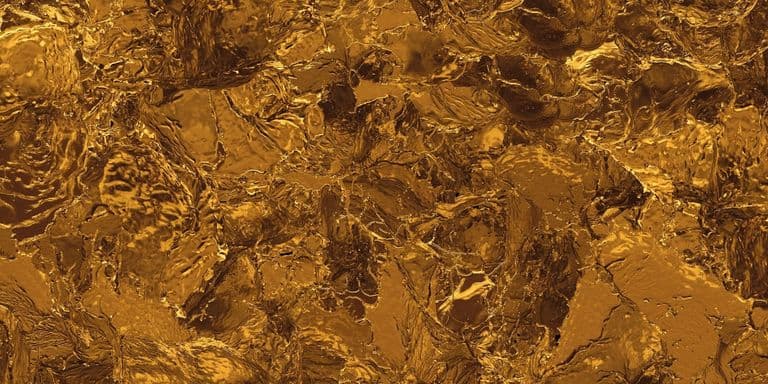
A pigment gets its colour by absorbing some wavelengths of light and scattering the rest; gold does something else entirely. It absorbs much of the blue and violet end of the spectrum — polished gold reflects only about 40 percent of light below 500 nanometres but more than 90 percent of orange and red, which is the whole reason it looks yellow — and throws the rest back like a mirror instead of scattering it. It also does not oxidise at ordinary temperatures, so a gold surface never develops the tarnish, patina, or fading that comes for every pigment and every other common metal. And because it mirrors rather than scatters, gold has no fixed colour of its own in the way paint does — it takes on the colour of whatever light and surroundings it reflects, always tinted toward yellow, and shifts as the viewer moves, behaving nothing like the reflective, absorptive logic behind why certain colours simply can't be mixed from pigment primaries. That instability is exactly why civilisations that wanted to represent something outside time and change kept reaching for the one material that doesn't visibly have either.
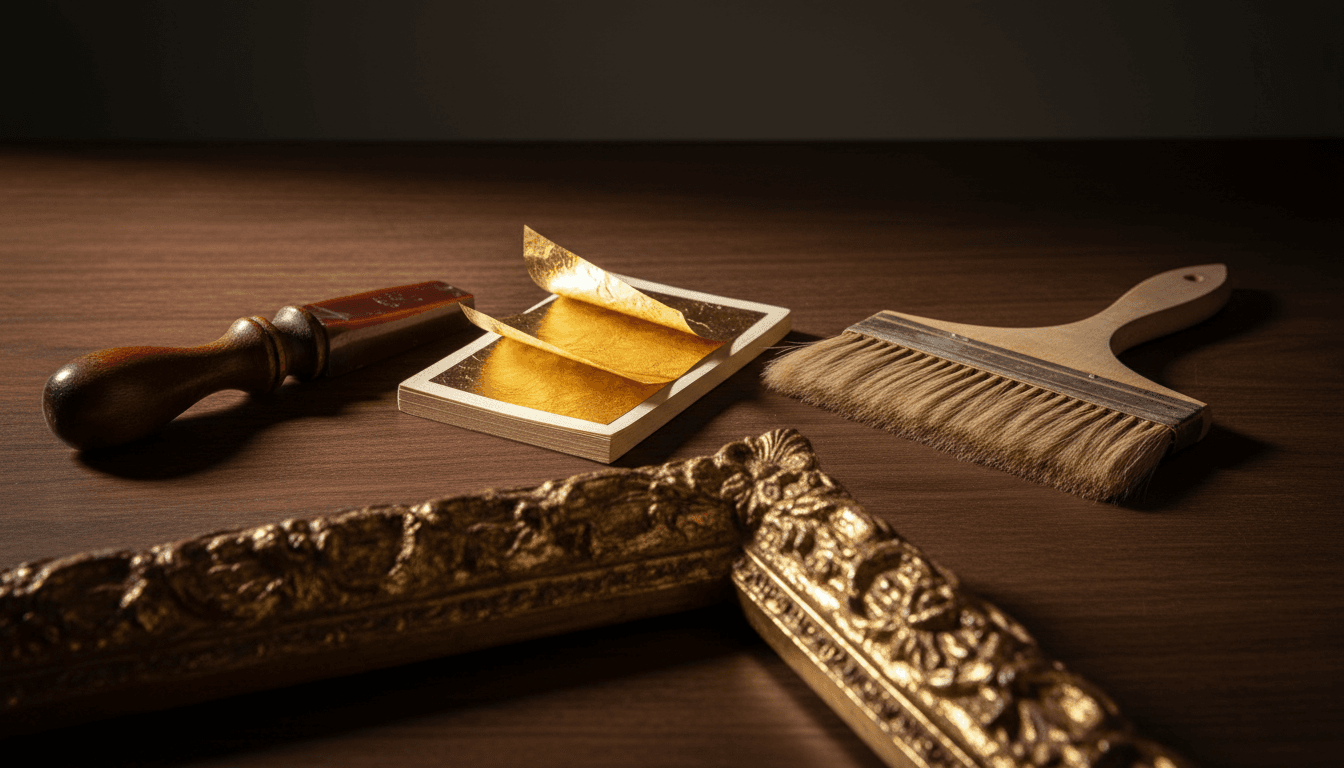
On a painted surface, gold almost always goes on as leaf — sheets beaten thinner than a human hair, laid over a clay-based ground called bole using one of two methods that have barely changed in centuries — with powdered shell gold kept for fine details and highlights.
Two ways to gild
| Water gilding | Oil gilding | |
|---|---|---|
| Size (adhesive) | activated with water | oil-based |
| Finish | can be burnished to a mirror shine | matte |
| Best for | interior, fine detail | outdoor, durable surfaces |
The bole's own colour — often red or a warm yellow — shows through any thinness in the gold above it and shifts the whole surface's warmth, which is why a gilder's choice of ground matters as much as how the gold leaf itself actually adheres.
Advertisement
Byzantium: gold as theology
By the sixth century, Byzantine artists were applying gold not as a background colour but as a field of what they understood as uncreated light — the icon's gold ground wasn't meant to depict a golden sky, it was meant to represent the presence of the divine directly. The material was doing something a painted colour couldn't: representing a thing with no visible form by using the one surface that itself refuses to behave like an ordinary, describable colour.
This convention travelled west with Byzantine influence and shaped centuries of Italian painting. Duccio and Cimabue's altarpieces in the thirteenth century still use gold grounds for exactly this theological reason, with halos and backgrounds in real gold leaf rather than yellow pigment.
The turn away: naturalism makes gold a problem
Gold cannot be shaded. It doesn't behave like cloth, skin, or sky under changing light — it just mirrors whatever hits it — and that becomes a liability the moment painters start chasing three-dimensional illusion rather than symbolic representation. Giotto, working in the same decades as Duccio, was already softening this convention with more naturalistic modelling of form; by the early fifteenth century, painters pursuing linear perspective and modelled light had largely abandoned gold grounds altogether. The shift from gold to paint is one of the clearest material markers of the move from the medieval to the early Renaissance — gold represents; paint depicts, and a movement built around depiction had less and less use for a material that couldn't be shaded.
The Baroque: gold as raw spectacle
Gold never disappeared — it moved off the picture plane and onto the frame, the altar, and the room itself. Baroque interiors used gilding at a scale that had nothing to do with theology and everything to do with power: gilded church interiors and palace rooms were built to overwhelm, and the gold leaf covering an altar or a ceiling was a direct, legible demonstration of a patron's wealth as much as a religious statement. This is the era that cemented gold's second permanent meaning, alongside the sacred: value, displayed as spectacle.
Klimt: gold returns to the canvas
Gold's return as a painted subject rather than a decorative surround has a specific, well-documented trigger. In 1903, Gustav Klimt travelled to Ravenna and saw the Byzantine mosaics in the Basilica of San Vitale — the same gold-ground theology that had shaped painting a thousand years earlier — and it launched what's now called his "Golden Phase." Portrait of Adele Bloch-Bauer I (1907) and The Kiss (1907–08) both use real gold leaf worked directly into the paint surface, consciously reviving the Byzantine idea that gold could represent something beyond ordinary description, but now applied to portraiture and eroticism rather than icons.
The twentieth century: gold as material argument
Modern and contemporary artists have used gold both to invoke its old meanings and to interrogate them directly. Yves Klein's Monogold paintings, part of a tripartite colour system he developed alongside his signature ultramarine (International Klein Blue) in the early 1960s, used gold leaf as a monochrome field in its own right — no longer a background for something else, but the entire content of the work, forcing the viewer to confront gold's material and economic weight with nothing else competing for attention. Later artists have gone further, using gold specifically to comment on art's commodification: gilding an ordinary object turns it into a direct, blunt statement about value that no other material makes so plainly, because the material is the argument, whatever the artist layers on top of it.
Where gold stands now
Gold in art today carries every meaning it has ever carried, simultaneously and without much friction: divine light in a Byzantine-influenced icon still made today, raw spectacle in a gilded frame, and a knowing commentary on value in contemporary work that uses it ironically. What hasn't changed is the physical fact underneath all three thousand years of meaning: gold still doesn't tarnish, still mirrors rather than scatters, and still refuses to be treated as just another yellow. Tutankhamun's mask looks, this year, exactly as bright as it did the day it went into the ground — which is the whole reason the material has never stopped being useful to artists with something to say about permanence.