What Artists Drew With Before the Pencil Existed
Leonardo drew with actual silver wire on specially coated paper — no erasing allowed. A storm-exposed mineral in the English Lake District, and later a British blockade of revolutionary France, gave us the pencil instead.
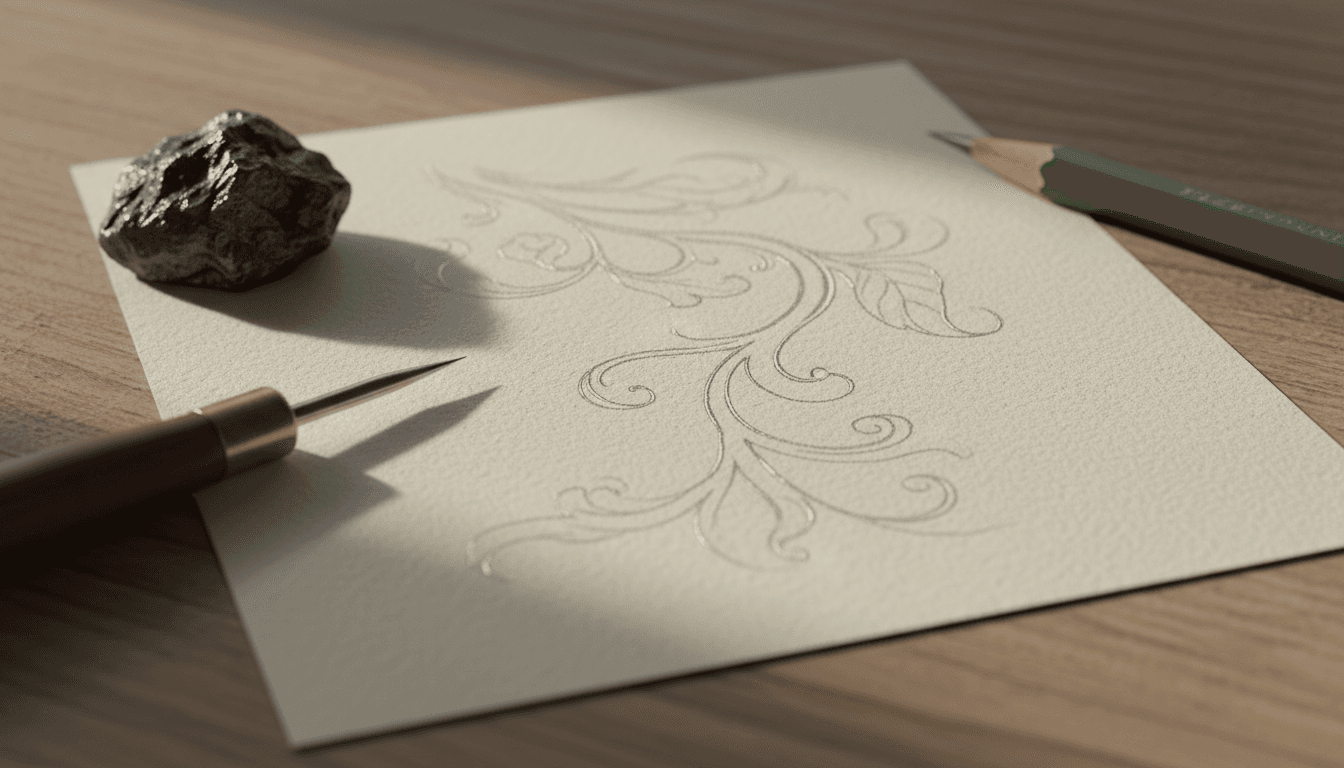
Leonardo da Vinci and Albrecht Dürer drew some of their most careful studies with a sharpened piece of actual silver wire, dragged across paper coated in bone dust. There was no eraser waiting in reserve if the line went wrong — silverpoint doesn't allow one. For roughly two centuries it was simply how serious draftsmen worked, right up until a violent storm in the English countryside knocked over a tree and exposed something that would replace it almost overnight.
Before graphite: drawing with actual metal
Silverpoint — one variety of the broader technique called metalpoint — works by dragging a fine silver wire or rod across a paper or panel surface specially prepared with a ground, usually a thin coating of bone dust or gesso, since silver leaves almost no mark on ordinary untreated paper. The line it produces is faint and precisely grey, and it can't be erased or reworked in any meaningful way once laid down — a genuine, unforgiving commitment with every stroke. That constraint is exactly why it suited the artists most associated with it: Leonardo, Dürer, Jan van Eyck, and Raphael all used it for careful preparatory studies, where total control of the hand mattered more than the freedom to correct a mistake — the same exacting, no-room-for-error mindset Leonardo brought to calculating a painting's perspective before a single line went down.
1500–1564: a storm exposes a mineral nobody had a use for yet
Sometime in this window, a storm near Borrowdale in England's Lake District uprooted a large tree and exposed a deposit of a dark mineral local shepherds initially mistook for coal. It didn't burn, which ruled that out quickly, but it left a dark, easy mark on wood and skin — useful enough that shepherds started using it to mark sheep. The material was graphite, and the Borrowdale deposit turned out to be extraordinarily pure and solid, cuttable directly into sticks — vein graphite of a kind so rare that today it is mined commercially only in Sri Lanka. Because nobody yet understood its actual chemistry, it was assumed to be a form of lead and called "plumbago," a misnomer that survives today in the term "pencil lead," despite pencils never having contained any lead at all.
The quiet takeover
Graphite solved silverpoint's core problem almost immediately: it made a genuinely dark, visible mark on ordinary paper with no prepared ground required, and while it couldn't be fully erased in its earliest form either, it was far more forgiving to work with than a metal stylus. Early graphite sticks were simply wrapped in string or sheepskin for a usable grip; in 1565 the Swiss naturalist Conrad Gesner illustrated one set into the end of a holder, and by 1662 Nuremberg's city council was ruling that pencils were the joint business of the city's lead cutters and its carpenters — the wood-cased pencil, by then an established trade. Silverpoint didn't disappear overnight, but its role narrowed steadily as graphite took over the everyday sketching work it had never been especially suited for.
Advertisement
1795: a trade blockade forces the modern pencil into existence
By the late eighteenth century, the original Borrowdale deposit was running low, and a separate crisis forced the next major change: at war with Britain and blockaded by the Royal Navy, revolutionary France was cut off from English graphite supplies entirely. The chemist Nicolas-Jacques Conté, commissioned in 1794 by the Republic's new mining agency to find a substitute, solved the shortage by mixing powdered graphite with clay and firing the mixture in a kiln, patenting the process in January 1795 — nearly five years before Napoleon seized power. The innovation did more than stretch a scarce material — Conté discovered that varying the ratio of clay to graphite let him control the resulting pencil's hardness and darkness directly, more clay producing a harder, paler line and more graphite a softer, darker one. That single adjustable ratio is still the basis of every pencil hardness grade sold today, over two centuries later.
Where it stands now
Graphite has been the default drawing and writing material in the West for so long that silverpoint now reads as a historical curiosity rather than a working default — though it never fully vanished, much the way egg tempera outlasted its own obsolescence once oil took over painting. A small number of contemporary artists still use it deliberately, precisely for the qualities graphite can't replicate: its hard, unforgiving line, and the way its silver marks slowly tarnish and warm in tone over years, an aging process built into the metal itself rather than something a modern material was ever designed to imitate.