Pointillism Doesn't Actually Work the Way You Think
"Your eye mixes the dots like screen pixels" is the standard explanation for pointillism. Seurat believed it too — and modern analysis of his own paintings shows it's not actually what's happening.
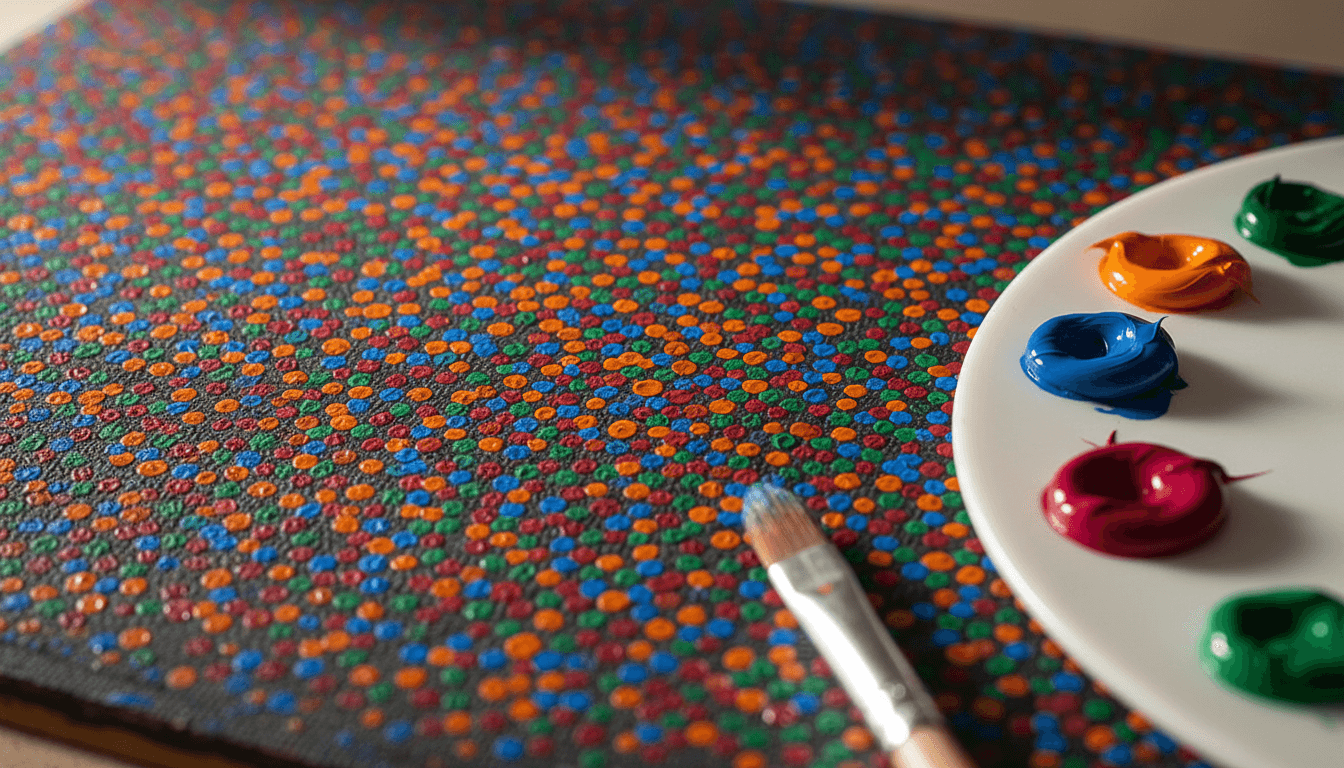
Step back from a Seurat painting and the dots resolve into smooth colour, which gets explained constantly as your eye "mixing" the individual dots the way a screen mixes red, green, and blue pixels into any colour you like. That's the standard explanation, repeated in art classrooms everywhere. It's also not quite what's actually happening on the canvas, and Seurat himself was working from a theory that doesn't hold up the way he believed it did.
At a glance
| The popular explanation | What's actually happening | |
|---|---|---|
| Mechanism | True additive mixing, like screen pixels | Simultaneous contrast, plus visual averaging at a distance |
| Result | A genuinely brighter, more luminous colour than mixed pigment | A shimmering, heightened apparent intensity — a different effect, not a brighter one |
| Comparable to | RGB light mixing on a monitor | Two colours placed close enough to interact, not close enough to blend |
What Seurat actually believed he was doing
Georges Seurat developed the technique — which he called chromoluminarism, though history settled on pointillism and divisionism instead — around 1884, growing directly out of Impressionism's own broken brushwork but pushing it toward something more systematic: colour science of his era, chiefly Michel-Eugène Chevreul's work on simultaneous contrast, Ogden Rood's writing on optics, and Charles Blanc's theories linking painting to the physics of light. The core belief was straightforward and, on its face, scientifically plausible: mixing pigments physically is a subtractive process that can only get duller as more colours combine, but juxtaposing small, separate dots of pure colour and letting the eye do the blending would instead behave like additive light mixing — the same principle a screen uses today, combining red, green, and blue light directly to produce a brighter result than paint ever could. Divisionists believed this gave them the maximum luminosity achievable by any means.
Why the theory doesn't actually hold up
Additive mixing is a specific physical process: it happens when separate light sources combine, the way a screen's red, green, and blue sub-pixels genuinely add their light together before it reaches your eye. Paint doesn't emit light — it reflects whatever ambient light is already in the room, and two dots of reflective pigment sitting next to each other on a canvas simply don't combine their reflected light the way two active light sources do. What actually happens when you step back from a pointillist canvas is closer to ordinary visual averaging: your eye's limited acuity at a distance blurs the individual dots together, producing a result that behaves much more like directly mixing the pigments would than like true additive light combination. Modern colour science confirms what later analysis of Seurat's own paintings has shown directly — his canvases don't achieve true additive mixture at all.
What's actually producing the effect
The real mechanism at work is simultaneous contrast — the same phenomenon Chevreul had already documented decades earlier while investigating complaints about inconsistent-looking black dye at the Gobelins tapestry works, and which shows up constantly across art history whenever colours are placed in close proximity rather than blended. Seurat's dots sit close enough to interact perceptually but not close enough to fully merge, and that specific spacing intensifies the relationship between adjacent colours — producing a mild shimmer and a heightened sense of visual vibrancy — without any of the colours actually combining into something new. It's a real, well-documented perceptual effect. It's simply a different one from the additive light-mixing Seurat thought he'd discovered.
Advertisement
The bottom line
Pointillism works, and the paintings genuinely do produce something a smoothly blended canvas can't — but the popular explanation borrows the wrong physics to describe it. The dots aren't secretly behaving like pixels on a screen, quietly adding light together before it reaches your eye. They're triggering simultaneous contrast, a real optical effect that intensifies and animates adjacent colour without requiring anything to mix at all. Seurat built an entire technique, and an entire movement, on a theory of light that turned out to be slightly wrong — and it worked anyway, for reasons closer to Chevreul's tapestry dye than to modern screen technology.
FAQ
Does pointillism really work by mixing colours in the eye?
Not in the way it's usually described — the dots don't achieve true additive light mixing the way screen pixels do; the visible effect comes mainly from simultaneous contrast and ordinary visual blurring at a distance.
What's the difference between additive and true optical mixing in pointillism?
Additive mixing combines actual light sources, as on a screen; pointillism uses reflected pigment, which behaves more like an averaged blend than a genuinely brighter light-based mixture.
Why did Seurat call his technique chromoluminarism?
Because he believed the effect worked through light-based, additive colour mixing — a term reflecting the specific optical theory he was working from, even though later analysis shows the mechanism works differently.
What is simultaneous contrast?
The phenomenon where a colour's appearance shifts depending on the colours placed next to it, first documented by the chemist Michel-Eugène Chevreul, and the actual mechanism behind much of pointillism's visual vibrancy.
Is pointillism the same as divisionism?
Closely related but not identical — divisionism refers more broadly to separating colour into distinct patches or dots, while pointillism specifically describes the use of small dots as the unit of paint application.