What Visual Artists Can Learn From Composers
Composers solve problems painters also face: pacing, tension, repetition, and silence. Learn how musical thinking can sharpen the structure of visual work.
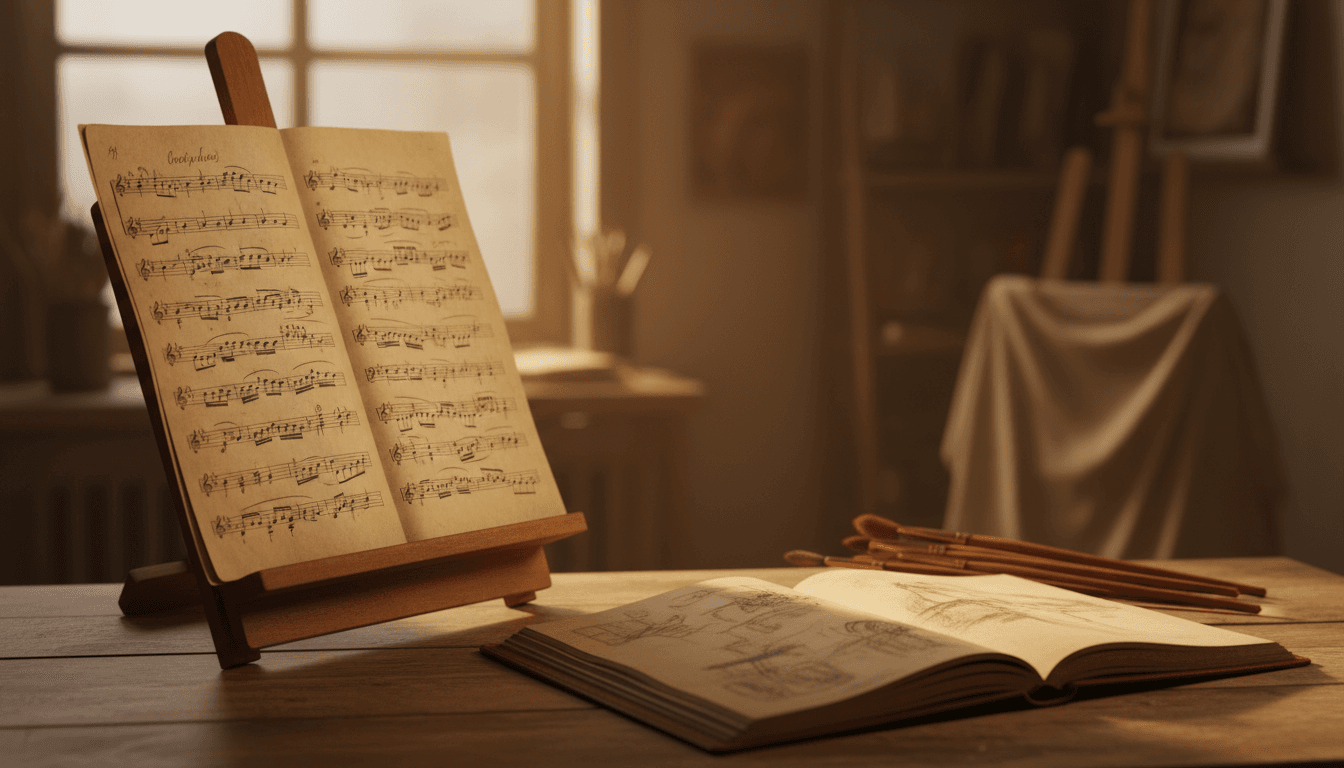
A painter can learn more from a composer than from another painter. That's a strange claim for a visual medium to need help from an entirely different sense, but music has spent centuries formalising exactly the problems — pacing, tension, repetition, silence — that visual art tends to solve by instinct or not at all.
The obvious objection
Comparing painting to music sounds like borrowed prestige rather than a real transfer of skill — the kind of thing said in an artist's statement to sound serious rather than because it teaches anything concrete. A painting isn't heard over time the way a symphony is; it can be taken in from any angle at any pace, which seems to make the whole comparison a metaphor rather than a method.
The evidence: one very real, very documented case
This isn't hypothetical. On 2 January 1911, the painter Wassily Kandinsky attended a concert of Arnold Schoenberg's music in Munich and was electrified by what he heard — atonal composition that abandoned the conventions of melody the way Kandinsky was trying to abandon representational form in painting. He wrote to Schoenberg almost immediately, praising what he called "the intrinsic life of the individual parts in your compositions" — precisely the quality he was chasing in his own canvases. The correspondence that followed shaped both men's work for years, and it's not incidental that Kandinsky titled entire series of his paintings Improvisation and Composition, musical terms borrowed deliberately because painting, in his view, needed exactly what music already had: a formal language for organising something across time and structure, not just across a flat surface.
What music actually solved first
Music is the art of organising time — it can't present everything at once, so it developed exacting tools for sequencing experience that visual art, left to a single glance, never had to develop on its own. A composer controls rhythm through duration and spacing; a visual artist controls the same thing through the path a viewer's eye or body takes, and through how information is spaced along it. Music builds tension and releases it, sometimes withholding resolution specifically to make it land harder; a strong diagonal or an unbalanced composition does the same job visually, and it only works if the tension was genuinely built rather than present everywhere at once. Music develops a motif through repetition and variation — stated, transposed, returned to — and a visual artist working in series faces the identical problem, the same discipline behind Monet returning to the same haystack under different light rather than painting it once and moving on: a shape repeated without change becomes wallpaper, and a shape repeated with just enough change stays alive. And music treats silence as structural rather than empty, a held rest doing more work than another note would; visual art has the same tool sitting right there in negative space, chronically underused because empty area reads, to an untrained eye, as a failure to finish rather than a decision.
Advertisement
The counter-consideration: doesn't this risk decoration rather than structure?
A fair worry: pasting musical vocabulary onto a painting — calling a passage a "crescendo," a shape a "motif" — risks becoming decoration rather than an actual borrowed tool. The real transfer isn't vocabulary, it's the underlying questions a composer is trained to ask that a painter usually isn't: what's the through-line a viewer should follow, where does the pacing speed up or rest, what's the central motif and how does it transform, where is the held breath before release. Kandinsky didn't paint music. He borrowed the compositional discipline behind it, which is the difference between quoting an art form and actually learning from it.
The verdict
Music wins the argument not because it's a superior art form but because it was forced, by its own nature, to solve problems visual art can quietly avoid solving at all — a painting can get away with no rhythm, no release, no silence, and still hang on a wall. A painting that borrows those disciplines anyway, deliberately, tends to hold attention the way Kandinsky's did once he stopped painting what he saw and started composing, in the fullest sense of the word, what he heard.