Did Ancient Greece's Most Famous Painting Contest Actually Happen?
The foundational legend of illusionistic painting comes from one source, written 400 years after it supposedly happened, describing two painters whose actual work has never survived to check the story against.
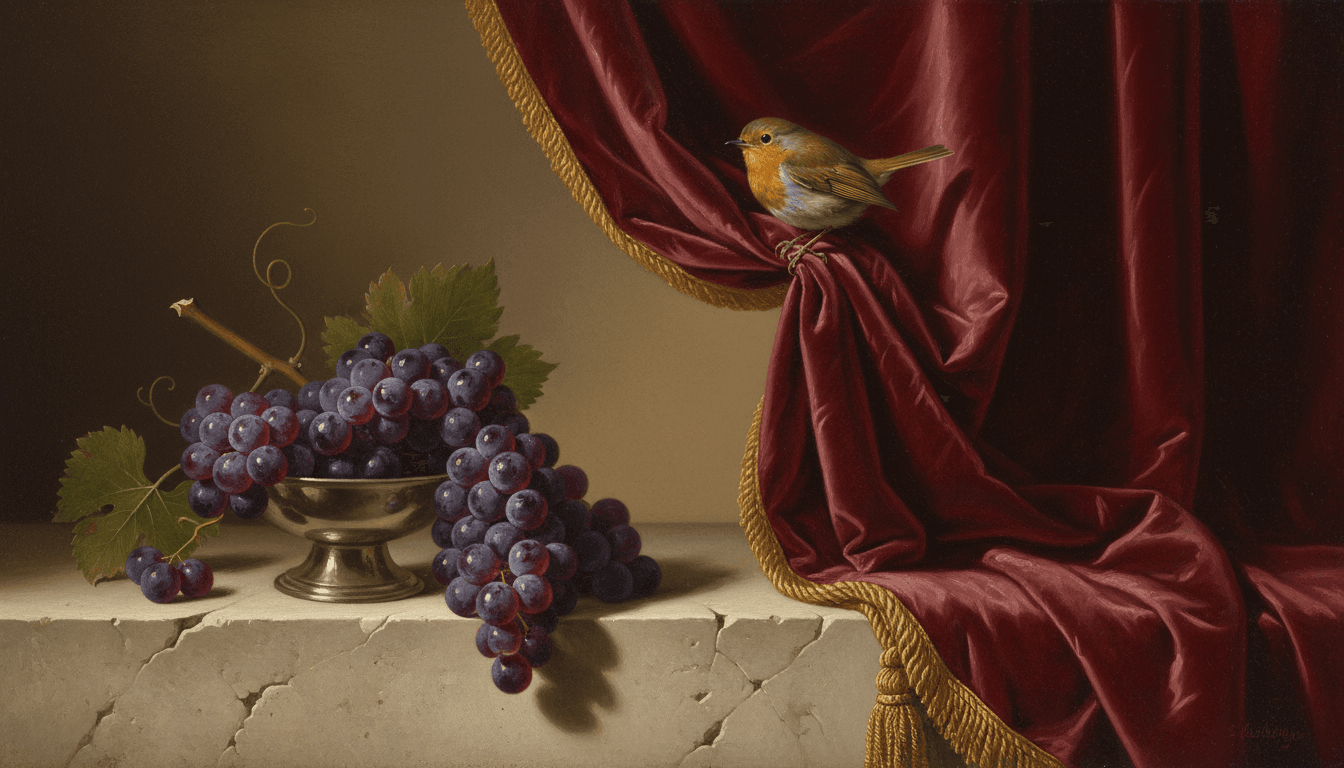
Did a painting contest in ancient Greece really get decided when one artist's painted grapes fooled actual birds, only for him to lose to a rival whose painted curtain fooled the judge himself? The story of Zeuxis and Parrhasius has been repeated as historical fact in art theory for roughly two thousand years. There's a real problem with treating it that way: the only source for it was writing four centuries after it supposedly happened, and neither artist has a single surviving painting to check the story against.
The claim
According to the Roman writer Pliny the Elder, writing in his Natural History around 77 CE, the Greek painters Zeuxis and Parrhasius staged a contest to settle which of them was the greater artist. Zeuxis unveiled a painting of grapes so convincing that birds flew down and tried to peck at it. Confident he'd won, Zeuxis asked Parrhasius to draw back the curtain covering his rival's entry — only to discover the curtain itself was the painting. Zeuxis conceded, reportedly saying he had deceived only birds, while Parrhasius had deceived a fellow artist. The anecdote became the founding legend of illusionistic painting, cited constantly in art theory well into the eighteenth and nineteenth centuries as proof of how far pictorial realism could go.
The evidence complicating it
Zeuxis and Parrhasius were real, documented painters, active in the fifth and fourth centuries BCE — but Pliny was writing roughly four hundred years after they lived, with no earlier surviving source recording this specific contest. None of either artist's actual paintings survive in any form, on panel or wall, which means there's no physical evidence to weigh against the story either way — nothing to confirm it, and nothing to definitively rule it out. Pliny's Natural History is also known to mix genuinely useful historical record with clearly moralising, story-like anecdotes about artists throughout its account of ancient painting, and classical historians generally treat many of these artist anecdotes as instructive parables rather than reliable reportage — entertaining, memorable, and probably at least partly invented or embellished in the retelling across four centuries of oral and written transmission.
What the story was actually doing, true or not
Whether or not the contest happened as described, the anecdote reveals something real about what ancient Greek art theory valued most: mimesis, the successful imitation of nature, treated as painting's highest achievement — centuries before anyone had a systematic geometry for constructing that illusion rather than relying on an individual painter's eye. The story's own internal logic makes this explicit — fooling animals is impressive, but fooling a trained fellow painter, someone who should know better than anyone what a real curtain looks like versus a painted one, is presented as the greater feat. That hierarchy of deception, animal fooled versus expert fooled, is itself a piece of ancient art criticism dressed up as a memorable anecdote, regardless of whether either brushstroke it describes ever actually existed.
Advertisement
Where the investigation stands
The contest almost certainly can't be verified as literal historical fact, and most classical scholars treat it as embellished at best, invented outright at worst — a teaching story built around two real painters' reputations rather than an eyewitness account. What's not in doubt is its afterlife: the anecdote shaped Western art theory for two thousand years, inspired centuries of later painters to create literal homages — trompe l'oeil paintings of grapes, curtains, and painted illusions referencing the story directly, in the same spirit (if not the same method) as a Northern Renaissance painter building a deception that only resolves from one specific angle — and gave an entire genre of art its working definition of success: does the illusion hold up against the sharpest, most sceptical eye available. Whether the birds were real is almost beside the point. The standard the story set was.