Chiaroscuro to Tenebrism: Why Caravaggio's Paintings Are So Dark
Caravaggio's spotlight-and-void look started as a drawing technique on tinted paper. It took two centuries, and one painter's extremism, to become the style we now call tenebrism — and its final descendant is film noir lighting.
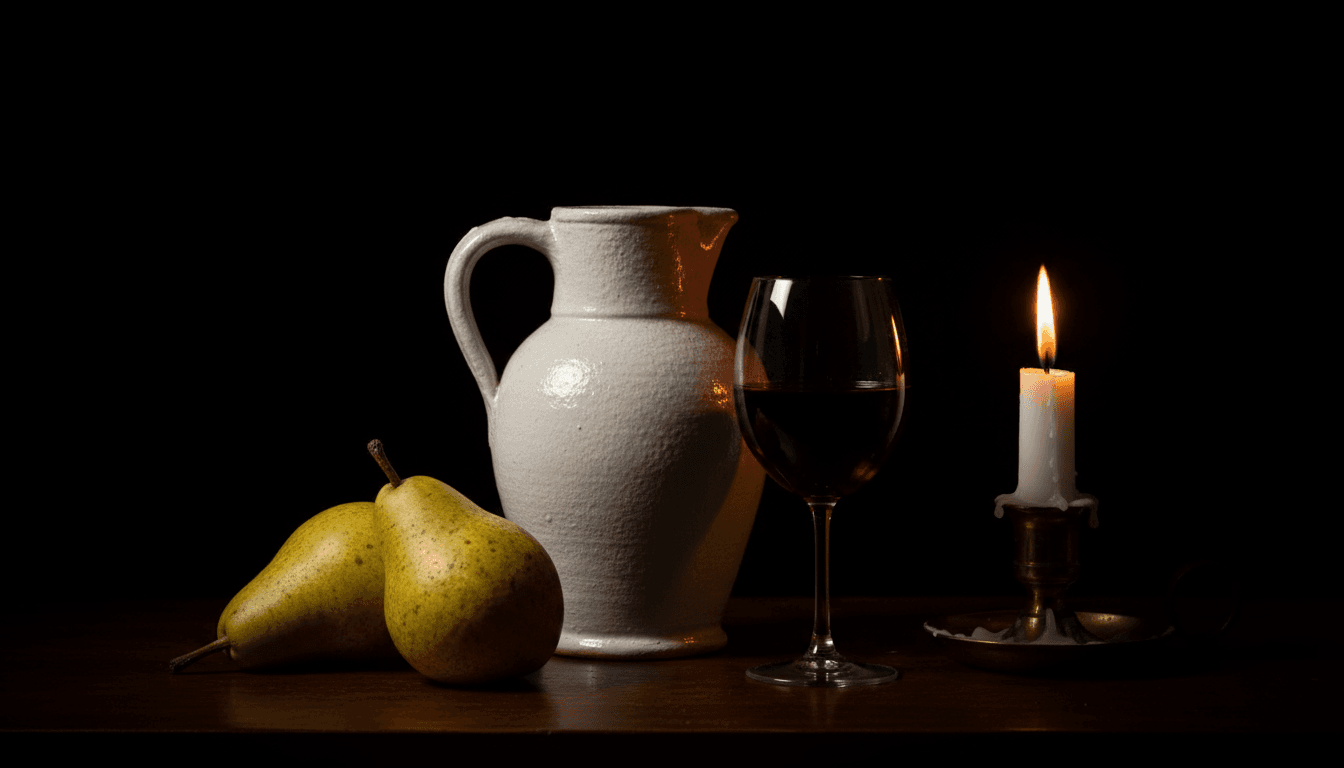
A figure emerges from total blackness, lit as if by a single unseen candle just out of frame — every other inch of the canvas swallowed in shadow so complete it reads as void rather than room. That effect, instantly recognisable as "a Caravaggio," didn't start as a painting technique at all. It began as a way of drawing on coloured paper, and it took nearly two centuries to grow into the spotlight.
Birth: ink and white gouache on tinted paper
Chiaroscuro — from the Italian chiaro, light, and scuro, dark — took shape during the Renaissance not on canvas but on paper, in drawings where the artist worked from the sheet's own mid-toned colour, adding white gouache toward the light and ink or dark wash toward the shadow. The technique had a real ancestor: late Roman manuscripts written on purple-dyed vellum, where scribes had long worked light and dark values into a coloured ground rather than a blank white one. Chiaroscuro drawing simply brought that manuscript habit into the artist's studio as a formal method.
Growing into painting: one tool among four
By the fifteenth and sixteenth centuries, chiaroscuro had migrated from paper into full painting, where it became one of four canonical Renaissance modes for handling colour and form, alongside cangiante (shifting hue to suggest shadow), sfumato (Leonardo's smoky, edgeless blending), and unione (soft transitions that keep colours bright). Used this way, chiaroscuro modelled a figure's volume through gradual, naturalistic light and shadow — depth and roundness, not drama for its own sake. The background stayed visible. The technique served the whole composition rather than overwhelming it.
Adulthood: one painter takes it to an extreme
That changed with Michelangelo Merisi da Caravaggio, active in Rome from the early 1590s until he fled the city in 1606. Caravaggio didn't invent chiaroscuro — he radicalised it, plunging entire backgrounds into near-total blackness and reserving light for a narrow, almost theatrical beam across his subject, treating the dark itself as a deliberate material choice rather than simply an absence to be avoided. His two Saint Matthew canvases for the church of San Luigi dei Francesi, unveiled in 1600, made his name, and art historians later gave the extreme version its own label: tenebrism, from the Italian tenebroso, dark or gloomy. The distinction from ordinary chiaroscuro is precise — chiaroscuro models form with a visible, integrated background; tenebrism erases the background almost entirely and turns light into a spotlight rather than a modelling tool.
Advertisement
Why are Caravaggio's paintings so dark?
Because he built the darkness into every stage of making them. He posed his models in a closed, darkened room lit by a single source high above — his biographer Giovanni Pietro Bellori described figures kept out of daylight in a dark brown atmosphere, under "a high light that descended vertically" — and a contemporary, Giulio Mancini, likened the effect to a room with one window and walls painted black. He worked straight onto canvases prepared with dark grounds, often letting that ground stand as shadow or outline, and instead of making drawings he scratched guide lines into the wet preparation with a sharp point; no drawings by him are known to survive. The darkness also had a purpose: in The Calling of Saint Matthew a shaft of light crosses a gloomy room toward the tax collector, so revelation arrives literally as light breaking into darkness. Rivals sneered that he couldn't paint his way out of the cellar. Time has deepened the effect: oil paint grows more transparent as it ages, so those dark grounds show through more than they did when the paint was fresh.
Chiaroscuro vs. tenebrism vs. sfumato
| Chiaroscuro | Tenebrism | Sfumato | |
|---|---|---|---|
| What it is | Modelling form with graded light and shade | Extreme chiaroscuro: a spotlit subject against near-black | Smoky blending with no hard lines or edges |
| Background | Visible and integrated | Swallowed in darkness | Soft, hazy, atmospheric |
| Edges | Soft or firm, as the form needs | Abrupt turns from light into void | Dissolved, as if in smoke (fumo) |
| Main era | Renaissance onward | Roughly 1600 to the mid-1600s | Around 1500 |
| Key names | Leonardo, Titian, Rembrandt | Caravaggio, Ribera, Zurbarán, Artemisia Gentileschi | Leonardo da Vinci |
| Famous example | Rembrandt's self-portraits | Caravaggio's The Calling of Saint Matthew | Leonardo's Mona Lisa |
Why it works on the eye
Chiaroscuro's modelling power rests on a basic fact about how the visual system reads form: the brain infers a surface's three-dimensional shape largely from how light and shadow fall across it, assuming a single, consistent light source — usually from above — unless told otherwise. A gradual gradient from light to dark reads as a curved or rounded surface; a hard, sudden edge between them reads as a sharp turn or an actual boundary. Tenebrism exploits the same mechanism at its most extreme setting — remove every visual cue except one tightly lit figure, and the eye has nothing left to do but stare exactly where the painter wants it to.
Spreading: Naples, Spain, and the low countries
Tenebrism travelled fast, following the same trade and patronage routes that carried Caravaggio's reputation. In Spanish-ruled Naples, Jusepe de Ribera adopted the style directly; in Spain itself, it shaped painters like Francisco de Zurbarán, sometimes nicknamed the "Spanish Caravaggio" for it. Artemisia Gentileschi, whose father Orazio was a friend of Caravaggio's in Rome, became one of the style's most accomplished practitioners. Painters from Utrecht such as Gerrit van Honthorst and Hendrick ter Brugghen carried it north after time in Rome, and Peter Paul Rubens absorbed both Caravaggio's dramatic contrast and the quieter night-scene lighting of the German-born painter Adam Elsheimer, deploying both across large-scale narrative canvases. Rembrandt, working in Amsterdam a generation later, pulled tenebrism inward into something more intimate — interiors lit by a single candle or lamp, the drama turned domestic rather than theatrical.
Where it stands now
Tenebrism as a dominant style didn't last much past the Baroque period, but chiaroscuro itself never left — it kept quietly modelling form in painting through Neoclassicism and Romanticism and, two centuries later, into the Impressionists' own very different, much brighter argument about how light actually behaves. Its most direct modern descendant isn't in a museum at all: cinema lighting, particularly the high-contrast, single-source setups of film noir, borrows the exact visual logic Caravaggio worked out on canvas four centuries earlier — light as a tool that reveals a subject by deciding, deliberately, what to leave in the dark.
FAQ
Why are Caravaggio's paintings so dark?
He posed his models in a darkened room under a single high light, painted onto dark grounds that he often left showing as shadow, and used darkness dramatically, so light reads as revelation. Ageing has deepened the effect, because oil paint becomes more transparent over time and lets the dark grounds show through.
What is the difference between chiaroscuro and tenebrism?
Chiaroscuro is any use of graded light and shade to model form, with the background still visible. Tenebrism is its extreme: the background drops into near-black and a single spotlight picks out the figures. Caravaggio is the painter most associated with it.
What is sfumato?
Leonardo da Vinci's technique of blending tones so softly that there are no visible lines or edges, from the Italian fumo, smoke. The Mona Lisa is the classic example. Where tenebrism sharpens the contrast between light and dark, sfumato melts it.
Who were the Caravaggisti?
The painters who took up Caravaggio's tenebrism in the early 1600s, including Orazio and Artemisia Gentileschi in Rome, Jusepe de Ribera in Naples, and Gerrit van Honthorst and Hendrick ter Brugghen, who carried the style back to Utrecht.
Did Caravaggio make preparatory drawings?
No drawings by him are known to survive. He seems to have painted directly from posed models, scratching guide lines into the wet ground with a sharp point instead of drawing the composition out first.