Bronze Casting: From Wax to Patina
Bronze casting is a process of destruction and replacement: the wax model is lost so the metal can take its place. The colour comes last, from chemistry.
Maybe you've just inherited a garden bronze that's gone a mottled green-black and you want to know if that's damage or design. Maybe you're a sculptor about to hand a plaster model to a foundry for the first time and you have no idea what happens to it next, or what you're actually paying for. Either way, the process is the same eight-step chain, and understanding it tells you what you're looking at and what you're buying.
The process, step by step
- Make the model. The sculptor works in clay, plaster, or wax, and this original is the only stage where the artist's hand touches the final form directly. Everything downstream is a copy of a copy.
- Take a mould. A flexible mould — usually silicone rubber, supported by a rigid outer "mother mould" to hold its shape — is built around the model. This mould is the sculpture's memory: it can be reused, but the model itself is often damaged or destroyed removing it.
- Cast the wax. Molten wax is poured or painted into the mould in layers, then pulled and cleaned up. This is your last chance to touch the piece before it becomes metal — a sculptor can still add or carve detail into the wax copy.
- Build the investment. The wax copy is coated, layer by layer, in a ceramic slurry that hardens into a shell. It has to be strong enough to survive a metal pour and porous enough to let trapped air and gas escape.
- Burn it out. The whole assembly goes into a kiln. The wax melts and runs out — this is the "lost wax" the process is named for — leaving a precise hollow void in the exact shape of the sculpture, and there is no going back from here.
- Pour the bronze. Molten metal, heated to around 1,100°C (2,000°F), is poured into the void. When it cools, the ceramic shell is broken away to reveal a raw, unfinished casting.
- Chase it. Large works are cast in sections and welded together, because a single pour of a big piece is impractical. Chasing is the slow, skilled work of grinding, filing, and re-texturing the surface to hide every weld and casting flaw — the difference between a bronze that looks cast in one piece and one that visibly shows its seams.
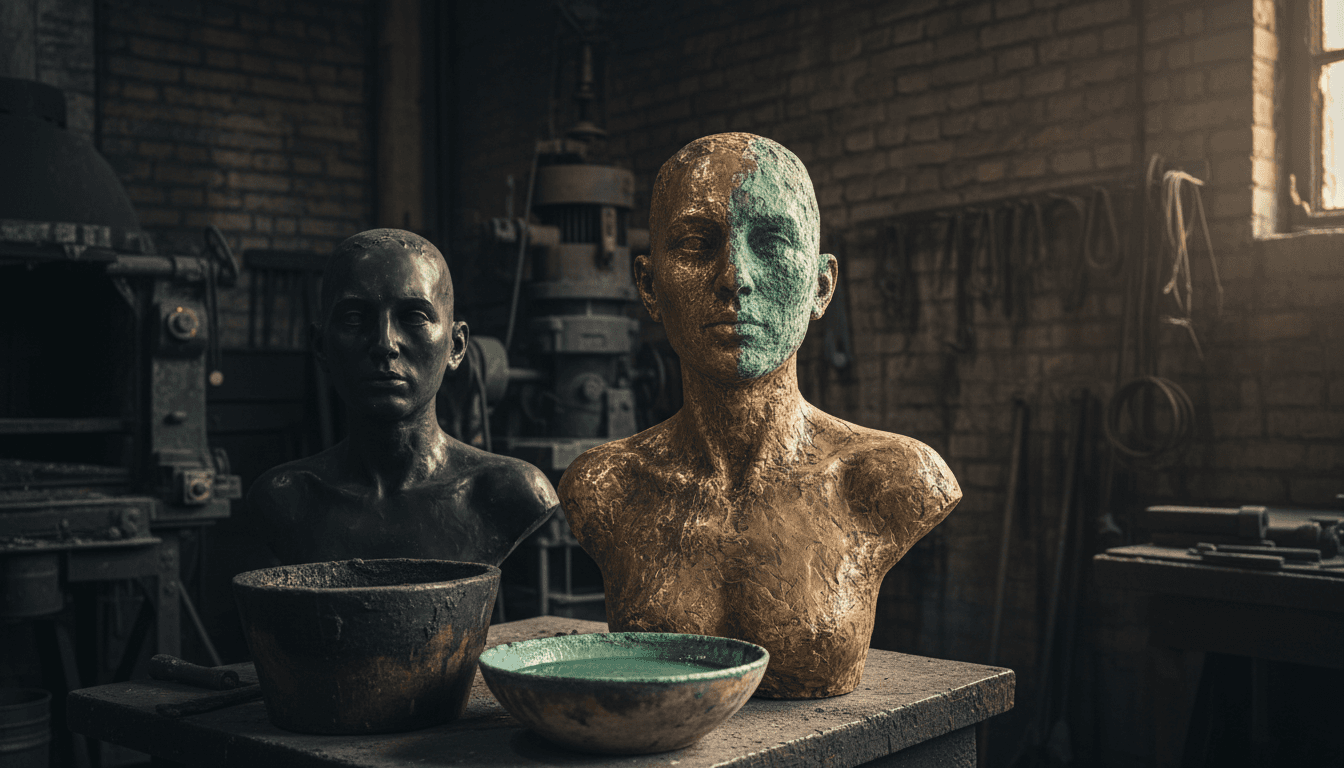
- Apply the patina. Only now does the sculpture get its final colour, and it is not the colour of the metal.
Advertisement
Why step 8 surprises people
Fresh, unpatinated bronze is a warm golden-brown, closer to a new penny than to anything you'd call "bronze-coloured" in the everyday sense. The green, black, or brown surfaces on the sculptures you actually see are a patina — a surface layer produced on purpose, with chemicals and heat, after the casting and chasing are finished. It is both decorative and protective, and it's the step where a foundry's individual skill shows most clearly: two castings from the identical mould can come out looking completely different depending on how the patina was applied.
Choosing a colour
| If you want... | The chemistry usually involves... |
|---|---|
| Brown or black tones | Sulfide-based solutions |
| Green tones | Chloride or ammonia-based compounds |
| A range of warm, varied tones | Nitrate-based solutions, often combined with heat |
Bronze isn't one metal — check the alloy
Before any of the above happens, "bronze" itself is a choice. A typical art-bronze alloy runs roughly 85–90% copper to 5–10% tin, with small additions of other metals, and different founders guard their own recipes. The alloy affects more than casting behaviour — copper is the element that reacts to form the patina, so the specific mix your foundry uses is quietly shaping what colours will even be possible at step 8.
Choosing a casting method
- Lost-wax (described above) captures fine detail with total fidelity, because the wax exactly replicates the model's surface. It's slow and labour-intensive, which is why bronze sculpture is expensive.
- Sand casting uses a mould of compressed sand around a pattern instead of an investment shell. It's faster and cheaper, but it captures less detail and generally needs more finishing — a reasonable trade for simpler forms or larger editions, evaluated by the same edition-size and provenance questions that decide the value of an artist's proof in printmaking.
- Ceramic shell is the modern refinement of lost-wax: thinner, stronger layers of ceramic slurry and refractory sand replace a traditional investment, allowing bigger, more precise pieces. This is now the standard for fine-art bronze, combining lost-wax's fidelity with the strength to go large.
Living with a bronze: basic care
- Keep it clean and dry. Regular washing removes pollutants and salts before they can start a chemical reaction on the surface.
- Wax it. A protective wax coating slows the patina's ongoing reaction with the air — remember, the colour is chemistry that never fully stops.
- Know your environment. A bronze near the coast, or somewhere de-iced with salt in winter, needs far more frequent attention than one in a dry inland setting, and how long it ultimately lasts depends more on that environment than on the metal itself.
- Inspect it periodically, especially anything kept outdoors — which brings us to the one problem that's genuinely urgent.
The one thing to catch early: bronze disease
If you see a powdery, light-green bloom breaking out on a bronze — different from the smooth, stable patina everywhere else — that's worth acting on quickly. It's called bronze disease: a self-sustaining corrosion driven by chlorides, which reacts to produce hydrochloric acid that attacks fresh metal and generates more chloride in turn, in a cycle that doesn't stop on its own. Left alone, it will keep eating into the piece. Caught early, a conservator can remove the chlorides and stabilise the surface; caught late, treatment gets difficult and expensive fast. This is the one bronze problem that genuinely rewards urgency over patience.
FAQ
How long does a bronze casting actually take, start to finish?
For a fine-art lost-wax piece, weeks to a few months is typical once you include mould-making, wax casting, investment, burnout, the pour, and chasing — patina application is usually the fastest single step.
Is my bronze solid metal all the way through?
Almost never for anything larger than a small figurine — sculptures are cast hollow to save weight and metal cost, with an internal wall thickness the foundry engineers for strength.
Can a faded or damaged patina be fixed?
Often, yes — a founder or conservator can strip and reapply a patina, though outdoor pieces will start weathering again immediately, which is why a maintenance wax coating matters more than a one-time fix.
Why are so many contested public monuments made of bronze?
Simply because it's the material of choice for durable public sculpture — its longevity, which is a virtue in most contexts, is exactly what puts century-old bronzes at the centre of present-day debates about which monuments should still stand.
Is an edition of bronzes less valuable than a one-off?
Not necessarily — value depends more on edition size, documented provenance, and whether it was cast during the artist's lifetime than on the mere fact of being a multiple, the same way it does for fine-art prints.