What Is a Large-Scale Sculpture?
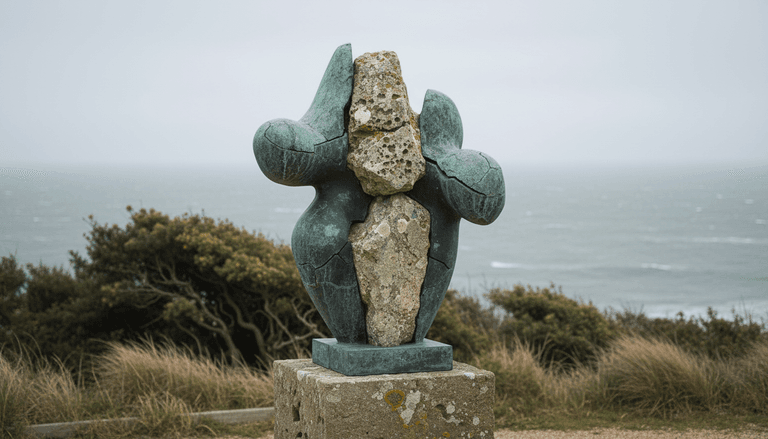
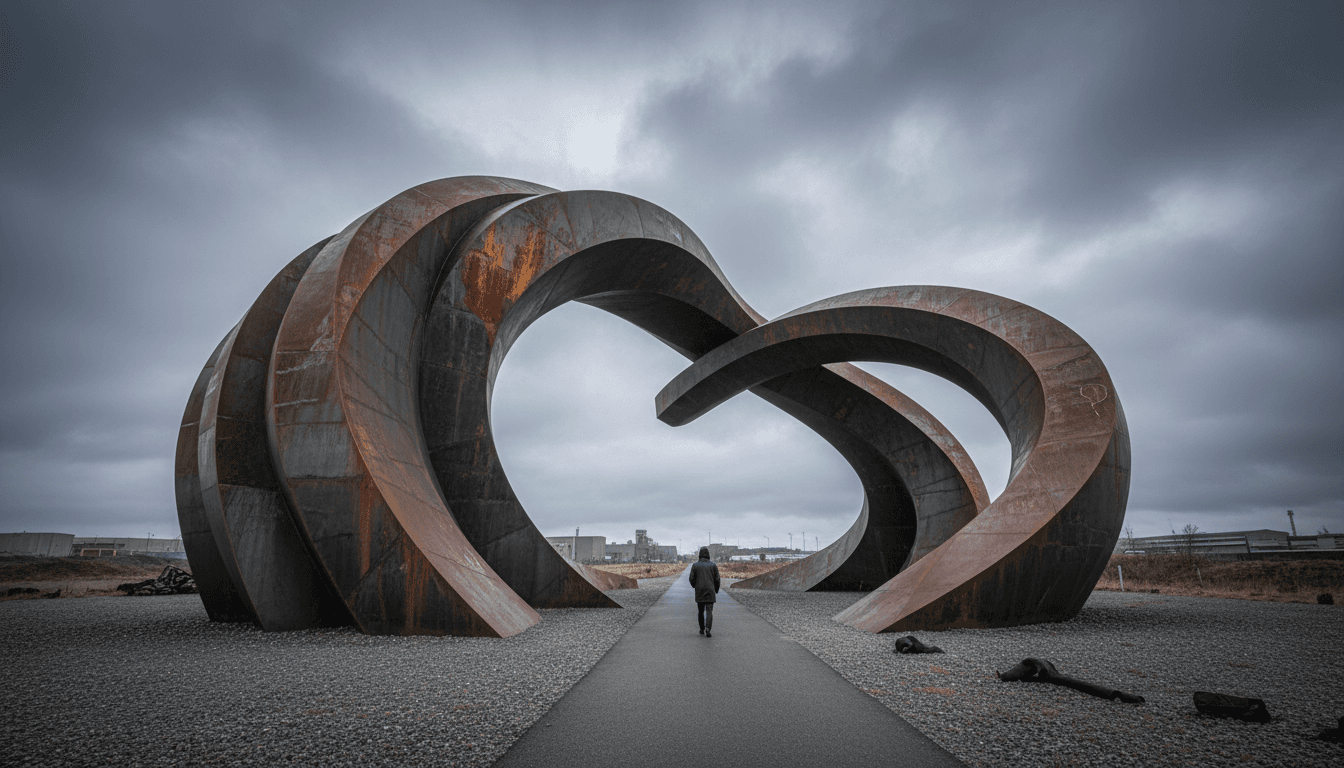
Large-scale sculpture is not sculpture made bigger. Past a few metres, wind, gravity, and viewing distance take over, and the work becomes an environment you move through.
In 280 BCE, a bronze figure of the sun god Helios rose above the harbour at Rhodes, roughly the height of the Statue of Liberty and, by every account, awe-inspiring enough to be counted among the wonders of the ancient world. It stood for barely fifty years before an earthquake brought it down, and it survives today only in legend — and in the word its own name gave the language: colossal. Large-scale sculpture has been chasing that same ambition, and running into the same physical limits, ever since.
1886: sculpture as a system
The Statue of Liberty, dedicated in New York Harbor in 1886, is where large-scale sculpture stopped being a single craft and became a collaboration between disciplines — a figure many times beyond life-size, built accordingly. The sculptor Frédéric Auguste Bartholdi designed the figure; the engineer Gustave Eiffel, a decade before his tower, designed the iron armature that holds the statue's paper-thin copper skin in place and lets it move with wind and heat rather than fighting them. The lesson embedded in the statue's structure — the skin doesn't support itself, the frame does the work invisibly — became the template for large-scale work for the next century. It was also a warning nobody heeded for a hundred years: when the iron armature corroded through the twentieth century, how long the sculpture would actually last suddenly wasn't theoretical, and its 1980s restoration was as much structural surgery as art conservation.
1927–1941: sculpture by subtraction
Mount Rushmore inverted the whole logic. Rather than assembling a form, the sculptor Gutzon Borglum spent fourteen years directing the removal of roughly 450,000 tons of granite to reveal four faces, each about 18 metres high, blasted and carved directly from a mountain. It is large-scale sculpture as civil engineering — the site itself was the material, and the question of whether the result justifies the scale of the transformation is still argued today, which is arguably the point of building something at a scale nobody can look away from.
1970: scale measured in geography, not metres
Robert Smithson's Spiral Jetty, built into Utah's Great Salt Lake in 1970, took large-scale sculpture somewhere neither Rhodes nor Rushmore had gone: a 460-metre spiral of basalt and earth whose size is geographic rather than architectural, and whose appearance changes with the lake's water level — sometimes submerged, sometimes exposed, its rock coated in shifting salt crystals. The work proved that "large-scale" doesn't require a plinth, a plaza, or even permanent visibility. It only requires a site big enough to hold the idea.
Advertisement
1998: designed to be seen at speed
Antony Gormley's Angel of the North, standing beside a motorway near Gateshead since 1998, is roughly 20 metres tall with a 54-metre wingspan — and it was designed for exactly one viewing condition: glimpsed from a moving car, at a distance, by people who are not looking for art. As an outdoor sculpture, its weathering-steel surface needs no maintenance, and its simplified, wing-spread silhouette carries the whole composition, because at speed and distance, detail was always going to be invisible. It has since become the region's own visual shorthand — printed on road signs, treated less as an artwork than as a place.
2006: when the surface becomes the structure
Anish Kapoor's Cloud Gate in Chicago, shown unfinished at Millennium Park's opening in 2004 and formally dedicated in 2006, looks like one seamless, impossibly polished blob of liquid metal, about 20 metres long. It is 168 separate stainless-steel plates, welded together and then ground and polished for years until the seams disappeared entirely — engineering that had to manage the thermal expansion of a shell weighing about 100 tonnes (110 US tons), wind load on a smooth curved surface, and the fact that any flaw in the polish would be magnified by the reflection itself. At this scale, the finish isn't decoration on top of the structure. It is the structure, because the viewer's eye has nothing else to read.
Where large-scale sculpture stands now
The economics have shifted the art as much as the engineering has. A permanent large-scale commission is a long-term liability — cranes, transport, insurance, and maintenance recur every year the work stands — so an enormous share of contemporary large-scale sculpture is now built deliberately temporary, for festivals and biennales, made from materials (foam, fabric, inflatables) that would never survive a decade but don't need to survive one. That's not a lesser version of the Colossus of Rhodes; it's a different medium entirely, one that pays its considerable costs once instead of annually — while the permanent tradition, from Eiffel's iron frame to Kapoor's welded plates, keeps solving the same problem the Colossus never got the chance to: how to make something built to overwhelm also built to last.