Can Art Have Multiple Meanings? Symbolic, Emotional and Conceptual Layers Explained
Yes — and the layers don't just sit side by side, they often disagree. How art historians separate what a picture shows from what it symbolizes, what it makes you feel and what idea it tests.
Yes. A single work of art carries several layers of content at once — what it literally shows, what its symbols stand for, what it makes you feel and what idea it puts to the test — and those layers don't have to agree with each other. The common assumption is that a painting has a meaning, hidden like an answer at the back of a textbook, and that interpretation is the business of finding it. In practice, most serious art is built to mean several things at once, and some of it is built so that its meanings pull against each other.
At a glance
| Layer | The question it asks | Evidence you use | Example |
|---|---|---|---|
| Literal (subject matter) | What is shown? | Your eyes and a careful description | A couple, a dog and a mirror in the Arnolfini Portrait |
| Formal | How is it made? | Composition, color, scale, technique | The black, white and gray of Guernica |
| Symbolic | What do its signs stand for? | The conventions of the period | The skull in a vanitas still life |
| Emotional | What does it make you feel? | Your response and the artist's handling | The anguish of Guernica |
| Conceptual | What idea does it test? | The artist's choices and how it is shown | Duchamp's Fountain, 1917 |
| Contextual | Who made it, for whom, and why? | Documents, patrons, history | Whether the Arnolfini Portrait records a marriage or a loss |
The layers aren't a ranking. They're different questions you can ask of the same object, and each has its own kind of evidence.
Panofsky's hat
The clearest map of these layers came from the art historian Erwin Panofsky, in the introduction to Studies in Iconology in 1939. He started not with a painting but with a street. An acquaintance passes you and lifts his hat. At the first level, you simply see a shape change — a man, a hat, a movement. At the second, you recognize a convention: in his culture, lifting a hat is a greeting. At the third, the gesture tells you something about the man and his world — his manners, his class, the period that shaped him.
Panofsky called these primary or natural subject matter, secondary or conventional subject matter, and intrinsic meaning or content. In a painting, the first is what anyone with eyes can describe; the second needs knowledge of the conventions — that a woman with a wheel is Saint Catherine, that a skull means mortality; the third is what the whole work reveals about the culture that produced it. Each level depends on the one below it, and each needs different expertise.
One painting, four layers: the Arnolfini Portrait
Jan van Eyck's double portrait in London's National Gallery, signed on the back wall Johannes de eyck fuit hic 1434 — "Jan van Eyck was here, 1434" — shows how the layers stack.
Literal. A man and a woman stand in a well-furnished room. He raises one hand; she rests her hand in his. There's a small dog, a pair of discarded shoes, oranges on the windowsill, a convex mirror on the back wall.
Symbolic. Almost every object has been read as a sign. A single candle burns in the chandelier in daylight. The dog has been read as fidelity; the oranges, expensive imports, as wealth; the mirror, which reflects two more figures in the doorway, as a witness to the scene.
Advertisement
Contextual and disputed. In 1934 Panofsky argued the picture was a kind of painted marriage certificate, with Van Eyck's inscription as the witness's signature. That reading dominated for decades and is now widely doubted. Later archival work found that Giovanni di Nicolao Arnolfini's first wife, Costanza Trenta, had died by 1433, which led some historians to propose that the painting is partly a memorial — the lone candle burning for someone no longer living.
Emotional. Whatever the documents say, the picture's mood is quiet, formal, almost ceremonial: two people holding still for the record.
The layers coexist. You can feel the stillness without knowing the scholarship, and you can doubt Panofsky's marriage theory while still recognizing the symbols. What you can't do is collapse them into one answer.
When the layers disagree
Picasso's Guernica (1937) has the most obvious emotional layer in modern art: anguish, screaming figures, a mother holding a dead child, painted after the bombing of the Basque town. Its symbolic layer is the opposite of obvious. Critics have spent decades decoding the bull and the horse — Spain, fascism, the people, brutality. Picasso refused to settle it. Asked about the symbols in 1945, he insisted the bull was a bull and the horse a horse, and said that if viewers found meanings in them, those meanings might be true, but they weren't his.
That's a genuine conflict between layers. The emotional content is unmistakable; the symbolic content is open, and the artist declined to close it. Neither cancels the other.
The opposite case is the Dutch vanitas still life, where the symbolic layer is so conventional that it can overpower the sensual one: the painter lavishes skill on glistening fruit and silver precisely to tell you that all of it decays. That tension is the subject of why vanitas paintings were never really about the fruit. And sometimes a layer is literally hidden, like the stretched skull across the floor of Holbein's Ambassadors, readable only from one angle — see the "mistake" in a 1533 painting that wasn't a mistake.
When the idea is the content
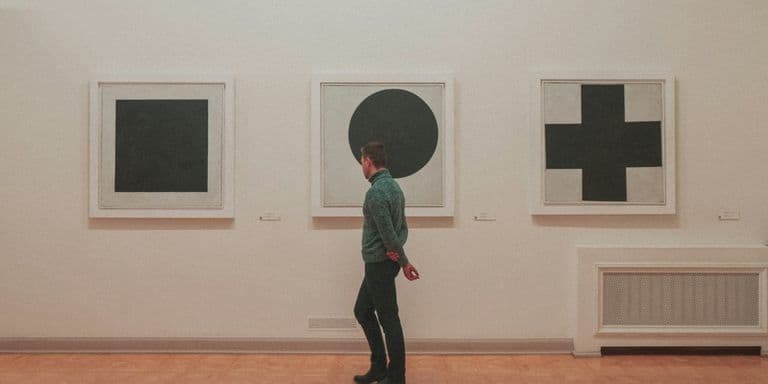
Conceptual art moves the weight of meaning to the top layer almost entirely. In 1917 Marcel Duchamp submitted a porcelain urinal, signed "R. Mutt", to the Society of Independent Artists in New York under the title Fountain. Its literal layer is trivial — a plumbing fixture. Its symbolic layer is thin. Its content is a question: what makes something art — the object, the artist's choice, the gallery, the label?
Fifty years later Sol LeWitt put the principle in one sentence in Artforum: "The idea becomes a machine that makes the art." In work like this, asking what it shows gets you nowhere, and asking what it proposes gets you everything.
At the other extreme, Mark Rothko insisted his color fields weren't about color relationships at all but about basic human emotions, and claimed that people who wept in front of them were having the experience he'd had painting them. Whether or not you weep, the emotional layer is the one he meant you to enter by; how large color fields create an emotional response looks at why that works.
Who decides what it means?
If a work has several layers, who gets the final word on them? Two influential arguments say: not the artist. In 1946 the critics W. K. Wimsatt and Monroe Beardsley called reliance on an author's intentions "the intentional fallacy" — the work, not the author's stated plan, is the evidence. In 1967 Roland Barthes went further in "The Death of the Author", arguing that meaning is made in the reader.
Art historians mostly take a middle path. The artist's intentions, the commission, the conventions of the period and the viewer's response are all evidence, weighted differently for different layers. Intention matters a great deal for the symbolic layer of a 15th-century altarpiece, where conventions were shared and documented. It matters much less for the emotional layer, which happens in you.
How to read the layers yourself
- Describe before you interpret. List what is literally there — figures, objects, colors, scale — before deciding what anything means.
- Check the conventions. Look up the symbols the period took for granted. A lily, a skull or an hourglass meant something specific to a 17th-century viewer.
- Notice your response, then question it. Your emotional reaction is real evidence about the work's emotional layer, and also about you.
- Ask what idea is being tested. Especially with modern and contemporary work, ask what question the artist is putting to you.
- Look for where the layers disagree. The most interesting meanings often live in the gap — gorgeous fruit that preaches decay, a horrifying scene painted with formal control.
For a fuller method, see how to develop visual literacy.
The bottom line
Art doesn't have one meaning waiting to be found. It has layers of content — literal, symbolic, emotional, conceptual and contextual — that can be read separately, that rest on different kinds of evidence, and that often contradict each other on purpose. If a quiz asks whether art can have multiple layers of content, the answer is true. The more useful lesson is that the layers are where the conversation about a work happens.
Advertisement
FAQ
Is it true that art can have multiple layers of content?
True. A single work can carry literal, formal, symbolic, emotional, conceptual and contextual content at the same time. Jan van Eyck's Arnolfini Portrait shows a couple in a room, fills that room with symbols, sets a quiet ceremonial mood and still provokes argument about whether it records a marriage or a loss.
What are the layers of meaning in art?
A useful set is literal (what is shown), formal (how it's made), symbolic (what its signs stand for), emotional (what it makes you feel), conceptual (what idea it tests) and contextual (who made it, for whom and why). Erwin Panofsky's classic version, from 1939, has three levels: natural subject matter, conventional subject matter and intrinsic meaning.
What's the difference between subject matter and content in art?
Subject matter is what a work depicts: a woman, a bowl of fruit, a bombed town. Content is what it communicates through that subject, including its symbols, mood and ideas. Two paintings of the same bowl of fruit can have very different content, as Dutch vanitas still lifes show.
Does the artist's intention decide what a work means?
Not on its own. The critics Wimsatt and Beardsley called reliance on intention "the intentional fallacy" in 1946, and Roland Barthes argued in 1967 that meaning is made by the reader. Most art historians treat intention as one strong piece of evidence among several — strongest for symbols in periods with shared conventions, weakest for your own emotional response.
How do I find the meaning of a painting?
Work up through the layers. Describe what is literally there, look up the symbols the period took for granted, notice your own response, ask what idea the work is testing, then look for where those layers disagree. See how to develop visual literacy for a fuller method.