The Paint That Oil Replaced
Egg yolk carried Western painting for a thousand years before oil paint existed. Its inability to blend forced painters to invent verdaccio underpainting — and it never actually disappeared.
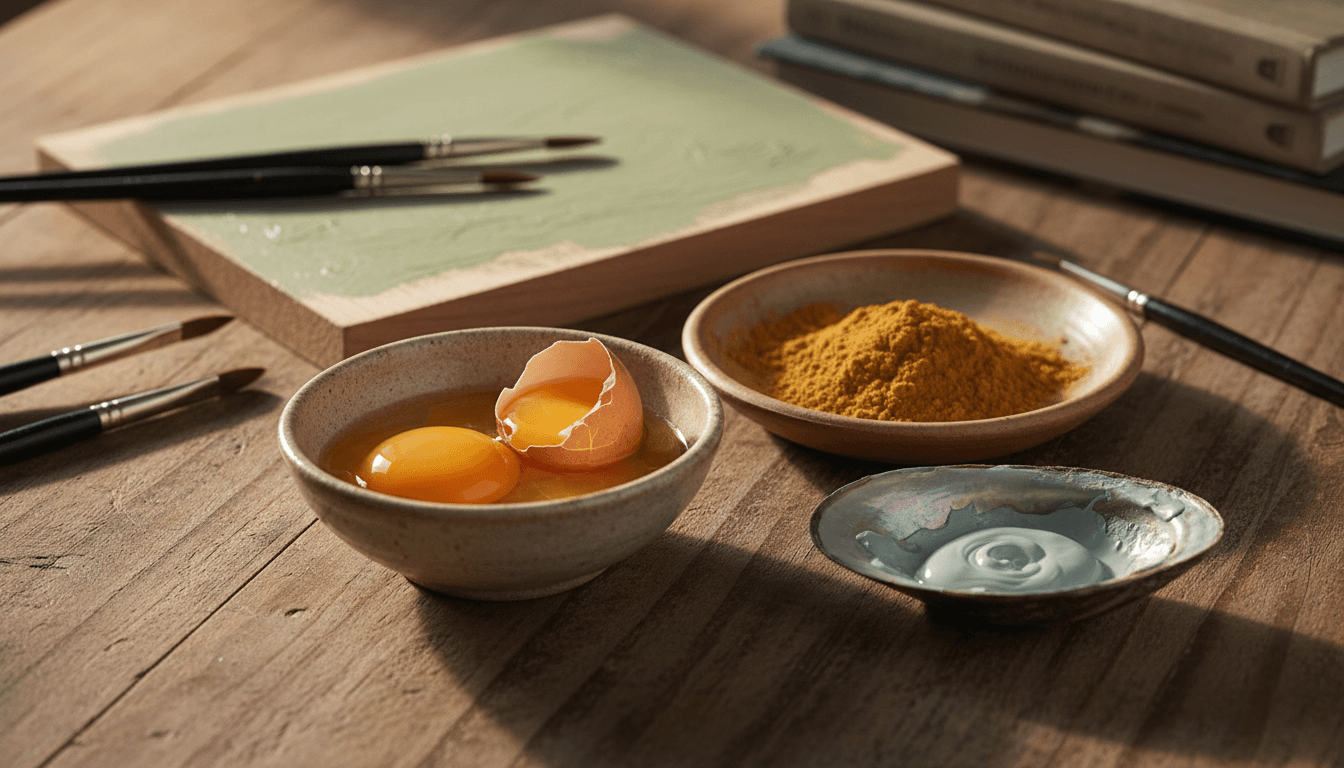
Crack an egg, separate the yolk, and you're holding the binder that carried Western painting for roughly a thousand years before oil ever touched a canvas. Mixed with ground pigment, egg yolk dries in minutes rather than days, forming a hard, matte film with a distinctive luminous glow — and unlike almost everything else in a painter's toolkit, its basic recipe hasn't changed since medieval workshops first wrote it down.
Birth: an accidental emulsion
Egg yolk works as a binder because it's a natural emulsion — it contains both water and fatty, oil-like compounds (chiefly lecithin) held together in one substance, which means it can carry pigment particles the way neither pure water nor pure oil manages on its own. As the water evaporates and the egg's proteins cross-link and set, the paint film hardens quickly into something durable and water-resistant, quite unlike the slow, months-long cure of an oil film. Painters didn't need to understand any of this chemistry to notice the practical result: tempera dries fast, and it dries for good.
Growing up: the medieval workshop standard
By the time the Italian painter Cennino Cennini wrote down his working methods around 1400 in Il Libro dell'Arte, egg tempera was already the established technique for panel painting across Byzantine icon workshops and Italian ateliers alike, applied over a chalk gesso ground in the fine, deliberate strokes the medium demands. Because tempera sets almost as soon as it touches the panel, blending it the way oil paint blends is essentially impossible — painters built up form instead through cross-hatching, layering thin strokes of slightly different tone over one another, the way a draftsman builds shading with a pencil rather than the way a painter smears colour with a brush.
Middle life: the medium that built the altarpiece
Duccio, Giotto, and generations of workshop painters after them built the entire visual language of early Italian panel painting inside tempera's constraints — the luminous, slightly stylised, sharply linear quality so recognisable in Trecento and early Quattrocento altarpieces isn't a stylistic choice made in spite of the medium. It's what tempera looks like when it's used well, fast-drying strokes accumulated with total control rather than blended into soft transitions.
A technique tempera made necessary: verdaccio
Because tempera can't be blended wet-into-wet, painters developed a specific workaround for rendering convincing flesh tones: an underpainting layer called verdaccio, a greenish-brown mix typically built from black, white, and a touch of yellow or red ochre, laid down first to establish the shadow structure of a face or body. Warmer, lighter tempera strokes were then cross-hatched on top, letting the cool green underlayer show through in the shadows and giving skin a subtly luminous, lifelike quality that a single flesh-coloured mixture couldn't achieve on its own. It's a solution born entirely out of tempera's constraint against blending — a technique that wouldn't need to exist in a medium that let colours mix freely on the surface.
Advertisement
Retirement: displaced, not defeated
Oil paint's slow cure gave painters something tempera structurally couldn't: time to blend, glaze, and rework a passage over hours or days rather than committing to it in seconds, a curing process that runs on entirely different chemistry from tempera's quick desiccation. By the turn of the sixteenth century, oil had displaced tempera as the default medium across most of Europe, and the shift is often — inaccurately — credited to a single inventor, when it was really oil's working properties, not its mere existence, that won painters over gradually across a couple of generations.
Where it stands now
Tempera never actually disappeared. The American painter Andrew Wyeth worked almost exclusively in egg tempera through the twentieth century, prizing exactly the qualities oil had displaced it for lacking: a matte, non-yellowing surface, and a hard, durable film that doesn't crack the way a thick oil passage eventually can. It survives today as a specialist's choice rather than a default — slower to learn, less forgiving to work in, and valued precisely because those constraints still produce an effect nothing else quite matches.