Melbourne's Laneway Art Isn't Vandalism — It's Policy
Hosier Lane is a genuine, deliberate exception to graffiti law. The lane right next to it, indistinguishable to the eye, isn't — and that gap reveals how patchwork the whole policy actually is.
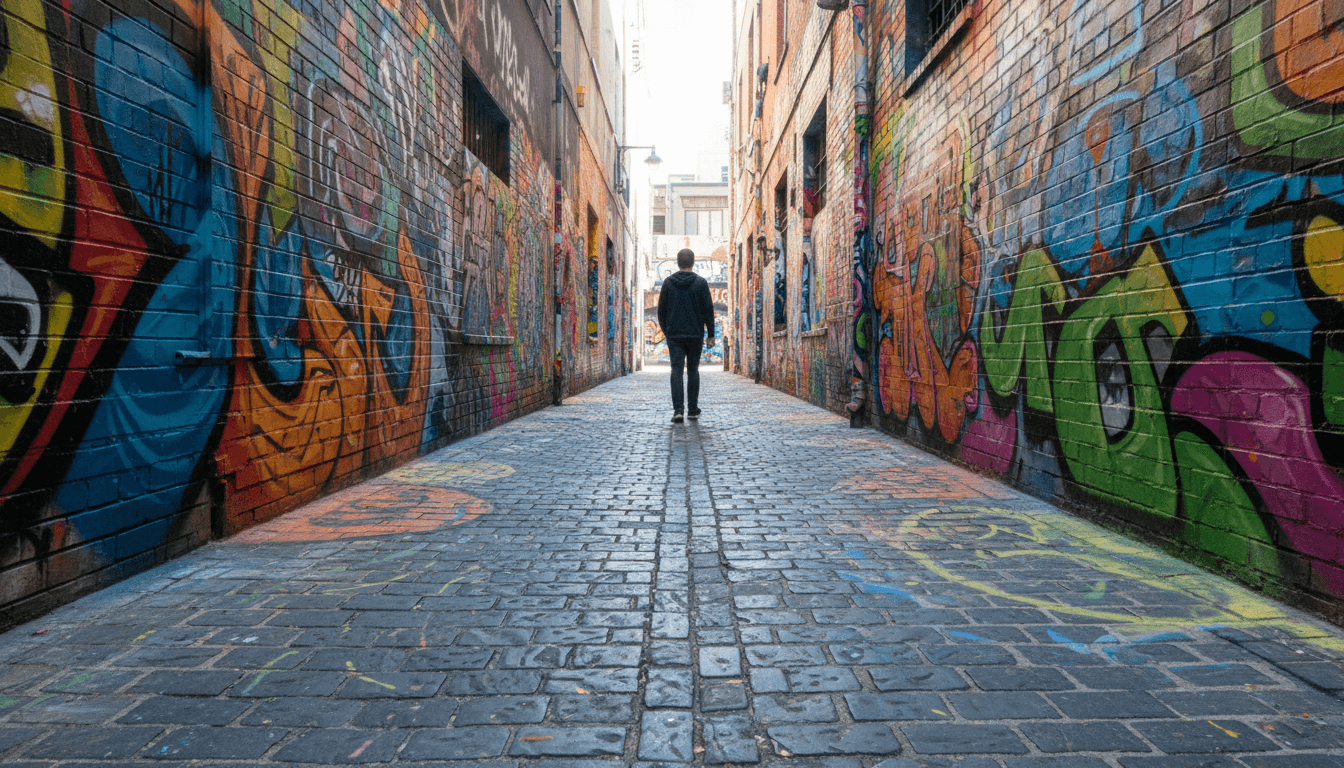
Is Melbourne's laneway street art actually legal, or is the city just choosing not to prosecute it? Tourists photograph Hosier Lane by the thousands assuming it's a straightforward, sanctioned public art zone — official, protected, permanent. The real answer is messier than that, and it involves an adjacent laneway, indistinguishable to the eye, where the exact same activity can carry a $29,000 fine and two years in prison.
The claim
Melbourne markets its laneway street art as deliberate cultural policy, not tolerated lawbreaking. The City of Melbourne's Graffiti Management Plan, built on community research, distinguishes between "tagging" — a name or symbol scrawled without permission, which residents consistently dislike — and "street art," larger, more considered work that many residents actually value when it's placed appropriately. Under Victoria's planning scheme, street art can be applied legally where the local planning rules permit it and the property owner has given approval. Hosier Lane, the most photographed of all of them, goes further still: the council describes it as a long-standing de facto free-to-paint area that doesn't require individual permits or permission at all.
The evidence that complicates it
Here's where the tidy story runs into trouble. A Melbourne City Council committee report examining the laneways found that Rutledge Lane — which intersects Hosier Lane and is, to most visitors, visually indistinguishable from it — had no permits in place for its street art at all. Under the Victorian Graffiti Prevention Act 2007, that gap isn't a technicality: anyone caught painting, drawing, stencilling, or wheat-pasting there without authorisation faces fines that can exceed $29,000 and up to two years' imprisonment. Two laneways, physically connected, visually identical, sitting on opposite sides of the law depending on paperwork most visitors have no way of seeing.
The same report found that legal status in these laneways ultimately rests with individual property owners, who can choose to tolerate or permit street art on their own walls but must apply for a council permit to do so formally — meaning the "policy" isn't one uniform rule for the whole district, but a patchwork of individual property decisions that happen to cluster into what looks, from the street, like a single coherent zone.
What's still genuinely unresolved
Even the officially tolerated status has an expiration problem built in. Whatever gets painted in a sanctioned laneway can legally be painted over by the next artist, or removed at the property owner's discretion, at any time — there's no protection for any individual piece, only for the general practice of painting there. That tension came to a head in 2008, when Australia's National Trust and Heritage Victoria proposed heritage-listing some of the CBD's laneways specifically to protect the street art within them — a proposal that runs directly against the form's own logic, since heritage protection freezes a specific work in place while the entire culture of laneway art depends on constant turnover. Meanwhile, the city keeps paying to remove unauthorised graffiti elsewhere, which makes the sanctioned laneways look less like a settled legal category and more like a deliberately drawn exception inside a much larger enforcement effort.
Advertisement
Where the investigation stands
Melbourne's laneway art is real policy, not a myth — the city has genuinely researched, distinguished, and in places formally protected the practice, and Hosier Lane's de facto free status is an actual, stated council position, not a rumour. But "Melbourne street art is legal" is too simple a sentence for what's actually a lane-by-lane, owner-by-owner, permit-by-permit patchwork, one where an artist can stand at the exact midpoint between two laneways and be fully within the law facing one direction, and risking a criminal charge facing the other — a patchwork you'd never guess at just walking through the commercial galleries a few blocks away on Flinders Lane, where the legal ground is far more solid, or standing in front of the NGV's own free, uncontested entrance.