Prussian Blue: The First Synthetic Blue
Prussian blue was an accident in a Berlin laboratory that became the first modern synthetic pigment — a cheap, deep blue that changed painting and printing forever.
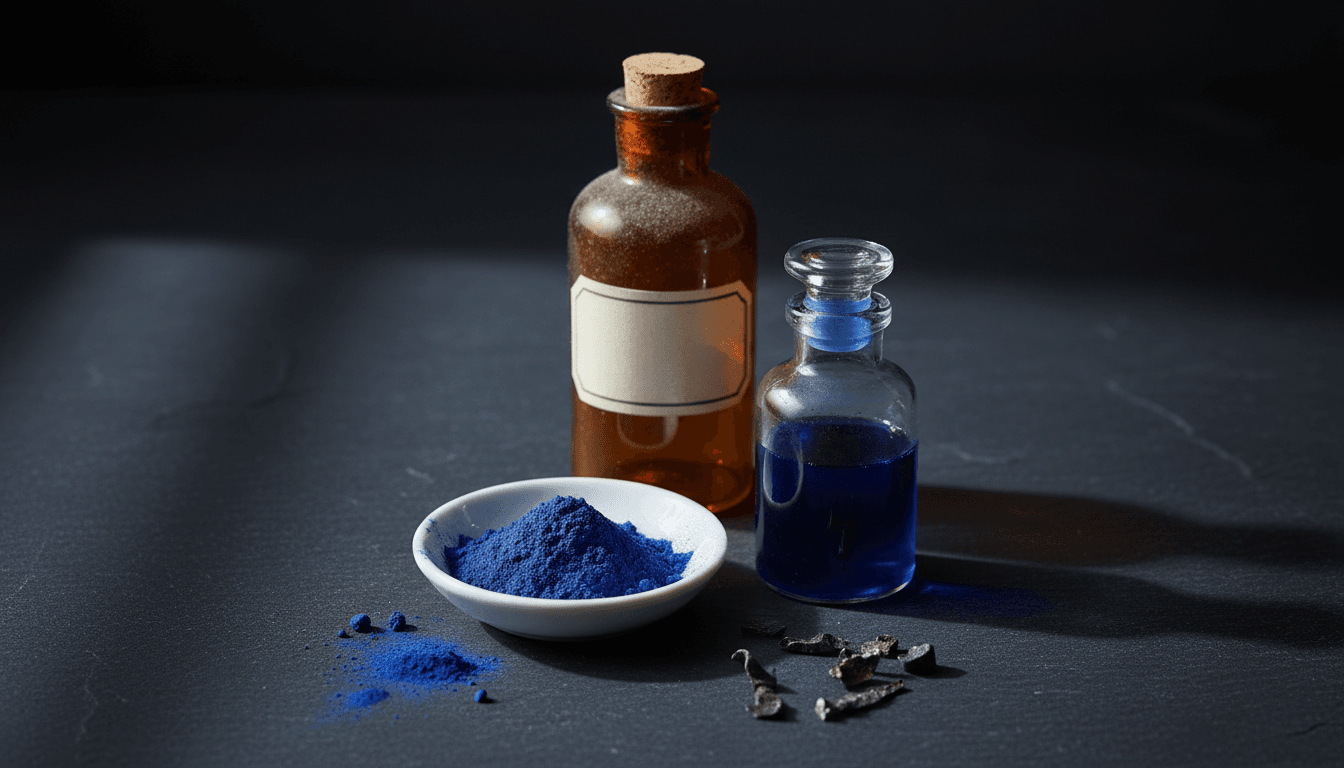
Sometime around 1706, in a Berlin workshop belonging to the alchemist Johann Conrad Dippel, a colourmaker named Johann Jacob Diesbach was trying to make a red pigment. He needed potash for the process and, apparently to save money, used a batch that had been contaminated with animal oil and blood from other experiments in Dippel's lab. The result was not red. It came out pale, then purple, and when Diesbach tried to concentrate it, it turned a deep, saturated blue unlike anything then available in Europe. He had just made the first modern synthetic pigment, and he didn't fully understand what he'd done.
Before the accident: why blue was a luxury
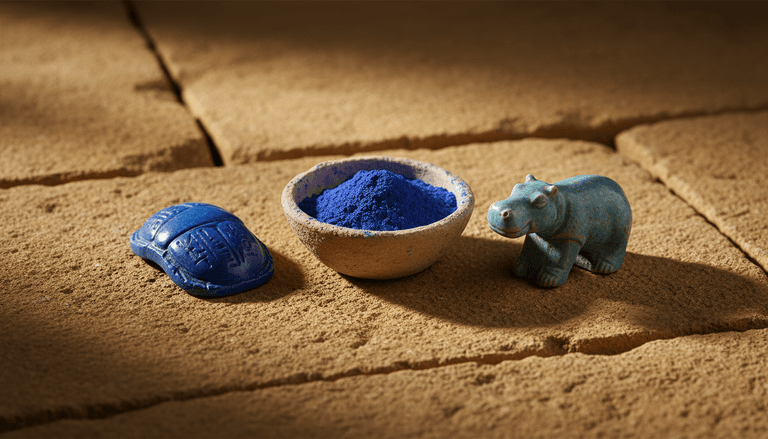
To understand why this mattered, you have to know what blue cost before it. Ultramarine, ground from lapis lazuli mined almost exclusively in what is now Afghanistan, was priced by weight against gold itself. Azurite was a cheaper natural alternative, but duller and less stable. A painter who wanted a deep, rich blue was choosing between a colour that cost a fortune and a colour that didn't quite deliver. Diesbach's accident didn't just add a new blue to the shelf — it broke a monopoly that had held for the entire history of Western painting.
What was actually happening, chemically
Nobody in 1706 understood this, but the reaction Diesbach stumbled into produces iron ferrocyanide — a compound built from iron atoms in two different oxidation states locked into a single lattice. The blue colour comes from a phenomenon called charge transfer: light energy briefly bumps an electron from one iron atom to its neighbour, and the specific energy that transfer absorbs happens to fall in the red part of the spectrum, leaving blue as what gets reflected back. It's the same general class of electronic effect behind several other pigments' colours, just tuned to a different, unusually deep result.
Going public: 1708 to 1710
The year itself is softer than the story. Reference books long gave 1704, but no period source supports that date; the one that does date the invention, a manuscript chronicle kept by the Berlin preacher Joachim Ernst Berger, enters Diesbach's new blue under 1706. Diesbach kept his recipe close, but word travelled through his employer's circle. The naturalist Johann Leonhard Frisch corresponded about the new pigment with Gottfried Wilhelm Leibniz — the philosopher and president of the Prussian Academy of Sciences — starting with a letter dated 31 March 1708. By 1709 the colour already had names: Preussisch Blau and Berlinisch Blau. Frisch published the first formal account of it in 1710, under the title Notitia Coerulei Berolinensis nuper inventi — "Notice of a newly invented Berlin blue." Within two years of an accident in a workshop, the pigment had a paper trail and a name that would stick for three centuries — a far cleaner origin story than the one behind Indian yellow, which took until 2018 to actually confirm.
Advertisement
Spreading through the palette: 1710s–1820s
| Before Prussian blue | After Prussian blue | |
|---|---|---|
| Best deep blue available | Ultramarine (from lapis lazuli) | Prussian blue |
| Cost | Comparable to gold by weight | A fraction of that cost |
| Who could afford a rich blue | Only the wealthiest patrons | Any workshop |
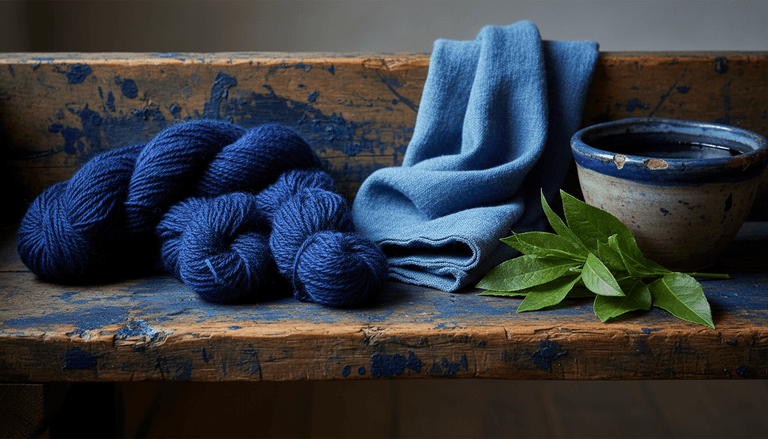
Prussian blue reached Parisian painters within a decade — Antoine Watteau and, after him, Nicolas Lancret and Jean-Baptiste Pater used it, and François Boucher relied on it extensively for both blues and greens. Because it could be manufactured cheaply from common materials rather than mined at great expense, it spread through printing, dyeing, and eventually industry — the same shift from farmed or mined colour to manufactured colour that woad and indigo had already been fighting over in the dye trade — doing to blue roughly what synthetic ultramarine, invented in France in the 1820s, would later do to the last remaining natural-pigment monopoly.
Crossing an ocean: Hokusai's waves
Prussian blue reached Japan by the early nineteenth century, arriving through Dutch trade at a moment when the woodblock print tradition was reaching its own peak. Katsushika Hokusai's Great Wave off Kanagawa, from his series Thirty-six Views of Mount Fuji (c. 1830–33), depends on the pigment's intensity for its deep, saturated blues — a colour that simply hadn't been available to Japanese printmakers in that depth before European trade brought it to their door. One Berlin accident, travelling by ship, ended up defining the single most reproduced image in the history of Japanese art.
A second life: photography and the blueprint
The same iron chemistry that makes Prussian blue found an entirely different application in the 1840s. In 1842, the astronomer John Herschel invented the cyanotype process, which produces a blue image through a related iron reaction when exposed to sunlight. Within a year, the botanist Anna Atkins was using it to record specimens: her Photographs of British Algae: Cyanotype Impressions, begun in October 1843, is generally recognised as the first book ever illustrated with photographic images — every plate a ghostly white silhouette on a field of Prussian-blue-adjacent colour. The same chemistry went on to become the literal "blueprint," the standard reproduction method for architectural and engineering drawings well into the twentieth century.
Where Prussian blue stands now
Prussian blue is still manufactured and sold today, valued specifically for a deep, slightly greenish tone that the brighter, more stable phthalocyanine blues developed in the 1930s never fully replaced — some painters keep both on the palette rather than choosing one over the other. Its cyanide-based chemistry, oddly, turned out to be medically useful rather than dangerous: because the cyanide groups are locked permanently into the pigment's crystal structure, Prussian blue is used as an actual antidote, administered to patients who've ingested thallium or radioactive caesium, binding the toxins in the gut so the body can pass them out. Three hundred years after a cost-cutting mistake in a Berlin workshop, the same compound is still on painters' shelves and, under a different label entirely, in hospital pharmacies.
FAQ
Who discovered Prussian blue?
It's usually credited to the Berlin colourmaker Johann Jacob Diesbach, who produced it by accident around 1706 — older references say 1704 — while trying to make a red pigment, using potash contaminated with animal oil and blood.
Is Prussian blue toxic, given that it contains cyanide?
No — the cyanide groups are locked into a stable crystal structure rather than existing as free cyanide, which is also why the compound is used medically as an antidote for certain kinds of poisoning.
Is Prussian blue the same chemistry as a blueprint?
Related, not identical — the cyanotype process that produces architectural blueprints uses a similar iron-based photochemical reaction, discovered separately by John Herschel in 1842.