What Ultramarine Cost
Lapis-derived ultramarine was priced by the ounce, above gold — not because the stone was rare, but because the yield was dreadful and the labour was skilled. Then Guimet made it in a furnace, and the most meaningful blue in painting became just another pigment.
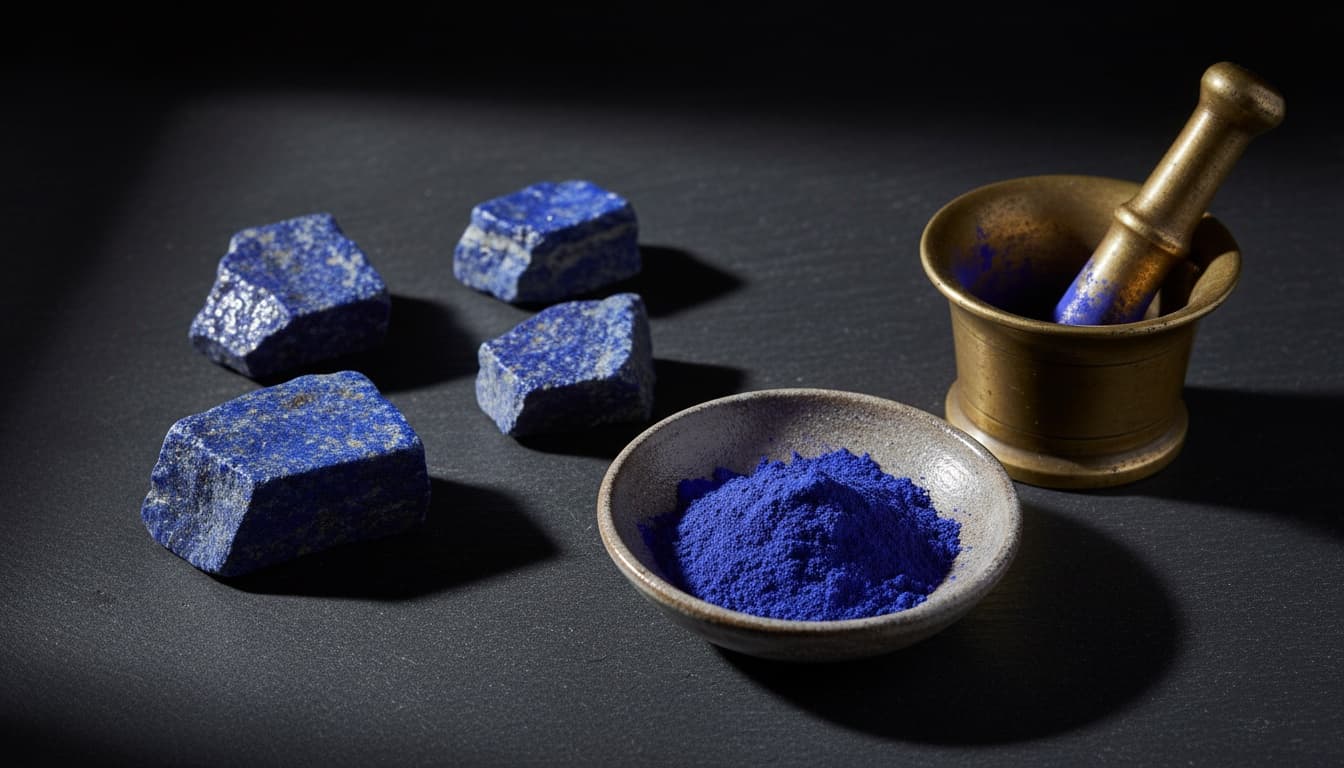
Lapis lazuli was never simply a blue rock. For most of the history of European painting it was a line item — negotiated, weighed, and written into contracts beside the gold.
Origin: a name that is a shipping note
Ultramarinus: beyond the sea. The stone came from essentially one source, the mines at Sar-e-Sang in Badakhshan, in what is now northeastern Afghanistan, and travelled thousands of miles to reach a workshop in Florence or Bruges.
Becoming a pigment: the hidden cost of extraction
Distance was only half the price. Lapis ground straight into powder yields a disappointing grey-blue, because the rock is only partly lazurite; the rest is calcite, pyrite, and feldspar. Extracting the true colour meant the laborious process Cennino Cennini set down around 1400. Paraphrased, it runs: melt pine resin, gum mastic, and new wax together; knead the powdered stone into them, hands greased with linseed oil, and leave the dough at least three days; then work it with two sticks in warm lye until the blue runs out into the liquid and the grey stays behind.
Days of labour, and each successive washing gave a weaker blue. A pound of good stone might yield only ounces of first-grade pigment — which is how a colour ends up priced by the ounce above gold, not because the raw material was scarce, but because the yield was terrible and the hands were skilled.
Life in use: an expense written into the contract
Patrons specified it exactly as they specified gold leaf, because both were sums someone had to approve. Fifteenth-century commissions named ultramarine by grade and by weight, and its placement in a painting was itself an argument: on the Virgin's mantle, the expense was the devotional statement, and a viewer who knew the price could read the painting's priorities straight off the palette.
1826: the pigment loses its scarcity
In 1824, the Société d'Encouragement pour l'Industrie Nationale in Paris offered 6,000 francs to anyone who could manufacture the colour synthetically. Jean-Baptiste Guimet announced a working process in 1826 and was awarded the prize in 1828; Christian Gmelin in Tübingen had arrived somewhere similar independently and disputed priority. Guimet's method needed no mine and no sea — china clay, sodium carbonate, sulfur, silica, and charcoal, fired together to produce the same polysulfide radical caged in an aluminosilicate lattice that makes lazurite blue, in particles finer and more uniform than ground rock ever gave. He kept the process secret and built a factory at Fleurieu-sur-Saône; his son later spent the proceeds founding the Musée Guimet. Within a generation the artificial pigment sold for a fraction of the natural price — cheap enough for house painters, cheap enough for laundry blue.
Advertisement
What was actually lost
Not the colour. French ultramarine is cleaner, stronger, and more reliable than most natural grades, carrying none of the pyrite glint or calcite haze that came with the rock. What went was legibility. When blue was the most expensive substance in the picture, its placement was a statement anyone who knew the market could read — the same logic that had once made Tyrian purple the colour of emperors. Cheap blue goes anywhere, and therefore says nothing about where it went.
Where it stands now
Yves Klein understood the problem exactly. The most proprietary blue of the twentieth century, International Klein Blue, was made from Guimet's own cheap powder — Klein simply invented a binder to hold its brilliance, then lodged the formula in a sealed envelope at the French patent office, manufacturing by artifice the scarcity that price once supplied for free. The stone still comes from Afghanistan, still costs a premium as a natural pigment for conservators and purists, and still sits, mostly, in museum tubes and specialist orders — a mineral that spent five centuries as a devotional currency before chemistry made it just another blue.
See also our pieces on prussian blue: the first synthetic blue, egyptian blue: the first synthetic pigment, and gold in art.