Why Watercolor Granulates on Some Papers
Some pigments settle into grain and others dry smooth. Learn what causes watercolor granulation and how to control it on different papers.
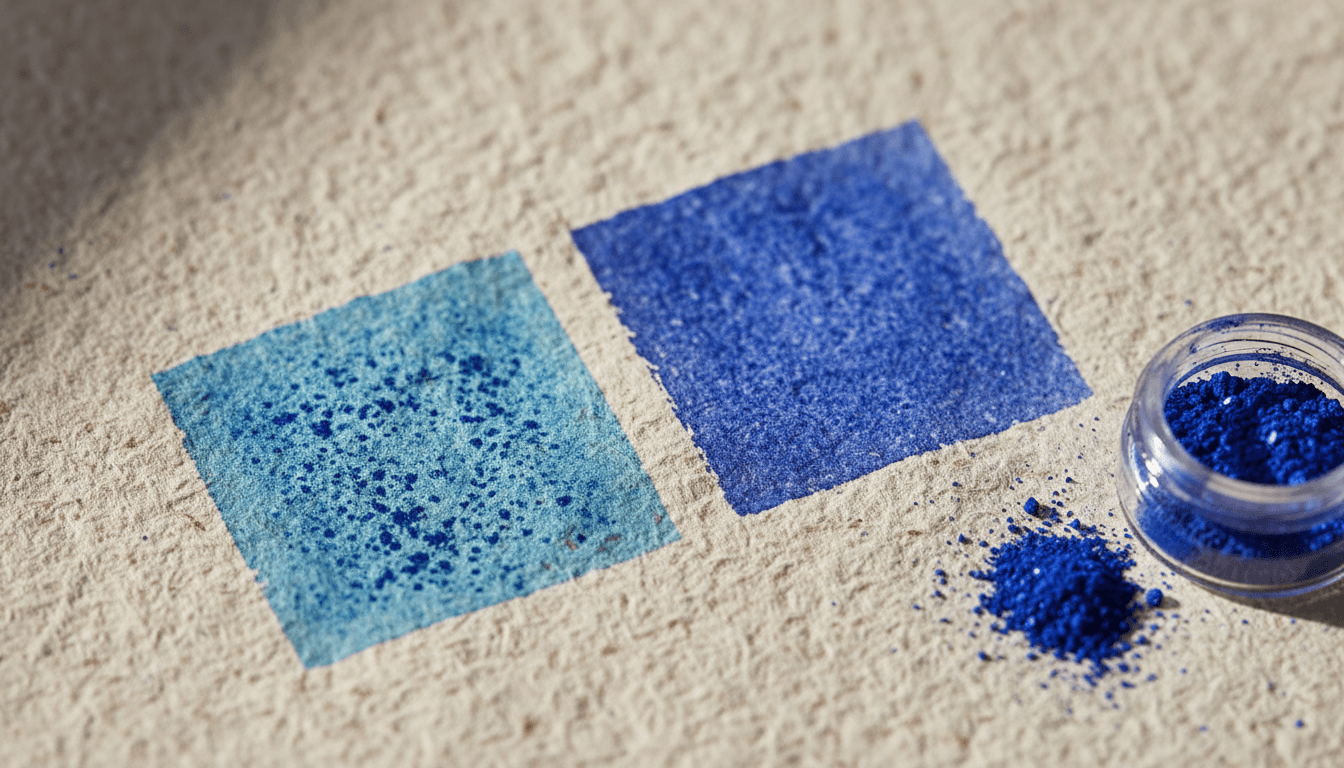
A wash of ultramarine dries into a mottled, grainy texture like frost on a window. A wash of phthalo blue, applied the exact same way, dries perfectly flat. Painters who don't know why tend to treat the difference as random luck, or a flaw in one tube of paint. It isn't random at all — it's straightforward physics, and once you see the mechanism, you can turn it on or off on command.
At a glance
| Pigment | In a wash | Why |
|---|---|---|
| Ultramarine (synthetic in almost every tube) | Granulates; how strongly varies by brand | Soft particles clump, and makers mill the clumps down to different degrees |
| Cerulean and cobalt blue | Granulate | Dense, relatively coarse inorganic particles settle before the water is gone |
| Raw and burnt umber, many ochres and earth colours | Granulate | Dense, relatively coarse earth particles settle before the water is gone |
| Phthalocyanine blue and green | Lie flat | Fine, light organic particles stay suspended until the wash dries |
| Quinacridones and most other synthetic organic pigments | Lie flat | Fine, light organic particles stay suspended until the wash dries |
What's actually happening
Granulation is sedimentation, not chemistry — the same process that drops silt out of a river, just happening on a sheet of paper instead. In a wet wash, pigment particles are suspended and moving freely. As the water evaporates, the heavier, coarser particles fall out of suspension faster than the fine ones and settle into the low points of the paper's surface, where they stay once everything dries. What you're looking at afterward is a map of exactly where the heaviest particles happened to sink.
Why some pigments do it and others never will
The pigments that granulate are, without exception, the physically heavy ones: inorganic pigments like ultramarine and cerulean, and earth pigments like the umbers and ochres, whose particles are dense and relatively coarse. Neither of those blues, as most painters buy them, is a mined mineral — cerulean is a cobalt stannate first synthesised in 1805, and nearly every tube of ultramarine holds the synthetic version made since 1828 rather than ground lapis lazuli. Gravity wins the race against evaporation before the water is fully gone. Synthetic organic pigments — phthalocyanines, quinacridones — are the opposite: their particles are fine and light enough to stay suspended for the whole drying time, so they settle evenly and dry flat. The pigment sets the tendency — chemistry closer in spirit to why Prussian blue behaves the way it does than to anything about technique — but the maker sets the degree. A "phthalo blue" from any decent manufacturer dries flat, while ultramarine varies from brand to brand: its soft particles clump together, manufacturers mill those clumps down to different degrees, and the result runs from Winsor & Newton's ultramarines, which produce some of the most pronounced wash textures in Bruce MacEvoy's pigment tests, to brands he rates as comparatively smooth.
The paper decides how visible it gets
Granulation needs somewhere to collect, and the paper's surface is what supplies it, in much the same way any painting surface's preparation shapes what the paint on top of it can actually do. A rough or cold-press sheet is full of small pits and valleys, and settling particles drop into them, making the grain obvious. The same pigment on smooth hot-press paper granulates far less visibly, because there's much less texture for the particles to collect in. Sizing adds a second variable: a heavily sized sheet keeps the wash sitting on the surface longer, giving particles more time to separate before the water is gone; a more absorbent sheet pulls the water away faster and can lock the pigment in place before it fully settles.
Advertisement
Using it on purpose
Once you know the mechanism, granulation stops being a surprise and becomes a tool. For weathered stone, water texture, or atmospheric distance, a granulating wash reads as surface and depth in a way a flat synthetic wash simply can't. Landscape and botanical painters lean on this constantly, which is part of why traditional earth-and-mineral palettes feel different from modern synthetic ones even in the same composition.
To encourage granulation: work on cold-press or rough paper, choose the heavy mineral pigments, lay a genuinely wet wash, and then leave it alone — reworking a drying wash stirs settled particles back into a muddy distribution rather than a clean grain.
To suppress it: work on hot-press or smooth paper, keep washes thin, and reach for single-pigment synthetic colours instead of the heavy earths. A mixture of a heavy mineral and a light organic pigment can granulate unevenly, since the two components separate from each other as well as from the water — which is why some mixed greens dry with a speckled surface while a single-pigment green from the same palette dries perfectly flat, a version of the same binder-and-medium mismatch that shows up elsewhere in watercolour and acrylic.
The bottom line
Granulation is neither a defect nor a mystery — it's sedimentation, decided almost entirely by pigment density and paper texture, and both variables are things a painter can choose rather than merely notice after the fact. A pigment either has heavy enough particles to fall out of suspension or it doesn't, and a paper either gives those particles somewhere to collect or it doesn't. Everything else is just the two variables meeting.
FAQ
Is watercolor granulation a flaw?
No — it's a predictable physical process, and many painters deliberately choose granulating pigments for texture in skies, stone, and water.
Why does ultramarine granulate but phthalo blue doesn't?
Ultramarine's particles are dense and coarse enough to settle out of suspension before the wash dries; phthalo's particles are much finer and stay suspended, drying into a flat, even film.
Does paper choice really change granulation?
Yes, significantly — rough or cold-press paper's texture gives settling particles somewhere visible to collect, while smooth hot-press paper shows far less grain from the same pigment.
Can I make a non-granulating pigment granulate?
Commercial granulation mediums exist and can coax some texture from smoother pigments, though the effect is usually more pronounced and reliable with genuinely heavy, mineral-based colours.
Why do some mixed colours granulate unevenly?
Because the heavy and light pigments in the mixture settle at different rates, separating from each other as well as from the water, which produces a speckled rather than uniform texture.