Why Watercolor Lifts and Acrylic Doesn't
Watercolour lifts because gum arabic stays water-soluble; acrylic does not because it forms a plastic film. The difference is chemistry, and it changes how you paint.
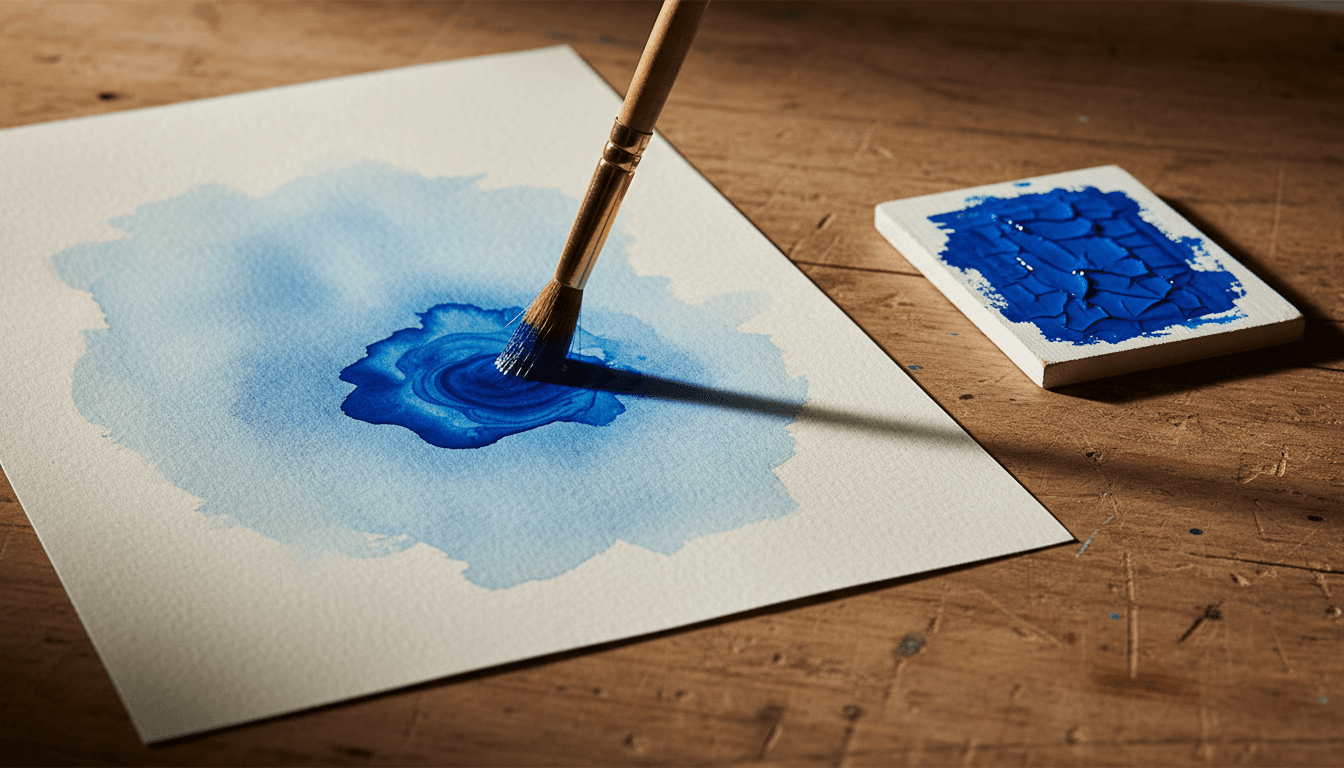
Watercolour and acrylic can sit in tubes side by side and look like the same kind of paint. They are not. A watercolour painting can be rewetted and lifted off the paper years after it dried; an acrylic painting cannot be recovered once it cures, not with water, not with anything short of a razor blade. The difference has nothing to do with skill or technique. It is entirely the binder.
At a glance
| Watercolour (and gouache) | Acrylic | |
|---|---|---|
| Binder | gum arabic | acrylic polymer emulsion |
| How it dries | water evaporates; binder stays soluble | water evaporates; polymer particles fuse into a film |
| Reversible? | yes, indefinitely | no, once cured |
| Invented/standardised | ancient; industrialised 18th–19th c. | 1955, Cincinnati |
| Typical failure mode | lifting, staining, fading of fugitive pigments | film peeling if applied over an incompatible surface |
Why watercolour lifts
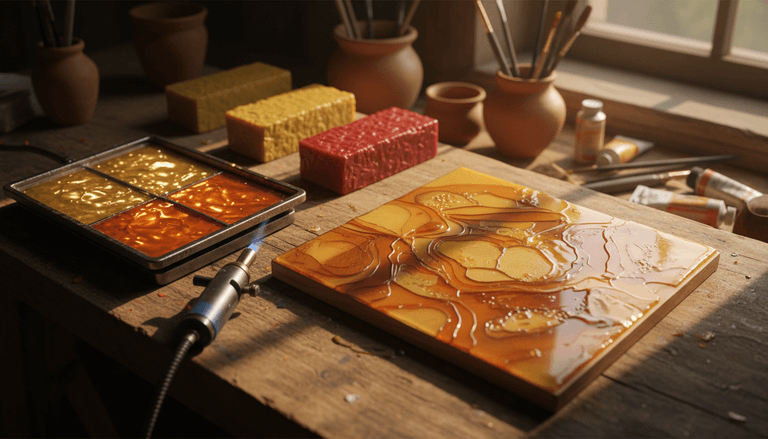
Watercolour's binder is gum arabic, a natural gum tapped from Acacia senegal and Acacia seyal trees across the Sahel — and its name records a trade route rather than a tree, since the gum reached medieval Europe through Arab merchants. For centuries the harvest from Nubia and Kordofan went down the Nile to Alexandria and was sold as gum arabic; from the late seventeenth century a West African grade shipped out of Senegal and Mauritania as "Senegal gum"; and Sudan, whose organised gum trade dates only from 1820, became the dominant source in the modern era. Gum arabic dissolves in water, and critically, it does not undergo any chemical change as watercolour dries. The water simply evaporates and the gum hardens by desiccation, the same physical process that turns a puddle into a dry patch of mud. Add water again, at any point, and the gum redissolves and releases the pigment with it.
That reversibility is not a defect that watercolourists tolerate — it is the entire working method. Lifting, the technique of removing paint with a damp brush to recover a highlight or correct a passage, only exists because the binder never stops being water-soluble. A watercolour is, in a real sense, never finished chemically. It is finished when the artist decides to frame it under glass and stop touching it.
Why acrylic doesn't
Acrylic's binder is a synthetic polymer suspended in water as an emulsion — countless microscopic plastic particles held apart by water and a surfactant. As the water evaporates, those particles are forced into contact, and they coalesce into a single continuous film. Unlike gum arabic's drying, this is closer to a phase change than a simple desiccation: the individual particles fuse and lose their separate identity, forming a plastic sheet that will not redissolve in water no matter how long you soak it — a permanence oil paint reaches too, though by an entirely different chemical route and on a far slower timescale.
Advertisement
This is a comparatively young chemistry. The first commercially viable water-based acrylic for artists was developed in 1955 by Henry Levison, a color chemist who had been running an oil-paint manufacturer called Permanent Pigments in Cincinnati, Ohio, since 1933. Levison's first product was an acrylic gesso; a soft-body acrylic paint followed in 1956, sold under a new name he coined for the whole line — Liquitex, short for "liquid texture." Acrylic is, by the standards of painting media, barely seventy years old, and its irreversibility is precisely what oil and watercolour painters found startling about it when it arrived: a water-cleanable paint that, once dry, behaved like nothing else in the studio.
The gouache exception
Gouache looks and handles like an opaque, poster-paint version of acrylic, which makes its behaviour genuinely surprising the first time you meet it. Gouache uses the same binder as watercolour — gum arabic, with a larger proportion of pigment and often a white filler for opacity — so despite its solid, covering look, it reactivates exactly like watercolour does. An illustrator can rework a gouache painting for years, which is exactly why the medium remained the default for commercial illustration long after acrylic existed: opacity without commitment.
Why watercolour became the medium of the sketch
Watercolour's reworkability is also why it became, by the late eighteenth century, the default medium for travel, landscape, and botanical recording. Britain in particular institutionalised it: the Society of Painters in Water-Colours was founded in London in 1804, specifically so the medium could be exhibited and judged on its own terms rather than as a lesser cousin of oil painting. J.M.W. Turner built much of his reputation on watercolour sketches made on the move, and the medium's portability — a small box of pans, a brush, and paper, nothing that needed hours to dry before packing up — suited an era that was travelling more than any before it. None of that would have worked with acrylic's commitment; the whole point was a medium a painter could correct in the field and finish later.
What this means at the easel
- Watercolour rewards a gradual approach. Lifting and glazing let a painter build up and correct indefinitely, which suits transparent, layered work.
- Acrylic rewards decisiveness. Every layer is permanent the moment it cures, which suits bold, opaque, fast-layered work — and punishes hesitation.
- Watercolour is a partnership with the paper. The pigment binds into the paper's fibres, so the paper's sizing and texture change how the paint behaves as much as the pigment does.
- Acrylic is a partnership with the surface beneath it. Because the paint forms an independent film rather than soaking in, that film's adhesion to the ground is what determines whether it lasts — a poorly prepared surface can cause acrylic to peel in a way lifting could never touch watercolour.
The bottom line
Watercolour and acrylic look like cousins in the tube and behave like opposites on the surface, and the reason is not the pigment — it is almost never the pigment — it is the binder. Gum arabic never stops being water-soluble, so watercolour never stops being reworkable. Acrylic's polymer particles fuse into a permanent film the moment they dry, so acrylic never goes back. Once you know which binder you're holding, you already know how forgiving — or how final — every brushstroke is going to be.
FAQ
Why does watercolour lift even after it's fully dry?
Because its binder, gum arabic, never chemically changes as it dries — it only desiccates, and rewetting it redissolves the gum and releases the pigment, regardless of how long ago it dried.
Why can't you lift acrylic paint?
Because acrylic's polymer particles fuse into a single continuous film as the water evaporates. That fusion is not reversible with water; the film has to be mechanically removed.
Does gouache reactivate like watercolour?
Yes. Gouache uses the same gum arabic binder as watercolour, just with more pigment and often a white filler for opacity, so it rewets and reworks the same way despite looking solid and opaque.
When was acrylic paint invented?
The first commercial water-based acrylic for artists came from Henry Levison's Permanent Pigments company in Cincinnati in 1955, initially as an acrylic gesso, with a soft-body paint following in 1956 under the new brand name Liquitex.
Is a watercolour ever truly permanent?
The pigment can be lightfast, but the binder remains water-soluble indefinitely, so a watercolour's permanence really depends on keeping it dry — which is why they're framed under glass rather than varnished.