The Bayeux Tapestry Is Embroidery: What the British Museum Is Showing
The Bayeux Tapestry is embroidery, not weaving: 68 metres of linen, ten shades of wool and three dye plants, on show at the British Museum until July 2027.
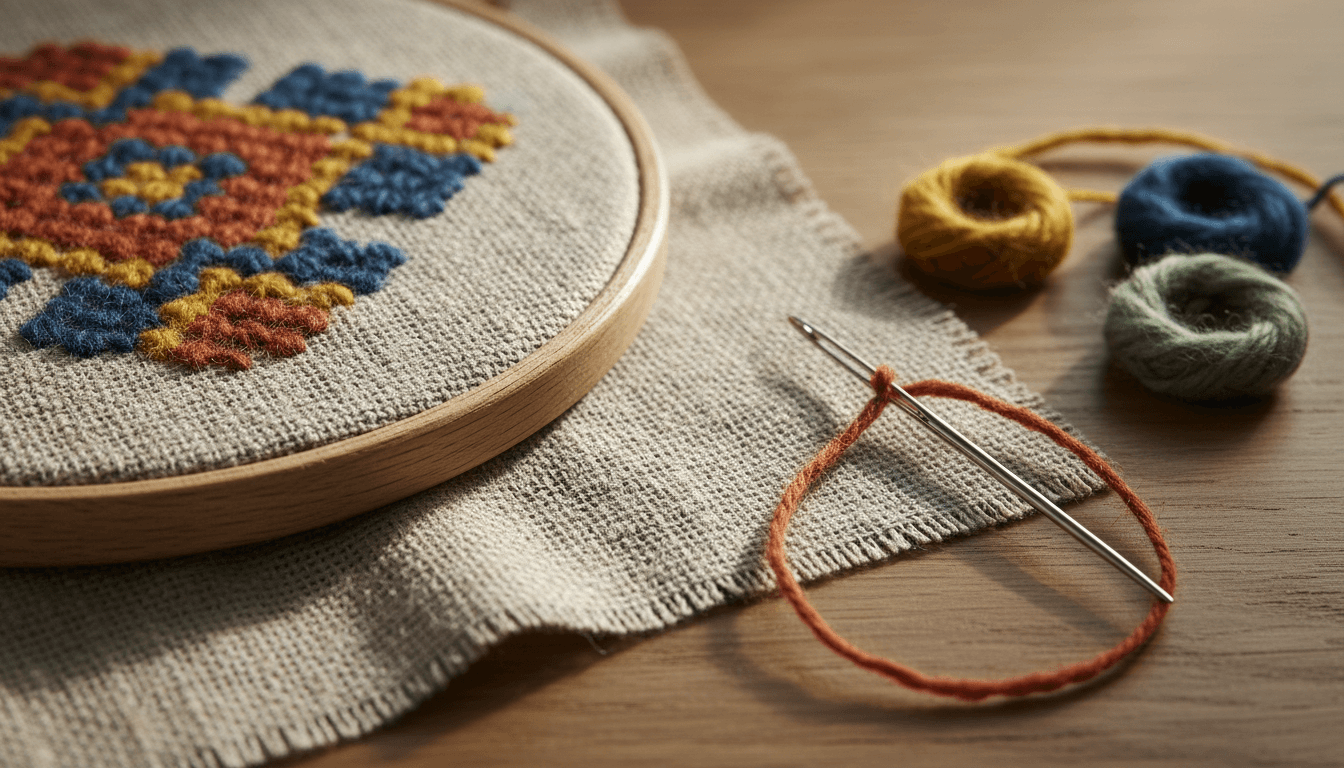
Up close, the Bayeux Tapestry isn't woven at all. It's a band of linen about 50 centimetres high with wool sewn onto its surface, in rows so regular that the Bayeux Museum reads them as a sign the design was drawn on the cloth first. A tapestry forms its picture as threads cross at right angles on a loom; this was done with a needle, and the museum doesn't hedge — the technique is "unquestionably embroidery."
On 10 September 2026 it went on display at the British Museum. Director Nicholas Cullinan had said it would be "the first time the Bayeux Tapestry has been in the UK since it was made, almost 1,000 years ago." Most of the coverage is about what the cloth shows: the run-up to the Battle of Hastings in 1066. The object is the stranger story — some 68 metres of linen, ten shades of wool, three dye plants, and nineteenth-century repairs that have aged worse than the eleventh-century stitching beside them. This piece starts with the show, then goes back through the centuries behind it.
On show: ten months in one straight line
The British Museum is showing the tapestry in the Sainsbury Exhibitions Gallery from 10 September 2026 to 11 July 2027, and the room helped win the loan. The Art Newspaper reported that the gallery is "long enough to be able to accommodate the Tapestry being displayed in a single length" — something Bayeux's upright, U-shaped display doesn't offer — and, in December 2025, that the length helped the British Museum beat the V&A to the loan. The museum says it is the first time the cloth has been shown flat in one continuous run. A Museums Association review called the case "the longest display case in the world," and Time Out found translations of the Latin captions running on screens alongside it. The museum puts the visit at 40 minutes. The Art Newspaper's reviewer, Martin Bailey, found the cloth lying flat at about waist height, a line of about 100 people at the case and a ban on photography; he managed 35 minutes after queueing.
Around the cloth sits the world it describes. The museum's press release lists loans that set the tapestry against documents of its own time: a charter of Edward the Confessor from 1060, granting land at Wheathampstead to Westminster Abbey and witnessed by people who appear on the cloth, among them Gyrth, Harold's brother, whom the tapestry shows falling at Hastings; the Bodleian's Junius 11 manuscript, probably made at Canterbury around the year 1000, which the tapestry's designers likely used for clothing, ships and everyday objects; a charter of William I to the citizens of London from 1067, written in Old English; and the Chew Valley Hoard, silver pennies of Harold II and William I, probably buried during the south-western rebellion against Norman rule. The museum dates the tapestry itself to 1072–77 and places its making in or near Canterbury.
Advertisement
In return, treasures representing all four UK nations are going to Normandy. The Art Newspaper lists the Sutton Hoo helmet (England), the Lewis chessmen (Scotland), the Mold gold cape (Wales) and the Dunaverney flesh hook (Northern Ireland). The same report, citing the Financial Times, said officials put the tapestry's value at around £800m for the Government Indemnity Scheme, and that the cloth would travel by truck through the Channel Tunnel after a dry run with a facsimile crate. The Museums Association adds a vibration limit of below 2 millimetres per second.
The loan took eight years to arrive. A deal Emmanuel Macron agreed in 2018 fell through when tests showed the tapestry was in worse repair than expected; a condition report followed in 2020, and conservation work began in January 2025. The Bayeux Museum, which had shown the cloth since 1983, closed for a two-year renovation on 1 September 2025, and the tapestry was taken off display on 19 September. After 11 July 2027 it returns to a new €38m museum designed by RSHP, due to reopen in October 2027.
Demand has been unusual even for the British Museum. Tickets went on sale on 1 July 2026 in stages — September to December first, then January to March slots in October and April to July slots in January — and the first release sold out within the first day, with an online queue that peaked above 80,000. Time Out lists adult prices of £33 at peak, £27 off-peak and £25 for the last weekday slot, with under-16s free when accompanied by an adult and National Art Pass holders paying £16.50. Igor Tulchinsky, founder of WorldQuant, is sponsoring the show with £5m, which includes a schools programme.
The story it tells: an oath, a coronation and a comet
The tapestry is a Norman account of how an English earl became an oath-breaker. It follows Harold Godwinson across the Channel to Normandy, where he lands in Ponthieu and is taken prisoner by Count Guy until Duke William secures his release. William gives Harold arms and armour — possibly a knighting — and Harold swears on holy relics under the caption "Ubi Harold sacramentum fecit Willelmo duci" ("where Harold made an oath to Duke William"). The caption says an oath was taken; nothing on the cloth says what Harold promised.
Edward the Confessor dies on 5 January 1066 and Harold is crowned the next day, with a figure labelled "Stigant Archieps" beside him. The label is a claim, not a record. Stigand had been excommunicated by the papacy, which considered his appointment unlawful, and it is generally thought that Ealdred, archbishop of York, performed the ceremony; Norman sources and the tapestry name Stigand, possibly to discredit the new king.
Then a comet. A star with a streaming tail hangs in the upper border over a group of men labelled "Isti mirant stella" ("these men marvel at the star"). It is Halley's Comet, which would first have appeared around 24 April 1066, in what is often described as the first known picture of it. Beneath it, in the lower border, runs a fleet of ghost-like ships, a premonition of the invasion.
The Battle of Hastings was fought on 14 October 1066, less than three weeks after Harold's victory over the Norwegians at Stamford Bridge, and the tapestry gives no hint of that campaign. It skips straight to the Norman landing and the battle, where Gyrth and Leofwine fall, and then to the caption "Hic Harold rex interfectus est" ("here King Harold is killed"). What survives of the ending shows unarmoured English troops running.
Origin: nine lengths of linen and ten shades of wool
The Bayeux Museum gives the length as about 68.3 metres. Nine pieces of linen, each between roughly three and fourteen metres, were sewn together after they were embroidered, and about 50 centimetres of the cloth's 70-centimetre height carries the stitching. The yarn is wool, and the museum counts ten shades of it. The cloth is divided into 58 scenes, and its Latin captions show English influence in style and spelling.
Those shades come from three plants. Woad gives the blues (more on that plant in Woad vs. Indigo: The Blue Dye Wars). Madder root gives the reds, pinks, oranges and browns. Weld, also called dyer's rocket, gives the yellows. Cochineal, the American insect red covered in Cochineal: The Insect That Made Red, wouldn't reach Europe for nearly five centuries, so the reds here are madder.
The stitching is as limited as the palette. The museum lists four stitches, but two do most of the work: stem stitch draws the outlines and the lettering, and couching — long threads laid across the surface and tacked down with tiny stitches, known as the "Bayeux stitch" — fills the coloured areas.
Who made it is still argued. The popular story that Queen Matilda and her ladies-in-waiting stitched it is, in the museum's view, unlikely; the name "Tapestry of Queen Matilda" only arrived in the nineteenth century. The cathedral canons called it the "Telle du Conquest," and eighteenth-century sources the "Toilette du duc Guillaume" — Duke William's little cloth. The usual reading now is that English embroiderers, probably in Kent, made it for a Norman patron — most likely Bishop Odo of Bayeux, William the Conqueror's half-brother — and most likely for the nave of his new cathedral, consecrated on 14 July 1077. The British Museum adds that they likely worked from manuscript drawings from Canterbury.
Advertisement
The case for Odo is circumstantial but consistent. He appears four times on the cloth, three of his followers who are named in Domesday Book are also shown, and the tapestry is first recorded in the cathedral he built. In the battle he carries a club rather than a sword, because clerics weren't supposed to shed blood. Who designed the cloth is a separate puzzle; candidates include Scolland, abbot of St Augustine's in Canterbury, and Lanfranc, archbishop of Canterbury. None is proven.
Reading the borders: fables, farm work and a woman nobody can identify
The strips above and below the main story aren't decoration. They carry hunting, farming, animals and a run of fables — Aesop's fox and the crow among them — plus naked and ribald figures that later reproductions often censored. An early border holds what is thought to be the earliest known picture of a harrow. Thames & Hudson's guide mentions one theory that reads the fables as a sly commentary on the action in the main band.
The oddest scene is in the main band itself. Under the caption "Ubi unus clericus et Ælfgyva" — "where a certain cleric and Ælfgyva" — a clergyman touches, or possibly strikes, a woman's face. The sentence has no verb. Below them, in the border, a naked man squats in a pose that mirrors the cleric's. Nobody knows who Ælfgyva was or what the scene records.
Use: a hanging for a cathedral nave
The first known mention of the tapestry is an inventory of Bayeux Cathedral's treasures from 1476, roughly four centuries after it was made. The cathedral hung it in the nave once a year, a custom still followed in 1728, by which point the purpose was largely to air the cloth; it stayed in the cathedral for about seven centuries. Whatever the original plan, the museum's view is that narrative hangings like this told stories to a largely illiterate public — and could serve as propaganda for a victorious conquest.
Publication came in 1729–30, when the Benedictine scholar Bernard de Montfaucon issued engravings after drawings by Antoine Benoît. The British Museum adds that from 1700 to 1842 the cloth was usually rolled out for academics and important visitors. Those engravings are now evidence in their own right: they show the cloth as it looked before the nineteenth-century restoration.
Near loss: a wagon cover, a Paris showcase and a missing ending
The Revolution nearly finished it. According to local tradition, in 1792 the tapestry was confiscated as public property to cover military wagons, and a lawyer, Léonard Lambert-Leforestier, took it off a wagon and kept it at home until the worst had passed, then handed it to the city administrators. In 1794 the Arts Commission seized it for the nation. In 1803 the Fine Arts Commission had it sent to Paris for the Musée Napoléon, while Napoleon was planning an invasion of Britain; it hung in the Louvre's Apollo Gallery from 6 December 1803 to 18 February 1804 and was back in Bayeux in 1804. From 1812 it was kept in Bayeux town hall and shown each September; between 1814 and 1836 custodians unrolled it on a table, and from 1842 it had a permanent display in the Matilda gallery.
By then it had lost its ending. The embroidery stops with English soldiers in flight, and the missing final scene is usually thought to have shown William's coronation. Scholars' estimates of the loss run from about 1.5 metres to as much as 6.4 metres across at least two panels. The Latin caption now beside the retreating soldiers, "Et fuga verterunt Angli" ("and the English turned in flight"), is a later addition made shortly before 1814.
Repair: the new thread failed first
The Bayeux Museum's assessment is that the original colours have changed little in almost a thousand years. What has faded is the repair. The nineteenth-century restoration yarns have lost badly — in some scenes to white — and the worst of it is in the heavily restored final sections. The medieval wool hasn't escaped entirely: the museum notes that the woad didn't fully penetrate the fibres, so some blue areas have faded. But the newest thread in the cloth has aged worst.
Mending began long before the Victorians. A linen backing was sewn on in 1724, and around 1800 large numerals were inked on it. A major restoration between the 1860s and 1870s, according to Thames & Hudson, replaced lost stitching, and later generations patched the hanging in many places and reworked some embroidery, especially in the final scene. A 2020 survey recorded 24,204 stains, 9,646 holes and 30 tears.
The restoration is part of why Charles Stothard's copy matters. The Society of Antiquaries of London commissioned him in 1816 to make a hand-coloured facsimile; his drawings, engraved by Basire and published between 1819 and 1823, record the tapestry as it was before the nineteenth-century restoration.
Advertisement
The arrow: how a repair became a debate
The tapestry's most famous detail is also its least certain. Under the words "Hic Harold rex interfectus est" stand two figures: one clutches an arrow in his face, the other falls beneath a horseman's sword. The traditional reading makes the first man Harold, and the arrow in the eye is what most people remember about Hastings. The evidence is thinner than the legend. The eighteenth-century engravings after Benoît's drawings show a spear or lance there, with no arrow fletching, and needle holes in the linen suggest something was removed or shortened and fletching added; the arrow is a possible eighteenth- or nineteenth-century modification after repair. The alternative reading makes the sword victim Harold.
The written sources split the same way. The early Latin poem Carmen de Hastingae Proelio has knights killing Harold with a sword and a lance, while the twelfth-century chroniclers Henry of Huntingdon and Wace put an arrow in his eye. One more complication: medieval imagery held that a perjurer died with a weapon through the eye, so an arrow may be the tapestry's way of marking Harold as an oath-breaker, whatever happened on the field.
War: two scraps of linen
In summer 1941 the German occupation commissioned a textile specialist, Karl Schlabow, to study the tapestry's materials — apparently as part of a study of the "ancestral heritage of the Aryan race." He took two small pieces of unembroidered linen, each one to two centimetres long. They sat on a glass plate among his papers until a chance discovery in 2023, and the German state of Schleswig-Holstein returned them to Bayeux in January 2026.
The tapestry itself had a worse summer three years later. On 27 June 1944 the Gestapo moved it to the Louvre. On 18 August Himmler sent a message, intercepted by Bletchley Park, ordering it taken to "a place of safety," thought to mean Berlin. On 22 August the SS tried to take possession, but the Louvre was by then back in French hands; Paris was liberated on 25 August. The cloth went on show at the Louvre that winter and returned to Bayeux in March 1945.
Copies: Victorian stitchers, a D-Day sequel and a magazine cover
Because the original is fragile and rarely travels, copies have done much of its public work. The best known is the Victorian replica at Reading Museum. In 1885–86 thirty-five women of the Leek School of Art Embroidery, working under Elizabeth Wardle, stitched a full-size copy from hand-coloured photographs made in 1872–74 and held at the South Kensington Museum. Male staff there had already added underwear to the naked figures, and the Leek embroiderers copied it. The replica was shown in Reading Town Hall in 1895, bought by Alderman Arthur Hill, displayed at the town's Art Gallery from 1897 to 1927, and has had a dedicated gallery since 1993.
The twentieth century added a sequel. Lord Dulverton commissioned the Overlord Embroidery in 1968 to record the D-Day landings: 34 panels and 83 metres, designed by Sandra Lawrence and stitched by 20 embroiderers of the Royal School of Needlework over five years, finished in January 1974 and shown at The D-Day Story in Southsea since 1984. Even in 1944 the tapestry was the obvious template for picturing an invasion of Normandy: The New Yorker's cover of 15 July that year, by its art editor Rea Irvin, was built on scenes from the tapestry, Latin captions and all.
If you're going
- Where
- British Museum, Sainsbury Exhibitions Gallery
- Dates
- 10 September 2026 – 11 July 2027
- Length
- About 68 metres
- Height
- About 50 cm embroidered (70 cm cloth)
- Materials
- Wool yarn on linen
- Dyes
- Woad, madder, weld
- Tickets
- £25–£33; under-16s free with an adult
If you can't get a ticket, Reading Museum has the full-size Victorian replica described above. Three things reward the 40 minutes in London. First, the blues, where the woad didn't fully penetrate and some areas have faded. Second, the final scenes, where the nineteenth-century repairs are palest. Third, the borders, where the fables and the Ælfgyva scene sit. For how to spend a ticketed visit well, see How to Experience Art Exhibitions Meaningfully.
Related reading: Woad vs. Indigo: The Blue Dye Wars, Cochineal: The Insect That Made Red and Egyptian Blue: The First Synthetic Pigment.