Why Michelangelo's Ceiling Survived and Leonardo's Wall Didn't
Michelangelo's ceiling is as vivid as ever. Leonardo's Last Supper started falling apart in his own lifetime. Both are "frescoes" — but only one uses a chemical reaction that locks pigment permanently into the wall.
Michelangelo's Sistine Chapel ceiling has kept its colour for five centuries. Leonardo da Vinci's Last Supper, finished little more than a decade earlier, had already begun to deteriorate within Leonardo's own lifetime — a visitor recorded the damage in 1517, two years before the painter died. Both are technically "frescoes." The difference between them isn't skill — it's a single chemical decision made before either artist touched a wall.
At a glance
| Buon fresco | Fresco secco | |
|---|---|---|
| Applied to | Wet lime plaster | Dry plaster |
| Binder | None needed — the plaster itself binds the pigment | Egg, glue, or oil, added separately |
| Working time | A few hours per section, before the plaster sets | No time pressure |
| Durability | Extremely high; pigment becomes part of the wall | Lower; sits on the surface and can flake |
| Famous example | Michelangelo's Sistine Chapel ceiling | Leonardo's The Last Supper |
Why buon fresco actually works
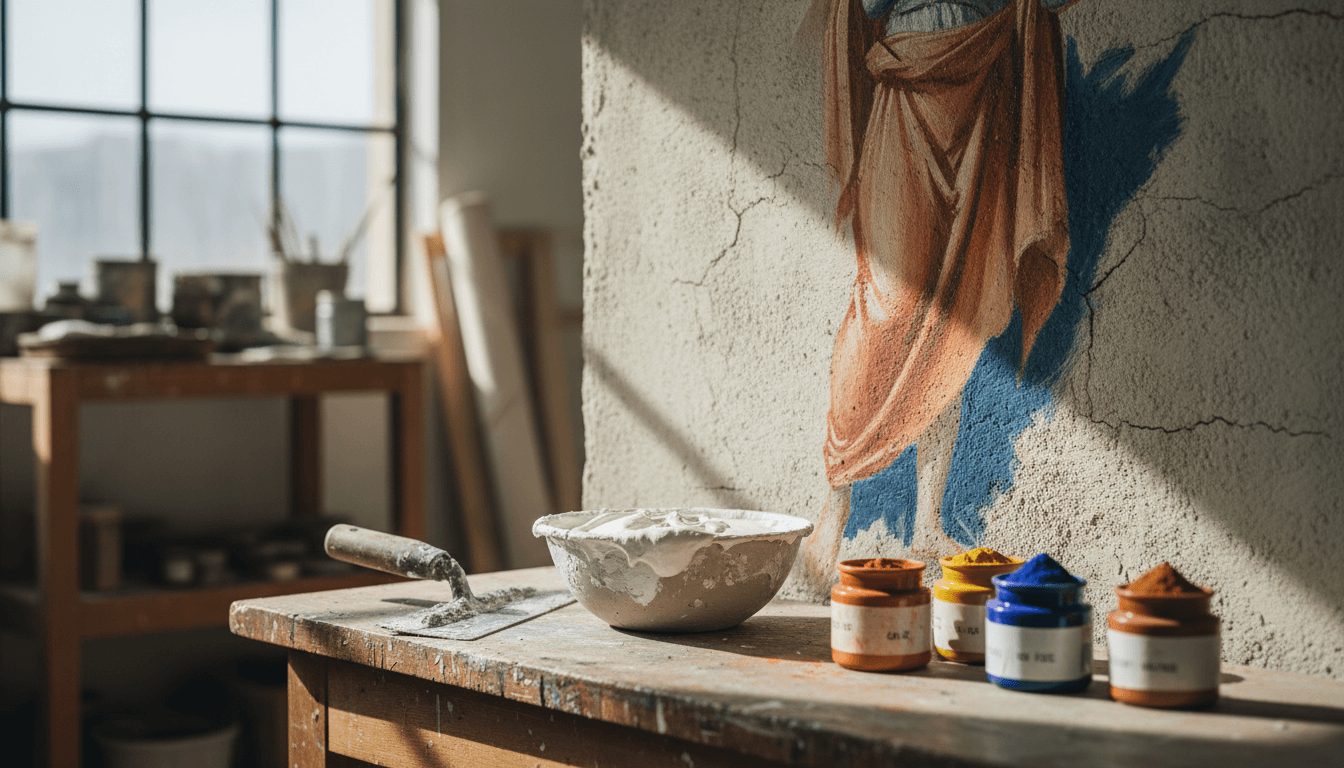
"Fresco" simply means "fresh" in Italian, and buon fresco — "true" fresco — describes pigment mixed only with water and applied directly onto plaster that's still wet. As the wet lime in the plaster dries, it undergoes a chemical reaction called carbonation: calcium hydroxide in the plaster reacts with carbon dioxide in the air, converting into calcium carbonate. That reaction doesn't just harden the wall — it locks the pigment particles into the plaster's own crystalline structure as it forms. The colour isn't sitting on top of the wall, the way it would on a conventionally primed and grounded surface. It has become part of the wall, which is exactly why a genuine buon fresco can survive scraping, weather, and centuries of handling that would strip an ordinary painted surface bare.
The catch that makes it so demanding
Carbonation only works while the plaster is still wet, which gives a painter a window of just a few hours to complete each section before the surface sets and stops accepting pigment. Painters solved this by working in patches — a section called a giornata, literally "a day's work" — plastering only as much wall as they could realistically finish before it dried, then plastering the next adjoining patch the following day. Mistakes couldn't be painted over; a section that went wrong had to be chipped away and re-plastered from scratch. The technique also has a real limitation: certain pigments, particularly some blues like azurite, react poorly with the plaster's strong alkalinity and simply don't work applied wet.
Fresco secco: easier, and worse for exactly one reason
Fresco secco solves both problems by painting onto plaster that's already dry, using a separate binder — egg, animal glue, or oil — to hold the pigment to the surface instead of relying on the wall's own chemistry. This removes the time pressure entirely and opens up pigments buon fresco can't use, including the blues that its alkaline plaster destroys. The trade-off is durability: since the pigment never becomes part of the wall's structure, it sits on top of it, bonded only by whatever glue or oil was added — and that bond weakens with time, humidity, and handling in a way the buon fresco reaction never does.
Advertisement
Why the Sistine ceiling and the Last Supper aged so differently
Michelangelo painted the Sistine Chapel ceiling almost entirely in buon fresco, and its colours remain vivid enough today to read clearly from the floor, decades and centuries of visitors later. Leonardo, working on The Last Supper a decade or so earlier, in the mid-1490s, experimented instead with an oil-and-tempera mixture applied to a dry wall — closer to fresco secco's structural logic — seeking the blending control that buon fresco's speed didn't allow. The painting began visibly deteriorating within Leonardo's own lifetime and has required repeated, extensive restoration ever since. Both painters were working at the absolute height of their skill. Only one of them was working with a technique that chemically bonds itself into the wall.
The bottom line
"Fresco" isn't one durable technique — it's two, and only one of them earns its reputation for permanence through actual chemistry rather than through the reputation of the artist using it. Buon fresco survives because the wall itself becomes the paint film; fresco secco survives only as long as its added binder does, which is considerably less long. Michelangelo's ceiling and Leonardo's wall are the two most famous demonstrations of that difference the art world has ever produced.
FAQ
What's the actual difference between buon fresco and fresco secco?
Buon fresco applies pigment to wet plaster, where a chemical reaction locks the colour permanently into the wall; fresco secco applies pigment with a separate binder to plaster that's already dry, which is easier but far less durable.
Why couldn't Michelangelo use certain blues in buon fresco?
Some blue pigments, like azurite, react badly with the strong alkalinity of wet lime plaster, so painters often had to apply those specific colours afterward using the secco method instead.
Why did Leonardo's Last Supper deteriorate so quickly?
Leonardo used an oil-and-tempera mixture on dry plaster rather than true buon fresco, seeking more time to blend and rework — a choice that gave him control but sacrificed the durability of the wet-plaster technique.
What is a "giornata" in fresco painting?
A single day's section of wet plaster, sized to exactly what an artist could paint before it dried — the basic working unit of buon fresco.
Is fresco painting still used today?
Yes, though far less commonly than in the Renaissance; some muralists still use true fresco for its unmatched durability, while most modern wall art uses faster, more flexible materials like acrylic.