Did Vermeer Secretly Use a Camera?
Vermeer's paintings contain optical distortions a naked eye shouldn't produce. One researcher's independent room reconstruction makes the case surprisingly strong — even though most art historians reject the wider theory it's part of.
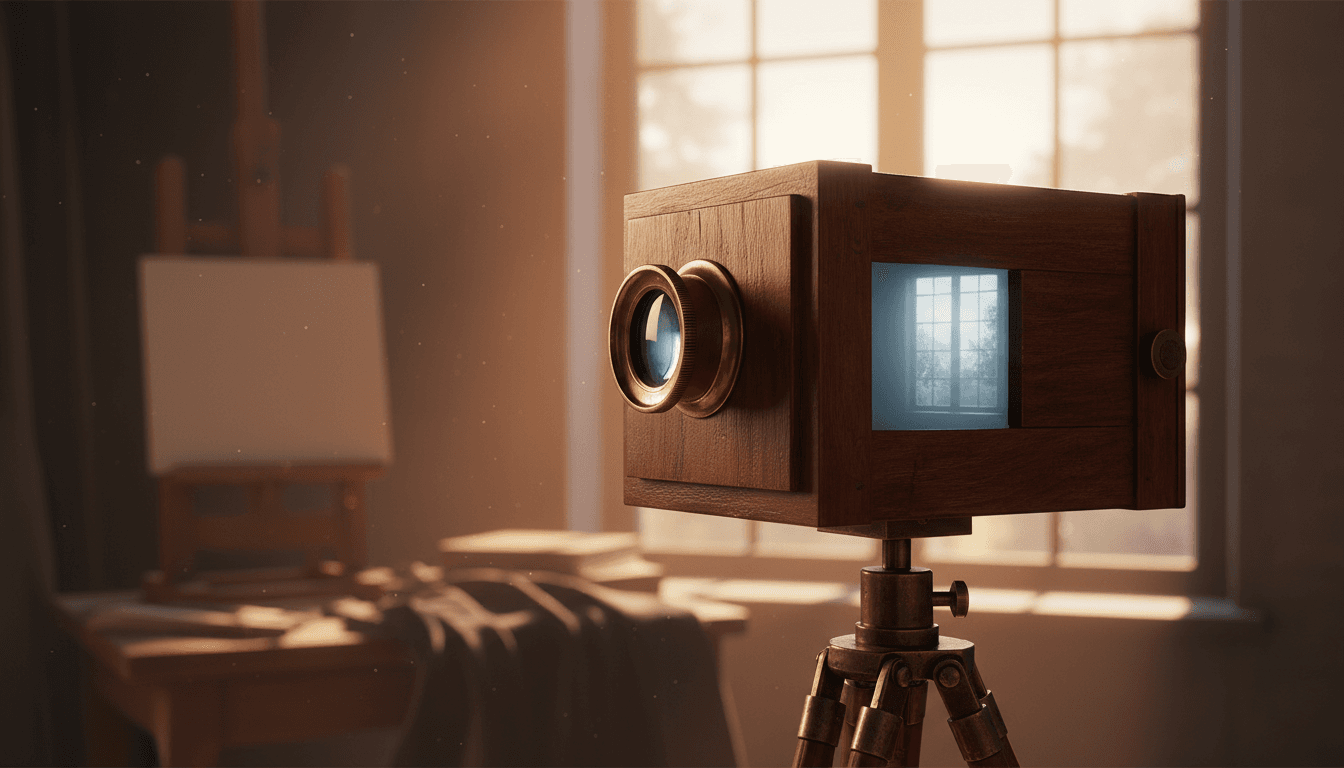
Did Johannes Vermeer secretly trace his paintings from a projected image, the way a photographer works from a lens rather than a naked eye? For a Dutch painter working in the 1650s and 60s, decades before anything resembling a camera existed in the form we'd recognise, that sounds like it should be an easy no. The actual case is stranger and more contested than that, and it hinges on optical artefacts that shouldn't appear in a painting at all — unless something like a lens was involved.
The claim
In 2001, the painter David Hockney published Secret Knowledge, arguing alongside physicist Charles Falco that the sudden leap in realism across Western art since the early Renaissance wasn't purely a matter of improving skill — it was substantially the result of artists using optical aids: the camera obscura (a darkened chamber that projects an image through a small aperture), the camera lucida, and curved mirrors, deployed far earlier and more widely than art history had previously assumed. Vermeer became the theory's most-discussed test case, because his paintings show specific visual quirks — out-of-focus passages in places a naked eye would naturally keep sharp, and bright, halo-like highlights on rounded surfaces — that match exactly the kind of distortion a simple lens produces, rather than anything a human eye actually sees.
The evidence for it
The strongest single piece of evidence didn't come from Hockney at all. The architectural historian Philip Steadman reconstructed the specific rooms depicted in several Vermeer interiors using the mathematics of the paintings themselves — the same kind of geometric precision that Renaissance perspective had made possible two centuries earlier, just run in reverse to infer a room from a painting rather than a painting from a room — and found that at least six of his canvases match an actual physical room with a precision that's very hard to explain without some kind of optical device fixing the exact geometry in place. The art historian James Elkins — otherwise cautious about the Hockney-Falco thesis generally — has called the case for Vermeer specifically about as close to proven as this kind of historical question gets.
The evidence against, and the practical objections
The broader Hockney-Falco claim — that this was standard practice across Renaissance and Baroque painting generally — hasn't fared nearly as well. Mainstream art history has largely set it aside; one skeptical assessment noted it carries essentially no currency within the field of legitimate art history, despite generating plenty of public attention. The physicist and Stanford professor David Stork raised a specific practical objection: a real camera obscura projects an image upside down and quite faint, which makes it a much harder tool to trace from accurately than the theory assumes. Elkins, even while taking the Vermeer case seriously, has pointed out that the actual experience of working from inside a camera obscura remains "radically undertested" — nobody, including the theory's proponents, has fully verified what it's really like to paint from one over the timescale a finished canvas would require.
Advertisement
What the practical test actually showed
In 2013, the retired software engineer Tim Jenison spent roughly five years attempting to settle the question empirically, using a simple mirror-and-comparator rig — not a true camera obscura, but a related optical aid — to reproduce a Vermeer interior stroke by stroke, without any formal training as a painter. The resulting film, Tim's Vermeer, documented a result that looked convincingly like Vermeer's work. What it demonstrated is that an optically-assisted, non-painter can produce Vermeer-like results with enough patience. It does not demonstrate that Vermeer himself used this exact method, only that the method is genuinely capable of it.
Where the investigation stands
The sweeping version of the Hockney-Falco thesis — that optical devices quietly explain the whole arc of Western realism — remains rejected by most working art historians. The narrower, Vermeer-specific claim is taken far more seriously, resting on Steadman's independent architectural reconstruction of Vermeer's actual rooms rather than on Hockney's visual intuition alone. Even here, though, "very likely" is different from "proven": no camera obscura or lens has ever been found among Vermeer's possessions, no contemporary document describes him using one, and the case remains built entirely on inference from the finished paintings — persuasive inference, but inference all the same, in much the same way Impressionist painters two centuries later were working from a theory of light and colour perception long before anyone could measure exactly what the eye was actually doing.