Why Paint Cracks: Flaking, Craquelure, and Age
Cracks in old paintings are not simply a sign of age. They are a record of movement — the support, the ground, and the paint film pulling against each other.
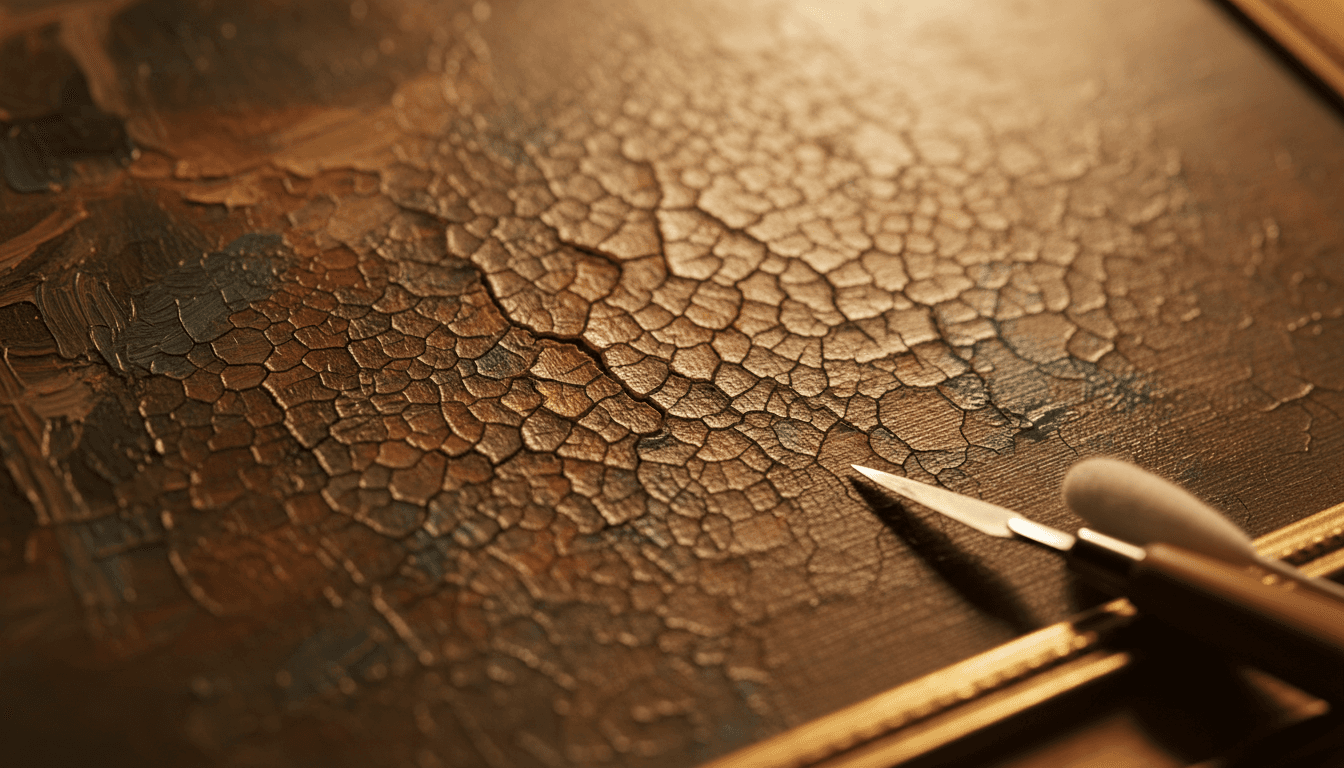
"It's just aging" is the explanation most people reach for when a painting develops a network of fine cracks, and it's not quite right. Age is the clock, not the cause. The actual mechanism is mechanical: a painting is a stack of different materials, each expanding and contracting at its own rate as temperature and humidity change, and cracking is what happens when that disagreement between layers finally exceeds what the weakest layer can absorb.
At a glance
| Crack type | Looks like | Caused by |
|---|---|---|
| Craquelure | A fine, even network of hairline cracks | Slow, repeated movement between layers over years |
| Drying cracks (alligatoring) | Coarse, mud-like cracking in the paint itself | A layer applied too thick or dried too fast |
| Flaking | Paint physically lifting or falling away | Failure of the ground or support underneath |
| Impact cracks | Cracks radiating from one point | Physical damage — a knock, drop, or careless handling |
Why a painting is a disagreement waiting to happen
A finished painting is a laminate: support, size, ground, paint, often a varnish on top — and every one of those layers has its own rate of expansion and contraction as humidity and temperature shift. Canvas moves constantly with moisture; a rigid wood panel moves less but can warp or split instead; the ground and paint film sit somewhere in between, and typically get stiffer, not more flexible, as they age. Stress builds at whichever interface is weakest, and cracking is that stress finding a release.
Craquelure — the fine, even web of hairline cracks visible on many old paintings, including some of the most famous ones in the world — is the signature of this process operating slowly, over centuries of ordinary humidity cycling. It's usually stable and doesn't threaten the paint's survival; it's essentially the painting settling into equilibrium with its environment.
Drying cracks are a technique problem, not an age problem
A completely different kind of crack can appear within months of a painting being finished, and it has nothing to do with age. If a layer is applied too thickly, or dries unevenly, the surface can skin over while the paint underneath is still curing — and as the interior finally dries and shrinks, the surface film cracks into the coarse, reptilian pattern painters call alligatoring. It's avoidable with technique: build up paint in thin layers, respect the "fat over lean" rule (each layer should be more flexible than the one beneath it, not less), and don't rush a thick final layer.
Flaking is the one that actually matters urgently
Craquelure is cosmetic; flaking is not. Flaking means the bond between two layers has genuinely failed and the paint is lifting or falling away from the support underneath — usually the result of a brittle or poorly prepared ground, a support that's moved more than the paint film can tolerate, or moisture that's worked its way between the layers. This is the one situation where waiting is actively costly: paint that's already lifting can be lost entirely, and a conservator should see it before it gets worse, not after.
Advertisement
What conservation actually does about it
- Assess. A conservator identifies the materials, maps the crack pattern, and checks whether the paint is stable or actively lifting, producing a condition report that becomes the baseline for everything after.
- Stabilise, don't restore. The guiding principle is minimal intervention: the goal is to stop active damage, not to make the painting look new. Every treatment is itself a permanent change to a historical object, so the least invasive option that achieves stability is preferred.
- Consolidate. Where paint is lifting, an adhesive is introduced under the flakes to re-bond them to the support — delicate, slow work, done under magnification.
- Address the support, if that's the actual source. A weak canvas may be lined (bonded to a new support); a warped panel may be braced. These are more invasive steps, used only when the support itself is the underlying problem.
The environment is the real lever
Controlling temperature and humidity does more to prevent future cracking than almost anything else available to an owner, because stress accumulates from movement, and stable conditions simply mean less movement. A painting hung over a working fireplace or radiator, or moved repeatedly between a humid basement and a dry, heated room, will develop damage far faster than one kept in steady conditions — the difference is measurable, and it's also the most within an owner's control of anything on this list.
Where varnish fits into the picture
Varnish sits on top of the paint film as a sacrificial, removable layer, and it plays a double role in this story. It protects the paint underneath from dirt, moisture, and UV exposure, but it can also crack in its own right — a varnish that's too hard and inflexible for the paint layer beneath it will craze independently, sometimes creating a pattern that looks like paint damage but is actually confined entirely to the surface coating. That distinction matters, because a cracked varnish can often simply be removed and replaced without touching the paint at all, while a cracked paint layer cannot.
Basic handling and display, for anyone who isn't a conservator
- Lift and carry a painting by the frame, never by pressing on the canvas itself.
- Move it vertically, not flat, which puts less uneven stress on the paint film.
- Keep it away from direct sunlight and heat sources, both of which accelerate ageing and, for sunlight, cause irreversible fading.
- Check it periodically. A new crack, or an edge that looks like it's lifting slightly, is worth a conservator's opinion before it becomes a bigger problem.
Why craquelure is sometimes part of the appeal
Stable craquelure isn't only tolerated by collectors — it's often read as a mark of authenticity, a visible patina that a modern reproduction or a recent forgery typically lacks. Conservators and scholars also use the specific pattern of a painting's craquelure as a kind of fingerprint: it varies by the materials used, the support, and the way the paint was applied, and can support (or undercut) an attribution or an estimated date. The cracks aren't only a flaw to manage — they're also a record of exactly how, and under what conditions, the painting was made.
The bottom line
Paint doesn't crack because it's old — it cracks because it moved, and movement is a function of environment and materials working against each other, not the passage of time on its own. Build layers that agree with each other, keep the environment stable, and treat flaking as urgent while treating fine craquelure as expected. That's most of what determines whether a painting lasts a decade or several centuries.
FAQ
What is craquelure?
The fine network of cracks that develops in a painting as its layers move against each other over years of ordinary temperature and humidity changes. It's usually stable and cosmetic.
Is craquelure a sign a painting is damaged?
Not typically — it's an expected, largely harmless feature of aging paint layers, and it's sometimes read as a mark of authenticity rather than damage.
What's the difference between craquelure and flaking?
Craquelure is surface cracking with the layers still bonded; flaking means the paint has actually separated from what's underneath and is lifting or falling away. Flaking needs prompt attention; stable craquelure generally doesn't.
How can I prevent my paintings from cracking?
Keep them in a stable environment away from heat and direct sunlight, handle them by the frame, and have any new or worsening crack looked at by a conservator early rather than late.
Why do some paintings develop cracks within months of being finished?
That's usually a drying crack from paint applied too thickly or too fast, not an ageing crack — it's a technique issue rather than a materials-aging issue.