How a Painting Is Actually Made: A Complete Guide to Mediums, Grounds, and Technique
Every painting is a stack of decisions made in order — support, ground, binder, technique — and each one constrains everything after it. Here's the complete physical process, from bare panel to a five-hundred-year-old surface still slowly curing.
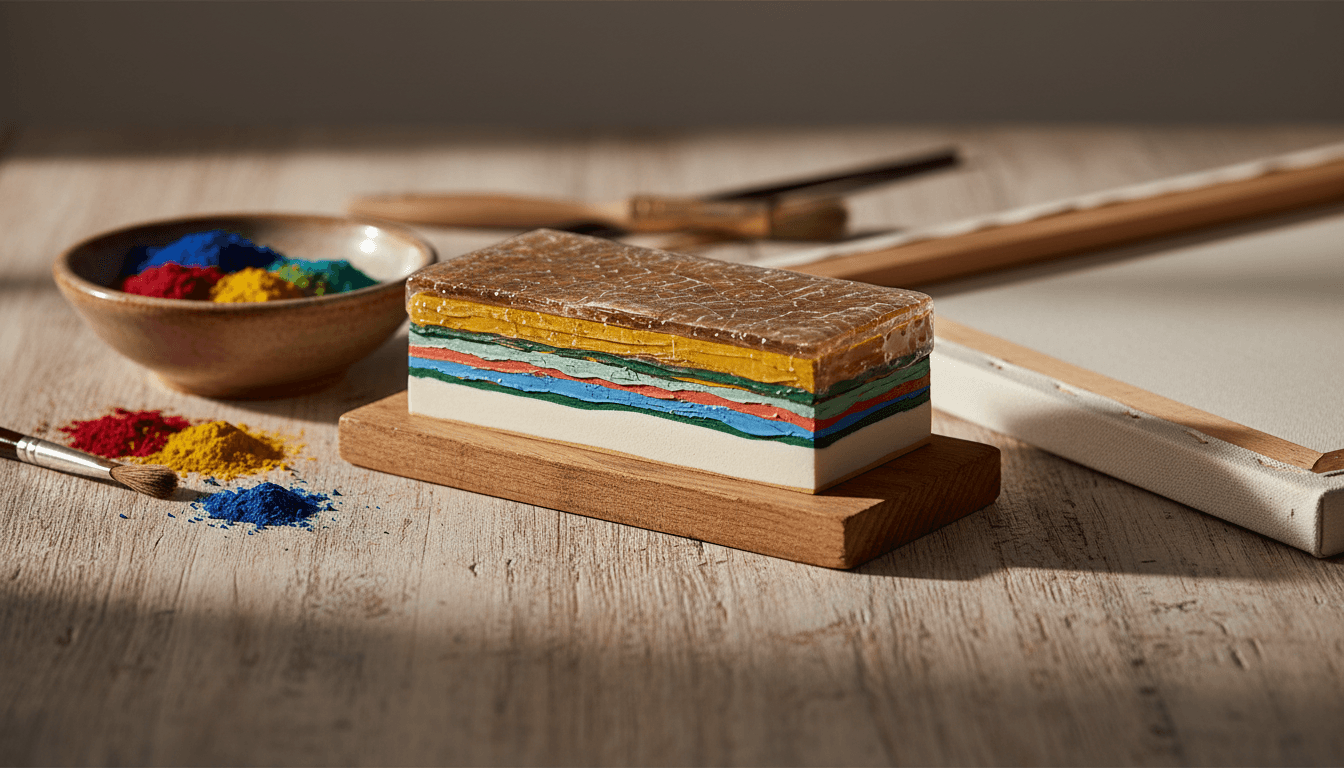
A finished painting looks like one continuous surface, but it's really a stack of separate decisions, each one made before the last one had a chance to fail. Choose a support, and you've already limited which grounds will hold. Choose a ground, and you've already decided which binders will bond to it properly. Choose a binder, and you've already set how long you have to work, how the piece will age, and what can eventually go wrong with it. None of these choices get made in isolation, and almost none of them can be undone once the next layer goes on. This is the complete build order — drawing to varnish, wet to fully cured — and the physical logic connecting every step.
At a glance
| Layer | Job | Main options |
|---|---|---|
| Support | The physical surface everything sits on | Wood panel, canvas, paper |
| Ground | Seals and gives the paint something to grip | Traditional chalk gesso, oil ground, acrylic gesso |
| Binder | Holds pigment together and to the ground | Egg, oil, wax, acrylic polymer, gum arabic |
| Technique | How light, form, and edges get built | Sfumato, chiaroscuro, grisaille, cross-hatching |
| Finish | Protects and seals the final surface | Varnish, wax, nothing at all |
Before any paint: drawing and transfer
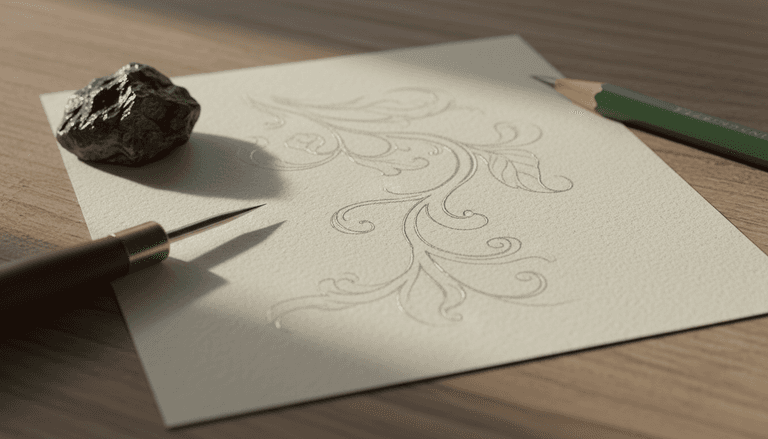
The very first marks on a support are usually never painted at all. A composition worked out on paper — a cartoon, in the technical sense of the word, from the Italian cartone, simply "large paper" — gets transferred onto the panel or canvas by one of a small number of established methods, and the choice of method has left physical traces conservators still read today. Pouncing pricks small holes along every drawn line of the cartoon, then pushes powdered charcoal or chalk through the holes onto the surface below, leaving a dotted outline a painter connects with a thin preliminary line; the technique was standard in fresco and panel painting for centuries, and pounced cartoons occasionally survive in their own right as historical objects. Squaring up, the more geometric alternative, overlays a grid on a smaller study and an enlarged matching grid on the final surface, letting an artist transfer proportions accurately square by square — the same method later adapted almost unchanged for enlarging photographs by hand before digital projection existed. A third option, direct transfer by tracing over a chalked or graphite-backed sheet, works closer to a modern carbon-copy and leaves a continuous rather than dotted line.
Once the composition is established, many painters worked from a further preparatory layer before any final color went down at all: a monochrome underdrawing directly on the ground, sketched in charcoal, ink, or a thin wash, establishing the composition's major masses and correcting proportions while corrections were still cheap. A separate tradition works this same problem out in color rather than value alone: a bozzetto, a small, loosely painted color sketch, lets a painter test a composition's overall color relationships at a fraction of the final scale before committing to the full-size work, and finished bozzetti occasionally survive and are collected today as complete artworks in their own right, quite apart from the larger paintings they were made to plan. Infrared reflectography, an imaging technique conservators rely on because many paint layers turn transparent in near-infrared light while carbon-based drawing does not, sees straight through the finished paint layers to reveal an underdrawing intact — and it has repeatedly shown that even celebrated old masters shifted a hand, moved a window, or entirely repositioned a figure between the underdrawing stage and the final paint, evidence of real working revision hidden beneath a surface that looks, to the naked eye, entirely settled and premeditated.
Advertisement
Who actually painted it: the workshop system
For most of the history this article is describing, "a painting by" a named master often meant something closer to "a painting directed by" that master, produced with real, substantial help from a workshop of assistants and apprentices. A Renaissance or Baroque studio typically divided labor along exactly the lines this article has already laid out: the master would establish the composition and execute an underdrawing or a color bozzetto personally, then hand off large, less individually demanding passages — background, drapery, secondary figures — to trained assistants working from the master's own studies, before returning to paint the passages that mattered most to the finished work's reputation, typically faces and hands. This wasn't considered dishonest at the time; it was simply how a busy, in-demand studio met demand that vastly exceeded what one person could physically paint, and workshop contracts from the period sometimes specify exactly which passages the master himself was contractually obligated to paint personally, leaving everything else to the studio's discretion.
This division of labor is part of why attribution disputes are such a persistent feature of art history, and part of why the same conservation science already discussed in this article — infrared reflectography, pigment analysis, even simple stylistic comparison of brushwork under magnification — gets applied specifically to separate a master's own hand from an assistant's competent but recognizably different touch within a single painting. A canvas can genuinely be "by" a famous name and still contain passages painted by three or four different hands, a fact the finished, unified surface was always designed to disguise rather than reveal.
Choosing a support
The very first physical decision — panel or canvas — already commits a painter to a set of consequences that show up decades later. Wood panel is rigid, heavy, and size-limited by the width of available timber, but it produces the smooth, stable surface that egg tempera specifically needs. Canvas flexes with humidity instead of fighting it, which is exactly why Venetian painters shifted toward it during the sixteenth century — cheap, plentiful sailcloth from the city's own shipyards, and a surface that could be rolled for shipping rather than crated as a rigid board. Neither support is simply better; a panel that would crack under canvas's constant flexing is exactly why panel painting stayed an interior, workshop medium while canvas took over everything that had to travel or scale up.
Scale itself is a related decision that reaches back into every choice above it. A small panel or canvas, worked at arm's length and viewed at the same distance, rewards fine detail and close, deliberate brushwork; a large canvas, often worked standing back and viewed across a room, has to read correctly from a distance the painter isn't actually painting at, which is why large-scale work frequently uses broader, more simplified passages that would look crude up close but resolve into convincing form once the viewer steps back to the intended viewing distance. Painters working large also face a purely physical constraint smaller work never raises: a canvas over a certain size needs a heavier wooden stretcher frame with internal cross-bracing to resist warping under its own tension, and transporting a finished large-scale work at all becomes a genuine logistical project rather than an afterthought.
The ground: the layer nobody's supposed to notice
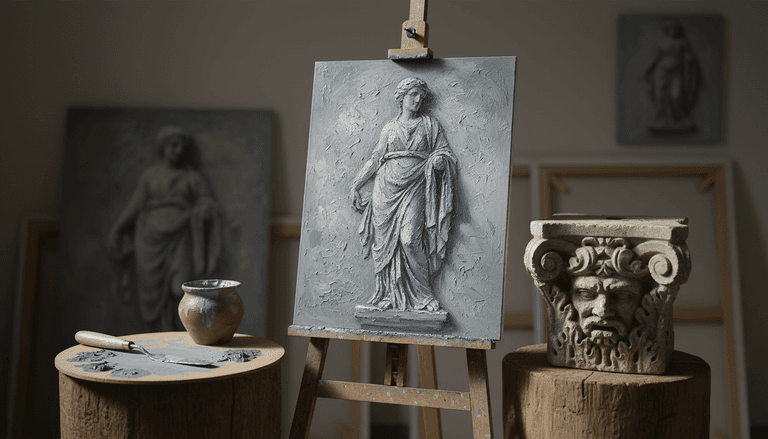
Whatever the support, nothing gets painted directly onto it. A ground seals the raw material so it doesn't drink up the binder above it, gives the surface a texture the paint can actually grip, and isolates the paint from whatever chemistry the support brings with it — unsealed canvas is acidic enough to rot from contact with raw oil over time. Traditional gesso, described in detail by the Italian painter Cennino Cennini around 1400, is chalk or gypsum bound in rabbit-skin glue, brushed on in many thin coats and sanded smooth between them; it's also brittle enough that it only works on a rigid panel, never on flexing canvas. Modern acrylic gesso solved that specific problem by trading rigidity for flexibility, which is part of why it became the default ground for canvas painting of every kind. An absorbent ground pulls binder out of the paint above it and produces a matte result; a sealed ground keeps paint sitting on the surface and produces something glossier and more saturated — neither is automatically correct, but the choice changes the final painting whether or not the painter meant it to.
Many painters add one further layer on top of a finished ground before any real color begins: an imprimatura, a thin, transparent, colored wash — often a warm earth tone or a mid-value grey — that tints the entire ground a single unifying hue rather than leaving it stark white. Painting on top of a toned ground lets small gaps of bare surface, deliberately left visible between brushstrokes, read as a coherent mid-tone rather than a jarring flash of white, and it gives a painter an instant, unified starting value to push both lighter and darker from, rather than judging every new stroke against pure white.
Advertisement
The binder decides almost everything else
Once the ground is ready, the single biggest decision left is which binder will actually carry the pigment — and this one choice determines working time, blending behavior, aging pattern, and how the painting can eventually fail.
Egg tempera was the medieval and early Renaissance default: egg yolk is a natural emulsion of water and fatty compounds, and it dries in minutes rather than days by simple desiccation rather than any chemical cure. That speed makes blending nearly impossible, which is why painters working in tempera built form through cross-hatching — thin strokes of slightly different tone layered like pencil shading — rather than the soft transitions oil allows. Oil paint solved tempera's core limitation by trading speed for time: linseed and the other drying oils cure through a slow oxidation reaction that can take years to fully finish, giving a painter hours or days to blend, glaze, and rework a single passage rather than committing to it in seconds. That same slow cure is also why the choice between linseed, walnut, poppy, and safflower oil matters as much as the pigment itself — linseed dries fastest and forms the toughest film but yellows the most, while the paler oils sacrifice strength for clarity, which is exactly why they're reserved for whites and pale colors that would otherwise drift warm with age.
Painters manage oil's drying speed further with siccatives, metal-based driers — commonly cobalt or manganese compounds — added in small amounts to accelerate oxidation in an otherwise slow-curing passage, and with retarders, the opposite additive, used to hold a passage open longer for extended blending. A twentieth-century compromise medium, alkyd resin, offers much of oil's working feel and depth while curing considerably faster through a related but distinct chemical mechanism, and has become a popular choice for painters who want oil's optical qualities without oil's patience requirement.
Two other binders solved entirely different problems. Encaustic uses molten beeswax, kept liquid on a heated palette and fused with heat after each layer — a chemistry so stable that the Fayum mummy portraits from Roman Egypt still show vivid, largely unfaded color two thousand years later, the best durability record of any painting medium on this list. Acrylic, barely seventy years old as an artist's material, uses a polymer emulsion that cures by coalescence rather than oxidation or desiccation: as water evaporates, microscopic plastic particles fuse into a single continuous film that will never redissolve in water again, unlike watercolor's gum arabic binder, which never stops being water-soluble no matter how long ago it dried. The same coalescence is also why acrylic paint reliably darkens as it dries — the binder is milky white while its particles are still separate and turns clear once they fuse, lifting a pale veil off the color underneath.
Choosing and organizing a palette
The physical arrangement of paint on a palette is its own working decision, made fresh at the start of every session. Many painters lay out their colors in a fixed, repeated order — often warm to cool, light to dark, or by pigment family, arranged the same way every time — specifically so the hand can find a given color without the eye needing to hunt for it mid-stroke, a small habit that removes one entire category of interruption from sustained, focused work. A limited palette, restricting the working colors to a small handful of pigments (often a warm and cool version of each primary, plus white), forces every mixture to come from the same small family, which tends to produce a naturally unified, harmonious result across a whole painting simply because every color shares some pigment DNA with every other color on the canvas; an extended palette, adding numerous specialized pigments for the exact colors they'd otherwise require mixing, trades that automatic harmony for direct access to intense, hard-to-mix colors like the phthalocyanines and quinacridones no combination of earth pigments can reach on its own.
Mixing itself follows a hierarchy most painters learn by trial and error rather than instruction: value (how light or dark a color is) reads from across a room even when hue is slightly wrong, while hue read up close matters more for convincing a viewer standing directly in front of the work. Getting the value structure of a painting correct first, even in a rough, nearly monochrome pass, and refining hue and saturation afterward, is why so many working methods — from grisaille underpainting to a loose tonal bozzetto — front-load value decisions before color ones; a painting with perfect color but a confused value structure reads as flat and unconvincing from any distance, while a painting with slightly imperfect color but a clear, correct value structure reads as solid and three-dimensional even from across a large room.
Brushes, knives, and the marks they leave
The tool a painter chooses to move paint is doing real, physical work that shows up permanently in the finished surface, and different tools were developed for genuinely different jobs rather than as interchangeable options. Round and filbert brushes, tapering to a point or a soft rounded edge, suit detail work and blended transitions; flat and bright brushes, squared off at the tip, lay down broad, controlled strokes and sharp edges more efficiently. Bristle brushes, traditionally hog hair, are stiff enough to move thick, heavily bodied oil paint and hold the texture of an individual stroke; softer sable or synthetic brushes spread thinner paint more smoothly and leave less visible brush texture behind, which is why detail work in any medium tends to favor the softer option regardless of what the bulk of the painting was built with.
Advertisement
A palette knife works on an entirely different principle: rather than dragging bristles through paint, it scrapes and presses a mass of pigment directly onto the surface, producing flat planes and sharp ridges a brush structurally cannot make, and painters working in a heavily impastoed style — thick, sculptural ridges of paint standing physically off the surface — often reach for a knife specifically because it can move far more paint per stroke than a brush without dragging or smearing what's already there. Impasto isn't only a visual effect; it's a real change in how light interacts with the finished surface, since a genuinely three-dimensional ridge of paint catches studio or gallery light differently depending on the viewer's position, adding a literal, physical dimension of change a flat passage of the same color can't replicate no matter how it's mixed.
Fresco plays by a completely different rule
Every binder above assumes paint sitting on top of a ground. Fresco inverts that relationship entirely. In true buon fresco, pigment mixed only with water is applied directly to wet lime plaster, built up in two distinct layers — a rough base coat called the arriccio, followed by a fine, smooth finishing layer called the intonaco that actually receives the paint — and as the plaster dries, a chemical reaction called carbonation locks the pigment permanently into the wall's own crystalline structure. The color isn't sitting on the surface; it has become part of it, which is why Michelangelo's Sistine ceiling has held its color for five centuries. The catch is brutal: carbonation only works while the intonaco is wet, giving a painter just a few hours per section before it sets, which is why frescoes are built from small daily patches called giornate — visible today, in raking light, as faint seams where one day's plastering met the next. Fresco secco, painting onto plaster that's already dry with a separate binder added, removes that time pressure entirely — which is closer to what Leonardo actually used for The Last Supper, and part of why it began deteriorating within his own lifetime. Michelangelo's ceiling, true fresco apart from a few passages finished dry, has had its own troubles — the 1797 explosion of a powder magazine at Castel Sant'Angelo brought down the plaster under part of the Flood and most of one of the ceiling's nude youths, and its 1980–94 cleaning had to strip away centuries of candle soot and the animal glue earlier restorers had brushed over it — but its paint has never failed the way Leonardo's did.
Building light and form once the paint is down
With a binder chosen, the next layer of decisions is entirely about how light and form get constructed on the surface — and this is where painting stops being pure chemistry and starts being optics. Chiaroscuro began as a Renaissance drawing convention before migrating into full painting as one of four canonical modes for handling light, modeling a figure's volume through gradual, naturalistic shadow rather than a hard edge; Caravaggio's later, more extreme version — tenebrism — plunges the background into near-total blackness and turns light into a spotlight rather than a modeling tool, exploiting the same basic fact of vision that a gradual gradient reads as a curved surface while a sudden edge reads as a boundary. Sfumato solves a related but distinct problem: eliminating the edge itself, built from dozens of extremely thin, translucent oil glazes with no visible boundary between one tone and the next — a technique only possible because oil's slow cure allows that much patient layering, and one with a measurable optical effect on the eye, since research into the Mona Lisa's famously shifting smile has shown the softness reads differently to a viewer's central and peripheral vision. Grisaille, a monochrome technique with real roots in a 1134 Cistercian ban on colorful church art, took on an entirely separate life as an underpainting stage — a "dead colouring" layer establishing a composition's full value structure before any color glaze goes on top, since getting light and shadow right in grey first makes every subsequent color decision more reliable.
Glazing: building color in layers rather than mixing it once
A glaze is a thin, transparent layer of paint, heavily diluted with medium, applied over a fully dried layer beneath it — and the optical result is genuinely different from mixing the same two colors together on a palette first. Light passes through a glaze, reflects off the opaque layer underneath, and passes back through the glaze a second time on its way to the eye, picking up color twice rather than once; the result reads as deeper and more luminous than a single flat mixture of the identical pigments ever could, because the light is doing more optical work on its way through. This is the technical foundation behind the glowing, jewel-like color in Northern Renaissance panel painting specifically — dozens of thin glazes built up patiently over a pale ground, each one drying fully before the next went on, a process that could take weeks for a single passage and that depends entirely on oil's slow cure to be possible at all. The rule painters follow to keep this process from cracking later is "fat over lean": each successive layer should contain at least as much oil as the layer beneath it, since a fast-drying, lean layer applied over a slower-drying, oil-rich one will cure and shrink first, pulling away from the still-moving layer underneath as it eventually catches up.
Advertisement
Protecting the surface: varnish and framing
Once the paint itself has cured enough to be stable — often a full year for a thickly painted oil passage, since surface-dry and fully cured are very different states — a final varnish layer seals and protects the paint film beneath it, saturating the colors slightly and evening out any differences in sheen between more and less absorbent passages. Traditional natural-resin varnishes, made from substances like dammar or mastic, yellow and gradually become insoluble over decades, which is precisely why conservators periodically remove and replace them rather than leaving a centuries-old varnish layer untouched — the paint underneath is treated as permanent, but the varnish is understood, from the moment it's applied, as a sacrificial, replaceable layer standing between the paint and the world. Modern synthetic varnishes resist yellowing far better and remain removable with gentler solvents, though many painters working in a traditional idiom still prefer a natural resin's specific optical warmth despite the long-term trade-off.
Varnishing too early — before the paint has genuinely finished curing rather than merely surface-dried — risks fusing the two layers that are meant to stay separate: Gamblin warns that a traditional dammar varnish dissolved in turpentine can crosslink with fresh paint, which is why it calls a wait of six months or more critical for that kind of varnish, and a varnish bonded into the paint can no longer be cleanly removed. Bloom, the cloudy, whitish haze that sometimes develops in a varnish, is a separate failure, usually caused by moisture caught in the varnish layer itself rather than by the age of the paint beneath it. Framing completes the protective sequence: glazing a finished work behind glass or acrylic sheet, ideally with a UV-filtering coating, blocks the specific wavelengths of light most responsible for pigment fading, while a slight air gap between the paint surface and the glazing prevents condensation from ever touching the paint directly.
Where it all goes wrong later
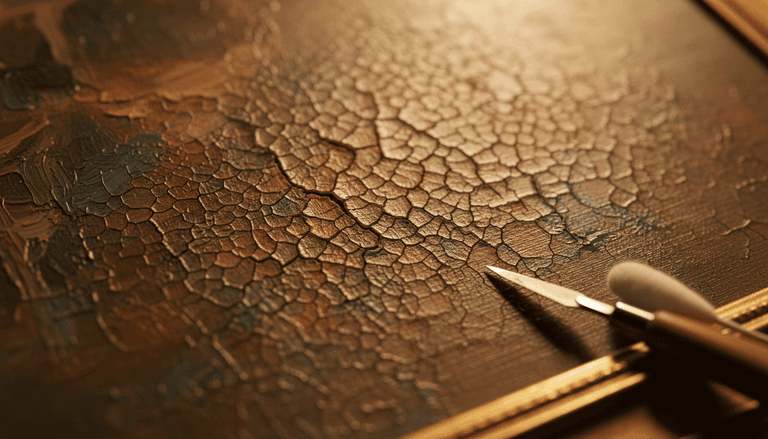
Every layer choice made at the start eventually shows up as a specific failure mode decades or centuries later, and most of them trace back to one root cause: a painting is a stack of different materials expanding and contracting at different rates as humidity and temperature shift, and cracking is what happens once that disagreement between layers exceeds what the weakest layer can absorb. Craquelure — the fine, even network of hairline cracks visible on many old paintings — is this process playing out slowly and harmlessly over centuries of ordinary environmental cycling. Flaking is different and genuinely urgent: it means a bond between layers has actually failed and paint is lifting away from its ground, usually from a brittle ground, a support that's moved more than the paint could tolerate, or moisture working its way between layers. Delamination, a related but more severe failure, occurs when an entire layer separates cleanly from the one beneath it rather than simply cracking on the surface — often the result of incompatible materials in adjoining layers, such as a fast-curing lean layer applied under a slower one in violation of the fat-over-lean rule. Drying cracks, the coarse "alligatoring" pattern that can appear within months rather than centuries, are a pure technique failure — paint applied too thick or too fast, skinning over at the surface while the interior is still curing underneath.
A decision framework, start to finish
- Work out the composition before touching the final surface. A cartoon, an underdrawing, or a squared-up transfer catches proportion problems while they're still cheap to fix.
- Pick the support for what the finished piece actually needs to do — rigid and stable for fine, controlled detail; flexible and portable for scale or shipping.
- Match the ground to the support's flexibility, not just its finish. A rigid ground on a flexing support is a crack waiting to happen.
- Choose the binder for the working time you actually want, not habit — tempera's speed, oil's patience, wax's permanence, acrylic's finality.
- Decide light and edge-handling as a technique, not an afterthought — chiaroscuro, sfumato, and grisaille are each solving a different problem, not interchangeable "styles."
- Build depth through glazing rather than a single flat mixture, where the medium and the timeline allow for it.
- Respect the slowest-curing layer in the stack. Varnishing, framing, or reworking before the layer beneath has actually finished curing is how avoidable damage gets built in permanently.
FAQ
What's the very first decision that shapes everything else in a painting?
The support — panel or canvas — since it determines which grounds can physically hold and which binders will behave predictably on top of them.
Why can't traditional gesso be used on canvas?
It's too brittle for a support that flexes with humidity; it cracks and separates from the surface, which is why it stayed a panel-only ground while acrylic gesso became canvas's default.
Which paint medium gives a painter the most working time?
Oil, by a wide margin — its slow oxidative cure can leave a passage workable for a day or more, compared to tempera's minutes or acrylic's short open time before the film begins to set.
Why do old paintings develop a network of fine cracks?
Because a painting is a stack of materials that expand and contract at different rates as humidity and temperature shift, and craquelure is that mismatch playing out slowly and mostly harmlessly over centuries.
Is one painting medium simply more durable than the rest?
Encaustic has the best track record by far — Roman-era wax portraits still show vivid color after two thousand years — though durability always trades off against working speed, blending ability, or cost.
What's the difference between an underdrawing and an underpainting?
An underdrawing is a linear sketch, usually monochrome, establishing composition and proportion; an underpainting is a fuller tonal or color layer, like grisaille, establishing value and sometimes color temperature before the final paint layers go on top.
Why do conservators remove and replace varnish but never the paint underneath?
Varnish is designed from the start as a sacrificial, replaceable layer that protects the paint and yellows or degrades in its place; the paint film is treated as the permanent, irreplaceable part of the object.
How long should a painting actually cure before it's varnished?
Traditionally six months to a year for a thickly painted oil work, since the surface can feel dry within days while the interior is still curing. A natural-resin varnish such as dammar applied too soon can crosslink with the fresh paint and stop being cleanly removable; some modern varnishes in milder solvents can go on once the thickest passages are dry and firm. Bloom — a cloudy haze in the varnish — is a different problem, usually caused by trapped moisture.
What's the real difference between a limited and an extended palette?
A limited palette (a small, fixed set of pigments) tends to produce naturally unified color since every mixture shares the same few ingredients; an extended palette adds specialized pigments for colors, like bright magentas or greens, that no combination of a limited set can physically reach.
Why would a painter use a palette knife instead of a brush?
A brush drags bristles through paint and can blend, taper, and vary pressure; a palette knife scrapes and presses a mass of paint directly onto the surface, producing flat planes and thick, sculptural ridges (impasto) a brush structurally can't create.
What's the difference between a cartoon and a bozzetto?
A cartoon is a full-scale preparatory drawing, transferred to the final surface by pouncing (pricking holes and pushing powdered pigment through) or squaring up (scaling a grid); a bozzetto is a small, loosely painted color sketch testing the composition's overall color relationships before committing to full size.
Why are attribution disputes so common in historical painting?
Because Renaissance and Baroque studios commonly divided labor between a master and trained assistants, with the master often painting only the most reputation-critical passages personally — a single canvas can genuinely contain several different hands beneath one attributed name.