The Medium That Never Actually Dries
Touch a centuries-old pastel and colour still comes off on your finger. That's not decay — pastel never had enough binder to actually dry, and Degas spent years fighting exactly that problem.
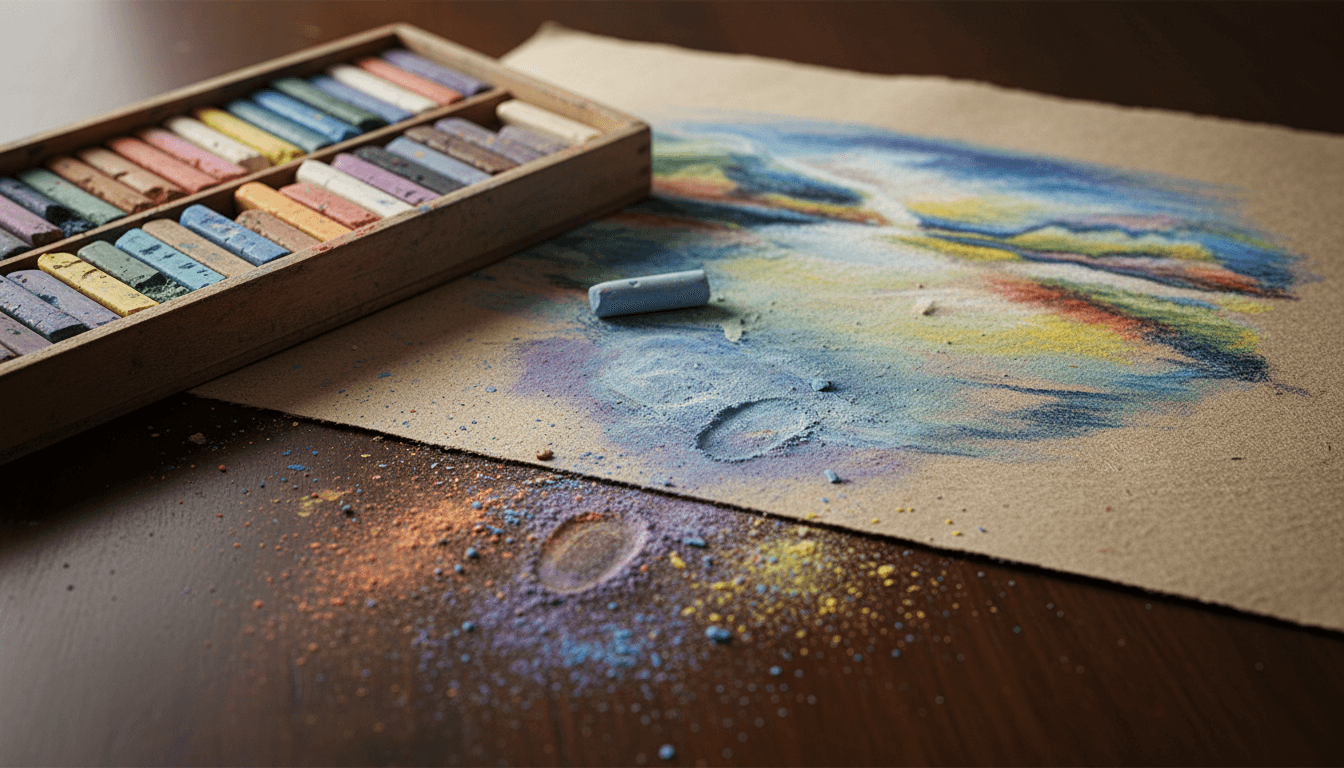
Run a finger across a finished pastel and colour comes away on your skin — centuries after the artist put it down. That's not damage or decay. It's the medium doing exactly what it has always done: pastel never actually dries, because there was never enough binder in it to cure into anything solid in the first place.
Birth: almost nothing but pigment
A stick of pastel is finely ground pigment mixed with only a minimal amount of binder — historically gum arabic, sometimes with a bit of chalk added to lighten or extend a colour — just enough to hold the powder together in stick form and no more. Unlike oil, acrylic, or watercolour, pastel involves no liquid binder at all during application: colour transfers to the paper because it's physically pressed into the tooth, the microscopic roughness, of the surface, and stays there through friction rather than any chemical bond. Because there's nothing here to cure, oxidise, or coalesce, a pastel painting is, in a real sense, never actually finished chemically. It's finished the moment the artist and the paper's texture agree to stop.
Early life: a portraitist's medium
Pastel's use for serious portrait work stretches back to at least the mid-seventeenth century, in the hands of painters like Robert Nanteuil, and it flourished through the eighteenth century with masters like Maurice Quentin de La Tour, who worked from a genuinely limited palette — reportedly as few as twenty-five colours — lightened or deepened by mixing in plaster chalk rather than reaching for a new stick. The medium's appeal was direct: because there's almost no binder diluting the pigment, a pastel mark reads with a brightness and saturation that other media, weighed down by oil or gum, generally can't match stroke for stroke.
Growing up: chemistry expands the palette
The nineteenth century changed pastel twice over. Manufacturers began binding sticks with a little oil or wax, making them less crumbly and easier to control, and the arrival of new synthetic dyes exploded the available colour range — suddenly including intense, previously impossible shades that earlier pastellists working from mineral and earth pigments simply never had access to. Painters like Degas and Edvard Munch inherited a genuinely richer, more chemically sophisticated medium than the one La Tour had worked with a century earlier.
Middle life: Degas solves the medium's real problem
Pastel's central limitation, then as now, is fixing it — spraying a dilute liquid over the finished surface to keep the loose pigment from simply falling off the paper over time. Commercial fixatives available to Degas altered the tone and dulled the colour's brightness, which frustrated a painter obsessively building up successive layers of colour, transparency, and contrast. His friend, the painter and chemist Luigi Chialiva, developed a custom fixative formula specifically for him — one that let Degas fix and build layer after layer without disturbing the colours already down, preserving both hue and the matte finish Degas wanted, a solution documented well enough to survive as an actual patent record.
Advertisement
Where it stands now
Pastel never solved its founding trade-off, and it was never really meant to: the same almost total absence of binder that makes its colour so vivid is exactly what makes the medium so physically fragile, vulnerable to smudging, falling dust, and anything short of careful framing behind glass with real spacing to keep the surface from ever touching it. It's a completely different failure mode from the cracking and flaking that eventually threatens an oil painting — pastel has no rigid film to crack in the first place, only loose pigment that was never asked to bond into one. That fragility is inseparable from the brightness — a pastel with enough binder to be sturdy would be a pastel with its whole reason for existing diluted away. Every finished pastel painting still hanging today is, quite literally, still just pigment resting in the paper's grain, held there by nothing more than the same friction that put it there in the first place.