How Oil Paint Dries: Oxidation, Not Evaporation
Oil paint does not dry the way watercolour does. It cures by reacting with oxygen, which is why it stays workable for days and why thick layers can wrinkle.
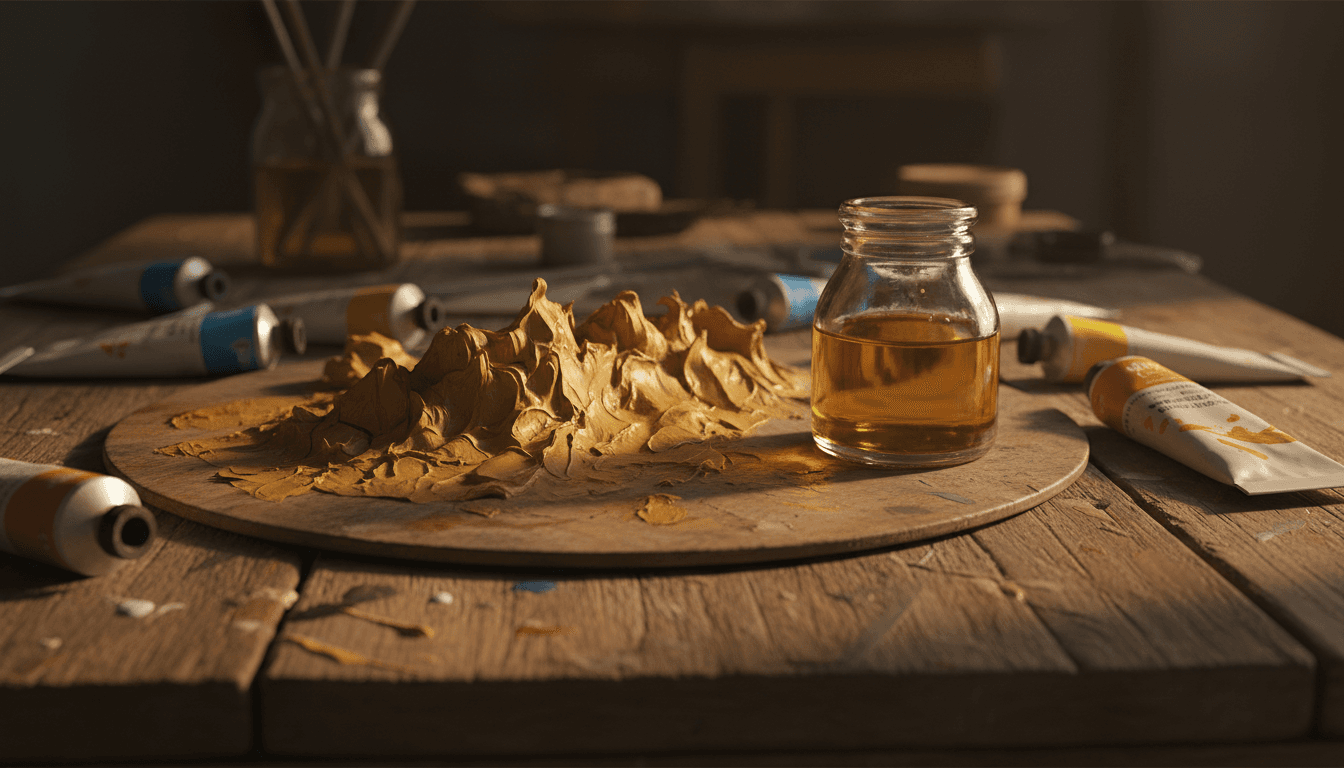
Fresh oil paint smells faintly of linseed, sits glossy and slow on the palette knife, and holds a brushstroke's ridge for hours after it's laid down. That last property is the tell: this is not a puddle waiting to evaporate. It is the beginning of a chemical reaction that, in the layers of a thickly painted canvas, will not finish for years.
Birth: a seed, pressed and refined
Oil paint's binder starts as flax seed, cold-pressed into linseed oil — the same crop, incidentally, that gives us linen canvas, so a painting's support and its paint can share a single field, laid down over a properly prepared ground before any of this chemistry gets to work. Poppy, walnut, and safflower oils serve the same role for painters chasing a paler, slower-drying alternative, but linseed has been the default since the medium existed, because its fatty acids are the most reactive of the bunch. That reactivity is everything: it is the entire reason oil paint behaves the way it does, from the moment it leaves the tube to the moment, decades later, a conservator examines it under raking light.
The choice of oil is already a decision about the painting's whole future. Linseed dries fastest and forms the strongest film, but it yellows the most over time — a real cost in a pale sky or a white dress. Poppy and safflower oils yellow less and stay workable longer, which is why they're often reserved for whites and light colours, but their films are measurably weaker, more prone to future cracking. There is no oil that wins on every count; a tube of "poppy white" and a tube of "linseed black" in the same set have already been formulated around this trade-off before the painter ever opens them.
First hours: alive and workable
| Watercolour (for comparison) | Oil paint | |
|---|---|---|
| Dries by | water evaporating | oxygen reacting with the oil |
| Surface dry | minutes | hours to days |
| Fully cured | minutes | months to years |
| Reversible while wet | yes | yes, for hours to days |
| Common failure | lifting | wrinkling, cracking |
Linseed oil contains unsaturated fatty acids — molecules with double bonds that are, chemically speaking, itching to react. Exposed to the air, they slowly bond to oxygen and then to each other, cross-linking into a network that hardens the paint from the outside in. Nothing evaporates, which is the whole reason watercolour can lift off the page while oil can't — one medium never stops being water-soluble, the other stops being soluble in anything at all once the reaction finishes. This is why a passage of oil paint can still be pushed around, blended, and corrected a full day after it went on the canvas — the surface may have begun to skin over, but the reaction underneath is only starting, and it is slow enough that a painter effectively gets to work in the reaction's very early minutes for as long as they like.
Advertisement
Middle life: the slow cure, and where it goes wrong
The cross-linking continues for months after a painting feels dry to the touch, and this delayed, differential hardening is the source of oil paint's two classic structural failures. A thick layer can form a skin at the surface, where oxygen is abundant, while the interior is still soft; as the interior finally cures and shrinks, the skin has nowhere to go but into wrinkles. And a lean layer — one with less oil — laid over a fatter one sets rigid first, then cracks as the oilier film beneath it keeps moving and shrinking for months afterwards — the reason painters follow the rule of "fat over lean," building each layer with at least as much oil as the one before it.
Pigments are not passive bystanders in any of this. Lead white and the cobalt colours are known to accelerate the oxidation; certain organic pigments retard it considerably, which is why two tubes from the same manufacturer, bought on the same day, can dry at visibly different rates. Manufacturers add metal-based driers — commonly cobalt, manganese, or zirconium compounds — specifically to even out these differences and keep a whole palette workable on a similar schedule.
The myth of the medium's invention
Oil-based paint is often credited to the Flemish painter Jan van Eyck in the 1430s, a claim that traces back to Giorgio Vasari's Lives of the Artists in 1550. It isn't true, and it wasn't even new information when Vasari wrote it down: a German monk writing under the name Theophilus had already described oil-based painting techniques in a treatise called On Divers Arts around 1125, three centuries earlier. What van Eyck actually did, in works like the Ghent Altarpiece completed in 1432, was refine the technique to a degree nobody had managed before — painting with linseed oil that had been heat-bodied, partly set in advance by gentle heating so it cured faster and held a softly rounded stroke, and building up translucent glazes in layers so fine that light seems to pass through the paint rather than bounce off it. He didn't invent the reaction. He learned to work with its timing better than anyone before him, and the effect was so startling that people spent the next four centuries assuming he must have invented the chemistry itself.
Old age: yellowing, varnish, and the long tail of the cure
An oil film keeps changing for the rest of its existence, just more slowly. The oxidation continues to develop for years, the film can yellow — a shift more visible in pale colours than dark ones — and it grows more brittle with age, which is one reason old paintings are more vulnerable to impact damage than new ones. Varnish, applied over the top once the film has cured enough to be stable, is itself a separate aging material: traditional natural-resin varnishes yellow and eventually become insoluble, which is why conservators periodically remove and replace them rather than leaving them for centuries the way the paint underneath is left alone. Varnishing too early — before the paint has genuinely finished curing, not just surface-dried — traps solvent beneath the new layer and can damage the film permanently, which is why the advice to wait, sometimes a full year for a thickly painted canvas, is not caution for its own sake.
Where the film stands now
A four-hundred-year-old oil painting is not, chemically, an inert object. Its paint film is still — very, very slowly — the same reaction that began the day it was laid on the canvas, now approaching some final, near-total state of cross-linking that it may never fully reach. Conservators reading a historic painting's craquelure, its yellowing, its varnish layers, are reading the visible record of a chemical process that simply never announced when it finished. Oil paint does not dry. It cures, on a timeline long enough that no painter who ever mixed a batch of it lived to see the reaction stop.