Site-Specific Installation for Sculptors
Site-specific installation is made for a place, not adapted to one. Learn how to read a site, design for movement, and plan for what happens after the show.
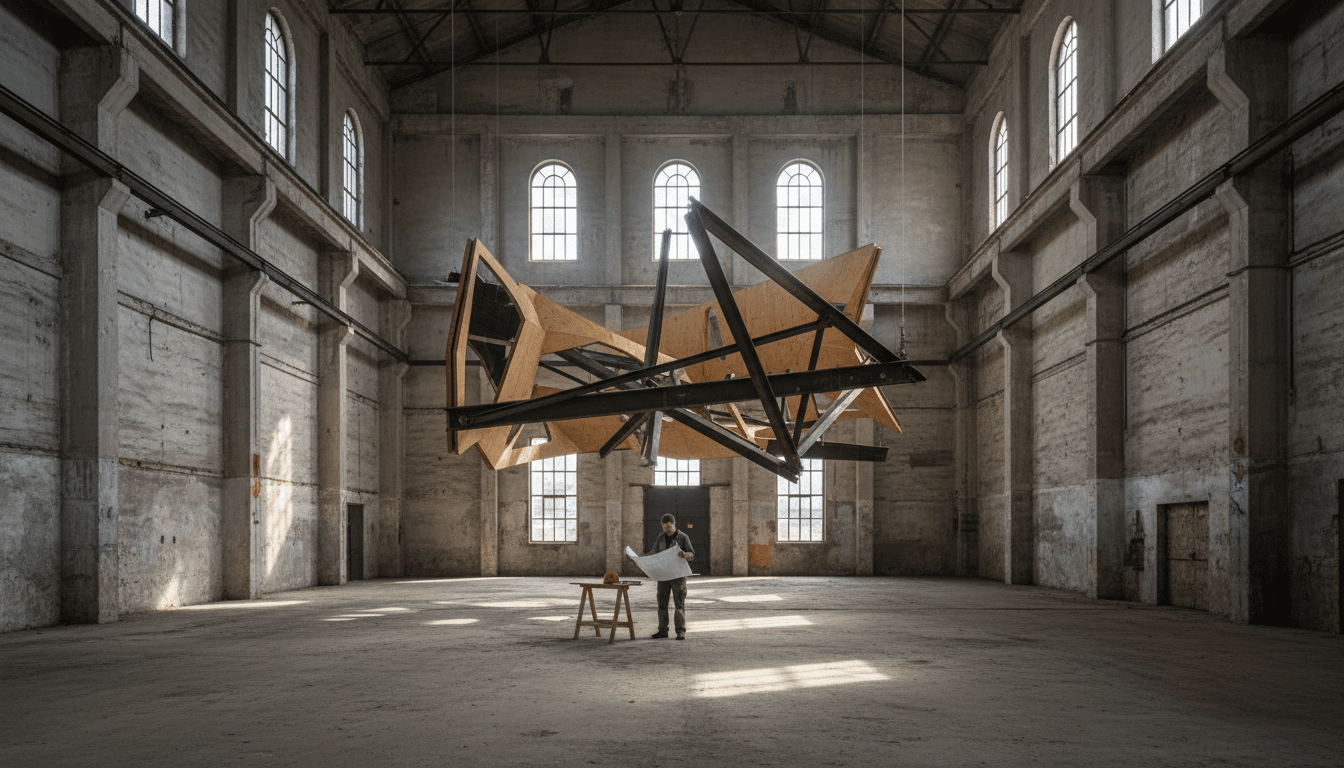
You've been offered a site — a warehouse, a plaza, a stairwell — and asked to make something for it, not just place something in it. That single distinction is the whole discipline of site-specific work: get it right and the piece can't be moved without falling apart as an argument. Get it wrong and you've built a portable sculpture that happens to be sitting in an interesting room.
The test that keeps you honest
| Category | What it means |
|---|---|
| Site-specific | Meaning depends on the site; moving it changes what the work is |
| Site-responsive | Adapted to a space, but survives being relocated |
| Site-adjusted | Simply chosen for a space, with no deeper dependency |
Before designing anything, ask one question: would this proposal work equally well in three other rooms? If yes, it's portable work, not site-specific work, whatever the wall text says.
Step 1: read the site before you design anything
The single most common failure in this discipline happens at the start: designing for an imagined space instead of the real one. Spend the first week producing no artwork at all — only notes, measurements, and observation.
- Read the architecture. Dimensions, but also columns, beam heights, door swings, outlets, and which walls actually bear load.
- Read the light, hour by hour. A room at noon and the same room at dusk support entirely different work.
- Read the traffic. Where people enter, where they pause, where they avoid.
- Read the history. An industrial shell, a domestic room, and an institution each carry a different temperature.
- Read the institution. Budget, timeline, and permissions shape what's actually possible, not just what's conceptually ideal.
Do this on foot, with a notebook and a phone camera, returning more than once without a plan. The material for the piece usually shows up in the gap between what you assumed about the site and what it actually offers.
Step 2: design for a moving body, not a fixed view
A viewer doesn't take in installation from one point — they enter, walk, turn, and leave, and that sequence is part of the composition, not incidental to it, the same attentiveness to sequence and pacing that a composer brings to organising time rather than a painter to organising a flat surface. A doorway, a low ceiling, or a long corridor sets a physical rhythm the work can amplify or disrupt. Filling a room trades on immersion; leaving it mostly empty trades on distance and reflection, the spatial cousin of what negative space does on a canvas. Design the whole path — approach, encounter, exit — as the thing you're actually composing.
Step 3: choose materials for the site's real constraints
Interior work can use lighter, more fragile materials that would never survive outdoors; exterior work inherits the full problem of weather, UV, and vandalism that any piece built to live outside has to answer for. Ephemerality can be a deliberate, meaningful choice — a work that decays on schedule says something a permanent object can't — but it has to be an intentional decision stated up front, not a surprise discovered when the piece collapses ahead of schedule.
Advertisement
Public sites bring permits, insurance, fire code, accessibility requirements, and load limits, and temporary work often needs a de-installation and disposal plan before it's even allowed to open. Learn these constraints early; discovering them late is how a concept gets quietly watered down under deadline pressure.
Step 4: plan the afterlife before the show closes
Most of a site-specific work's eventual audience will never actually stand in the room — they'll encounter it as documentation. Plan for that from the start rather than as an afterthought:
- Photograph and film with the experience in mind, not just the object — video in particular can carry a sense of scale and movement stills can't.
- Write about the piece while it's still up, when the reasoning is fresh, not months later from memory.
- Archive drawings, plans, and material samples alongside the images.
- Decide how the work ends — dismantled, dispersed, or, rarely, deliberately re-made somewhere else as an explicit new decision rather than a default.
The failure modes, in order of frequency
Designing before reading the site. Treating scale as the only response to place — a temptation that grows sharply once the work is genuinely large-scale and size starts to feel like the whole statement on its own. Ignoring budget and schedule until they force a compromise. Forgetting the moving body and composing a static image instead. And, most common of all: presenting a portable idea as though the site were incidental to it. Institutions and audiences sense that fast, and no amount of fabrication quality can hide it.
FAQ
What actually makes a work "site-specific" rather than just placed somewhere?
Dependency — its meaning has to come from the site itself, so that moving the work changes what it means, not just where it's seen.
How long should site research take before designing begins?
At minimum, a week of pure observation with no design decisions made, returning to the site more than once.
Can site-specific work be temporary?
Yes, and often should be — ephemerality can be part of the concept, as long as it's a stated intention rather than an accidental outcome of poor materials.
What's the biggest legal or logistical trap in public site-specific work?
Permits, insurance, and de-installation requirements that aren't discovered until late in the process, forcing last-minute changes to the concept.
Does documentation really matter that much?
Yes — most people who ever encounter the work will do so through photographs or video, not by standing in the room, so treat documentation as part of the work rather than an administrative afterthought.