Why Verdigris Slowly Destroys the Art It Colors
That dull brown foliage in an old master painting was very likely a vivid green once. Here's why verdigris and copper resinate degrade, and why standard cleaning treatments can make it worse.
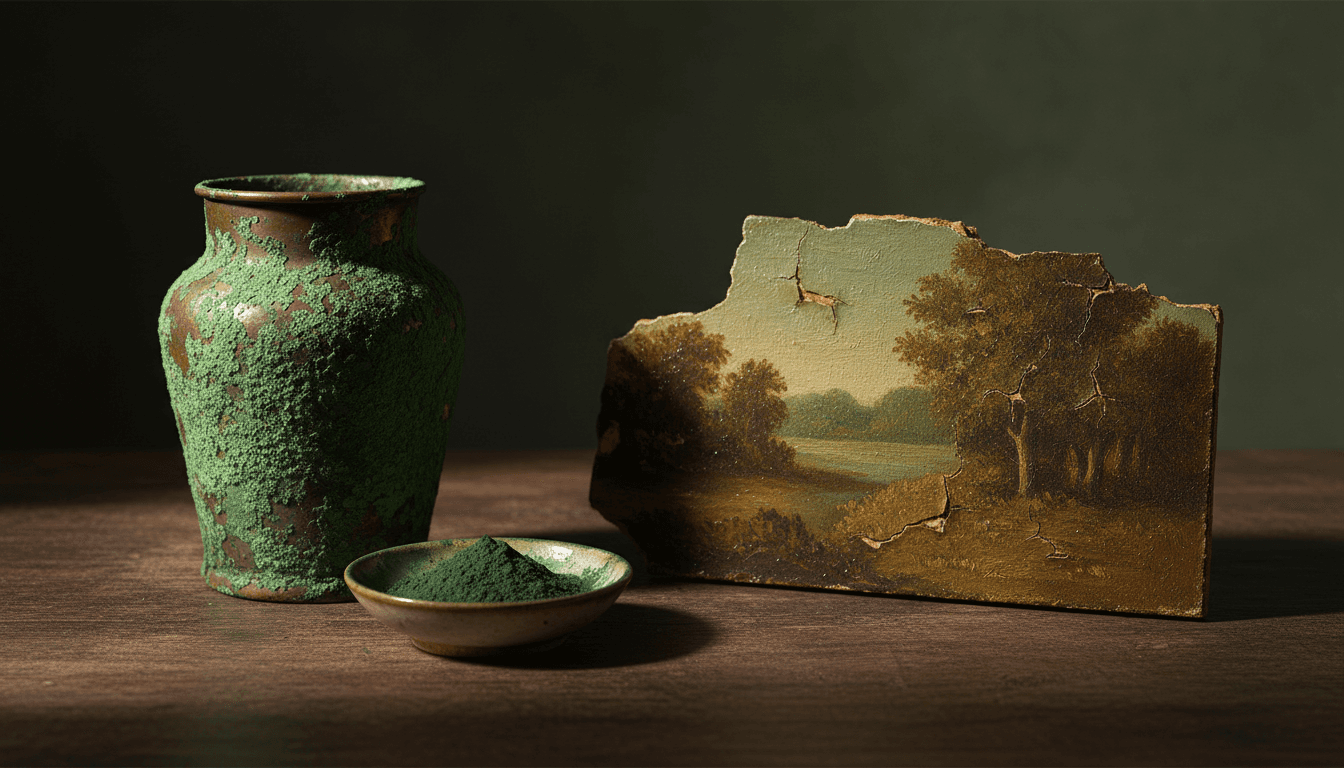
You're looking at a centuries-old painting and the trees look wrong — not faded exactly, but flattened into a dull brown or near-black, in a way that doesn't match the vivid greens still visible elsewhere in the same room. That's very often not damage, fading, or dirt. It's a specific, well-documented pigment failure, and once you know what to look for, it's easy to spot in collection after collection.
What verdigris actually is
Verdigris is a green-to-blue pigment made by exposing metallic copper to acetic acid — historically achieved by hanging copper plates over vats of fermenting grape skins or vinegar, letting the acid react with the metal's surface to form copper acetate. It's been manufactured this way since antiquity and stayed in constant use in manuscripts, maps, and paintings from the medieval period through the nineteenth century, prized for a genuinely vivid, saturated green that few other historical pigments matched — earning it a much longer, quieter run than the notoriously poisonous emerald green that eventually took over part of the same territory.
Why it rarely stays green
Verdigris used directly, mixed straight into oil or watercolour, is chemically unstable: it can shift from blue toward green and then continue on toward brown or black as it ages, and it can fade badly in watercolour altogether. To manage this, painters usually converted it into copper resinate — verdigris cooked into a natural resin — which produced a rich, deep, translucent glaze ideal for foliage and drapery. The trade-off only became visible generations later: copper resinate glazes are themselves prone to degrading as the resin ages and the glaze thins, and the endpoint of that degradation is a shift from glowing green to the dull brown or blackish tone now visible in a great many old master paintings. The vivid Renaissance and Baroque landscapes we see today are frequently missing an entire register of colour their original audiences would have seen clearly.
Why it's worse on paper than on canvas
On paper and parchment, verdigris causes a second, more destructive problem: in humid conditions, copper ions migrate directly into the cellulose fibres of the support itself, accelerating oxidation and hydrolysis that leaves the paper brittle, browned, and in severe cases cracked or perforated exactly where the pigment sits — a support-level failure with real parallels to how a painting's own layers can pull apart from each other over time, just driven by chemistry rather than mechanical stress. This is why maps, manuscripts, and drawings using verdigris are treated as higher-risk objects in archives and collections than paintings using the same pigment — the support itself, not just the colour, is what's actually at stake.
Advertisement
How to spot it
- Look for foliage or drapery that reads as brown, olive, or blackish where the surrounding composition suggests it should be a clear, saturated green.
- Check whether the tone is uniform or patchy. Verdigris degradation is often uneven, since resin thickness and light exposure vary across a single passage.
- In works on paper, look for localised browning or brittleness that follows the exact outline of a painted or drawn green area — a strong sign that the paper itself, not just the pigment, has been affected.
- Compare with a conservator's condition report if one exists, since pigment identification from visual inspection alone is a reasonable first guess, not a confirmed diagnosis.
What conservators actually do about it
Because copper is chemically reactive, a surprising number of standard conservation treatments make verdigris damage worse rather than better — a simple aqueous cleaning or a routine deacidification treatment, both safe for most other pigments and papers, can accelerate the exact corrosion they're meant to prevent. Modern conservation research has focused on chelating agents and stabilising treatments developed specifically for copper-based pigments, applied only after the specific verdigris phase present has been identified, since the pigment covers a genuinely wide family of related copper compounds rather than one single, uniform substance.
FAQ
Why do old paintings sometimes have brown foliage instead of green?
Often because the original green pigment was verdigris or copper resinate, both of which degrade toward brown or black over centuries — the brown you're seeing may not be the artist's intended colour at all.
Is verdigris the same as the green patina on outdoor bronze and copper?
Not chemically, though the word is often used loosely for both. True verdigris pigment is a manufactured copper acetate; outdoor patina forms naturally from different copper compounds (carbonates and sulfates), and the "verdigris" label applied to it is a common but technically imprecise habit.
Why is verdigris more dangerous on paper than on canvas?
Because on paper, copper ions can migrate directly into the cellulose fibres of the support, causing embrittlement and browning that goes beyond a simple colour shift — the material itself degrades, not just the visible pigment.
Should I try to clean a work that shows verdigris damage myself?
No — several standard cleaning and deacidification methods that are safe for other pigments can actively accelerate verdigris-related decay, and treatment should go through a professional conservator familiar with copper-based pigments specifically.
Was verdigris always this unstable, or did something change over time?
It was known even at the time to be a difficult pigment — historical painters converted it to copper resinate specifically to manage its volatility — but the long-term instability of that workaround wasn't something anyone could have observed within a single working lifetime.