Why Emerald Green Was Poisonous and Beloved
Emerald green was brilliant, cheap, and made of arsenic. It covered Victorian walls and canvases for a century, and it was abandoned only when a safer green finally existed.
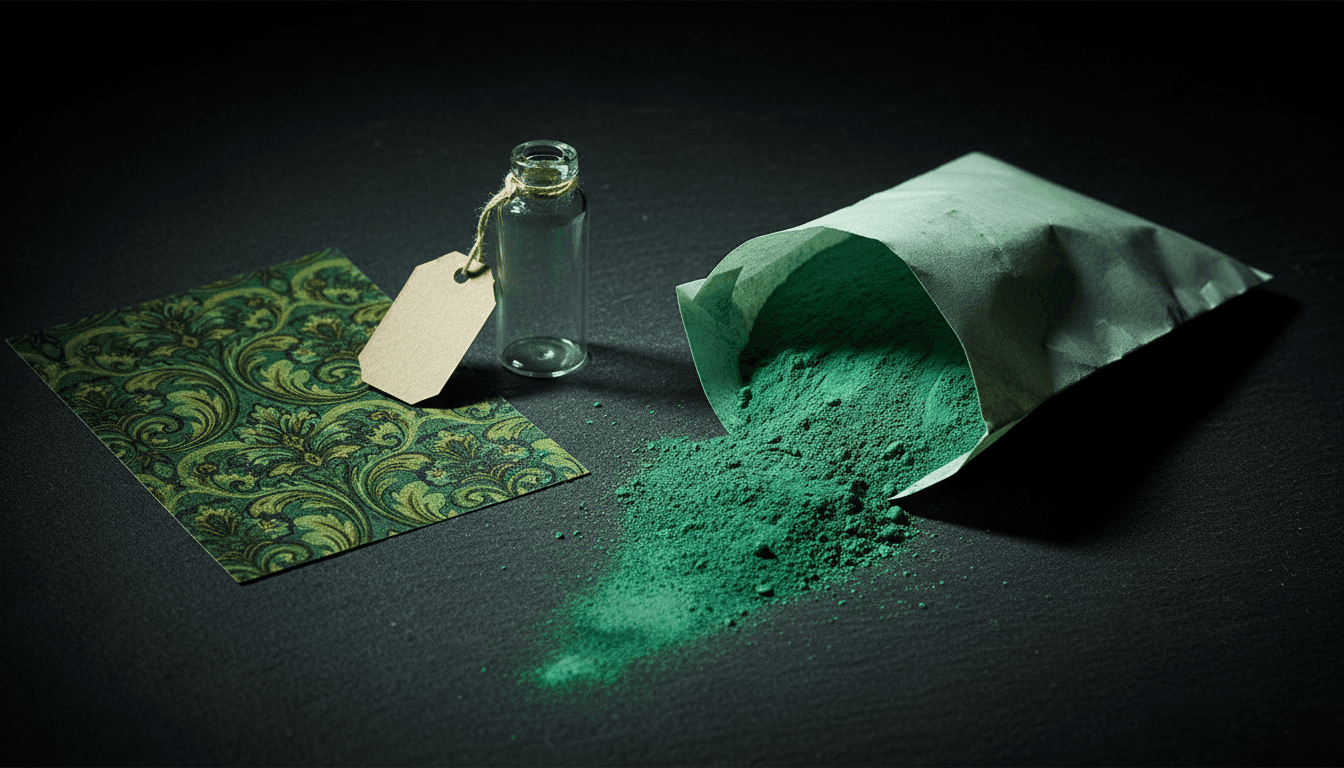
Did wallpaper kill an emperor? Napoleon Bonaparte died in exile on Saint Helena in 1821, and for over a century the official verdict — stomach cancer — went largely unquestioned. Then a Swedish researcher, working from a memoir of Napoleon's last days, became convinced the symptoms matched something else entirely: slow arsenic poisoning. The case he built, and the century of forensic argument that followed, turns out to hinge on a pigment that was, quite separately, one of the most dangerous colours ever put into mass production.
The claim
In the early 1960s, Sten Forshufvud went through Louis Marchand's day-by-day account of Napoleon's final illness and matched each symptom against the known progression of chronic arsenic poisoning. Convinced, he tracked down preserved locks of Napoleon's hair — kept by staff and passed down for generations — and sent them to Hamilton Smith, a forensic scientist at the University of Glasgow who had developed a technique sensitive enough to detect arsenic in tiny quantities. The hair came back elevated. To Forshufvud, that was close to confirmation: Napoleon had been deliberately poisoned, almost certainly by someone in his own household on Saint Helena.
The evidence that complicated it
The theory gained real scientific weight in 1982, when the chemist David Jones and physicist Kenneth Ledingham obtained an actual surviving sample of the green wallpaper from Longwood House, Napoleon's residence on the island, and analysed its pigment. It was Scheele's green — a copper arsenite pigment — and in Saint Helena's hot, damp climate, the wallpaper would plausibly have released arsenical vapour into the room continuously. Jones and Ledingham's calculations suggested the amount involved wasn't large enough to have killed Napoleon outright, but could easily account for the arsenic found in his hair, and might have worsened symptoms in a man who was already seriously ill.
The case against a poisoning
The theory ran into a harder problem in 2008, when an Italian nuclear physics team tested hair samples from four separate points in Napoleon's life — as a boy, during his exile, the day of his death, and the day after — alongside hair from his son and from Empress Josephine. Every sample, from every period and every person, showed roughly the same strikingly high arsenic level: about a hundred times what's found in living people's hair today. That consistency was the problem for the murder theory. A deliberate poisoning should show arsenic rising as the plot unfolds, not identical levels going back to childhood. What it looked like instead was background exposure — arsenic in medicines, hair tonics, wallpaper dyes, and food that were simply everywhere in early nineteenth-century Europe, absorbed by everyone around Napoleon at similar levels, poisoner or not. The official autopsy, meanwhile, had already found a large stomach ulcer that had turned cancerous — the same disease that had killed Napoleon's father, suggesting a hereditary component no conspiracy theory required.
Advertisement
What this has to do with a pigment
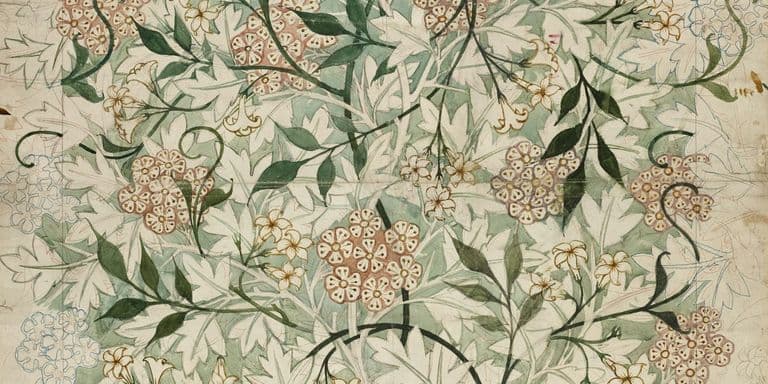
Whatever killed Napoleon, the wallpaper in his room really was coloured with Scheele's green, discovered in 1775 by the Swedish chemist Carl Wilhelm Scheele and soon followed by the more intense, more stable Paris green around 1814. Both were copper-arsenic compounds, both were strikingly cheap and bright at a moment when good greens were otherwise hard to make, and both spread far beyond any single emperor's prison — into Victorian wallpaper by the mile, into dyed fabric, into artificial flowers worn close to the face, into candles that released arsenic vapour when burned. It puts emerald green in genuinely dangerous company: the same century that papered its walls in arsenic also painted with mercury-based vermilion and, more grimly still, ground-up human remains sold as a pigment without most buyers asking too many questions. The designer William Morris, whose patterns are still printed today, used arsenic greens in his own wallpapers and defended them publicly against critics, a position that reads uncomfortably today but was entirely typical of an industry that had built itself around a colour nobody had yet proven, to universal satisfaction, was actually dangerous.
Why painters wanted it anyway
Emerald green is that later, brighter pigment — copper acetoarsenite, first made commercially in Schweinfurt in 1814 by Wilhelm Sattler and Friedrich Russ, and sold under a string of names: Schweinfurt green, Paris green, Vienna green, Veronese green. It was developed to improve on Scheele's green, and it did — no other copper green had its brilliance, and it was cheap to make. Painters wanted it for the same reasons paperhangers did. Technical analysis has found it in Monet's The Gare Saint-Lazare, Van Gogh's Bedroom in Arles and The Starry Night, Seurat's A Sunday on La Grande Jatte, and Picasso's Les Demoiselles d'Avignon, painted in 1907. It was never a well-behaved colour — it darkens beside sulfur-bearing pigments such as cadmium yellow and vermilion, and it is not especially lightfast — but nothing else on the palette was that green.
The people who lived with it
The danger was public knowledge for most of the colour's career. In 1858 the press reported a single London manufacturer getting through two tons of arsenic a week, and claimed a square foot of arsenical wallpaper held enough to poison five or six people. Damp and abrasion flaked the pigment into dust that could be breathed in, and heat and moisture could release toxic vapour from the wall itself. The people who handled the raw colour fared worst: in 1861 Matilda Scheurer, a 19-year-old maker of artificial green foliage for headdresses and wreaths, died of arsenic poisoning, the poison found at post-mortem in her stomach, liver and lungs. Many countries went on to ban arsenic as a colourant — the United States still had no such law in 1884 — and in Britain public pressure did much of the work. Morris, for all his defence of the colour, moved his wallpapers to arsenic-free greens in the 1870s, and in 1879 his printers, Jeffrey & Co., had a chemist from the Royal Arsenal at Woolwich certify their papers free of poison.
The safer green, and why it took a century
A safer green existed long before emerald green went away. Viridian — hydrated chromium oxide, first prepared by Pannetier in Paris around 1838 and patented by Guignet in 1859 — is chemically stable and contains no arsenic, and Renoir was mixing it into the rushes of La Yole in the 1870s. But viridian could not match emerald green's brilliance, so painters kept buying the poison: Picasso in 1907, and Malevich and Modigliani in the 1910s, were still painting with emerald green. What finally made it obsolete was phthalocyanine green, introduced to artists in 1938 — a non-toxic synthetic green strong enough to stand in for it, and extremely lightfast. Emerald green went out of production in the second half of the twentieth century; Winsor & Newton now sells "Winsor Emerald," phthalo green and white, as its successor.
Where the investigation stands
Most historians and toxicologists today lean toward natural death — a stomach cancer Napoleon himself feared, correctly predicting the disease that had killed his father — with environmental arsenic exposure as a real but incidental complication of the era he lived in, not evidence of murder. The wallpaper almost certainly did leach arsenic into Longwood House's damp air, and it probably did make an already sick man feel worse. What it very likely didn't do is kill him on its own, or prove anyone poisoned him deliberately. The case is a reminder that finding a toxin in a body proves exposure, not intent — and that a colour dangerous enough to poison an emperor's wallpaper was, at the time, dangerous enough to poison almost anyone's.