What Is a Life-Size Sculpture?
Life-size is a relationship, not a measurement. Match the body and a sculpture becomes a presence; miss the eye height and it becomes a monument. Here is how exact scale works.
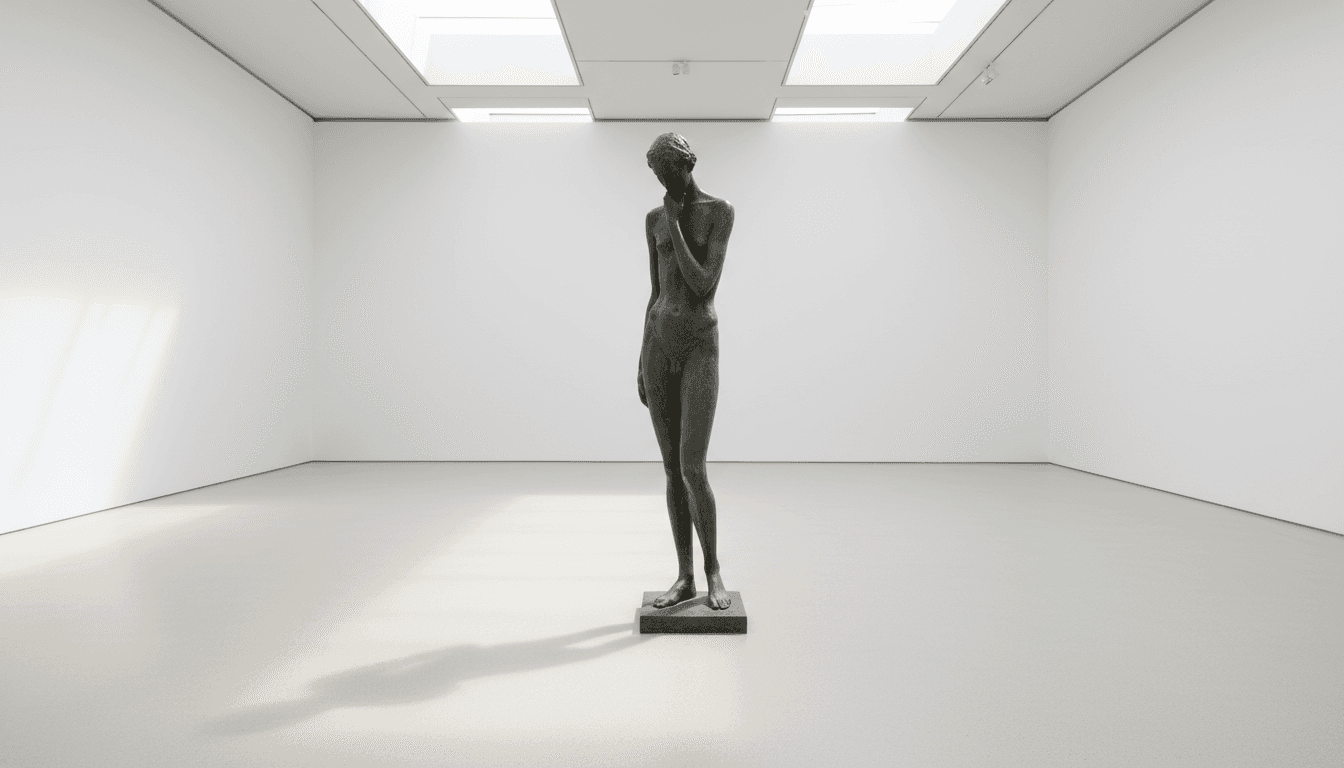
Why does a sculpture that's almost human feel worse than one that's obviously not? A crude carved figure at human scale reads as a person and feels warm. A hyperreal figure at the same scale can read as a corpse. Something happens right around the point of near-perfect realism, and despite decades of sculptors and researchers running straight into it, nobody has fully settled what that something actually is.
What counts as life-size
A life-size sculpture is built one-to-one with its subject — "equal in size to the original," in the definition of the Getty's Art & Architecture Thesaurus. For an adult that means a standing figure of roughly 1.63 metres for the median American woman and 1.75 for the median man, though the reference is always the subject rather than an average: a life-size statue of a child is a child's height. Go past the original and the vocabulary changes. "Over life-size" covers anything larger, and "heroic" names the band before colossal — "larger than life size without being colossal," in Ralph Mayer's Dictionary of Art Terms and Techniques.
The number that decides how a life-size sculpture reads is not its height but its eye line. A standing adult's eyes sit about 11 centimetres below the crown of the head — roughly 152 centimetres off the floor for that median woman, 164 for the man. Stand a life-size figure on the ground and its gaze meets the viewer's at that height; it reads as somebody in the room. Lift the same body onto a plinth and its eyes rise above ours — nothing about the anatomy has changed, but it now looks down, and it reads as a monument. That one-to-one match is also where the trouble starts, because a figure built at our exact scale gets checked against our own bodies.
The claim
In 1970, the Japanese roboticist Masahiro Mori proposed an explanation now known as the uncanny valley: as a representation of a human becomes more realistic, our comfort with it rises steadily — up to a point. Just short of true human likeness, comfort doesn't plateau; it drops sharply into a "valley" of unease before recovering, in theory, once realism becomes indistinguishable from the real thing. Mori's original claim was really just a hypothesis sketched on a graph, based on intuition rather than experiment, but it named something sculptors, animators, and roboticists kept independently rediscovering.
The evidence for it
Life-size figurative sculpture sits exactly on the terrain Mori described, and its history reads like a long, unplanned experiment confirming the hypothesis. Wax effigies — Madame Tussaud brought her first exhibition to London in 1802, having learned the craft making death masks during the French Revolution — have unsettled visitors for two centuries specifically because they aim for the valley rather than avoiding it. In the 1970s, the American sculptor Duane Hanson cast ordinary people — shoppers, tourists, security guards — in resin and fibreglass, dressed them in real clothes, and placed them in real rooms at exact life-size; visitors regularly mistook them for actual bystanders and then recoiled once they realised their mistake. Antony Gormley's Another Place (1997), a hundred life-size cast-iron figures modelled on the artist's own body and installed as an outdoor sculpture on Crosby Beach since 2005, works by staying just stylised enough to avoid the valley entirely — the figures read as a crowd of witnesses rather than as anything unsettling, precisely because the material and finish never chase full realism, and cast iron is durable enough to survive the tide it stands in.
Advertisement
The complication
Here's where the investigation gets harder than Mori's tidy graph suggests. Later researchers have never fully agreed on why the valley exists — competing explanations point to a mismatch between different cues (a real voice on an obviously fake face), difficulty categorising something as either clearly human or clearly not, or a kind of threat response to something that looks alive but moves or behaves wrongly. Different studies produce different graphs, some finding no clean "valley" shape at all, just a general discomfort that scales unevenly with realism. The effect is robust — almost everyone who works with life-size, near-realistic figures runs into it — but the single unifying mechanism Mori proposed in 1970 has never been confirmed as the actual explanation, and various sub-theories still compete for the answer.
What sculptors do about it, regardless
The uncertainty about the mechanism hasn't stopped sculptors from treating the valley as a working constraint, because whatever causes it, its edges are easy enough to feel out empirically. Working at exact human scale, rather than the exaggerated proportions of a large-scale sculpture, removes the room for error a smaller or larger figure allows, since the viewer has a lifetime of reference data — their own body — to check the sculpture against. Sculptors mostly respond by committing to one side of the valley rather than trying to navigate its middle: staying stylised enough that the small tells (eyes, skin, stillness) read as an artistic choice rather than a failure, or pushing all the way to hyperrealism and accepting that discomfort might be the actual point, as it clearly was for Hanson.
Where the investigation stands
The uncanny valley is real enough that it shapes how life-size sculpture gets made, and specific enough that artists can reliably provoke or avoid it on purpose. What remains genuinely open is the mechanism underneath it — whether it's one effect or several stacked together, and why the threshold sits exactly where it does. Fifty-six years after Mori's original sketch, sculptors have more reliable practical knowledge of the valley than psychologists have a settled explanation for it.