Why Art of This Century Mattered More Than Peggy Guggenheim's Collection
Peggy Guggenheim's collection is what survives of her, and it is the lesser of her two achievements. The greater one lasted just under five years, was running at a loss long before it closed, and no longer exists.
Peggy Guggenheim's collection is what survives of her, and it is the lesser of her two achievements. The greater one lasted just under five years, was running at a loss long before it closed, and no longer exists: Art of This Century, the gallery she opened at 30 West 57th Street on 20 October 1942 and shut in May 1947.
In those years it gave Jackson Pollock, Robert Motherwell and William Baziotes their New York debuts, early shows to Mark Rothko and Clyfford Still, and a juried exhibition to women artists in the winter of 1943. It also paid Pollock a retainer — $1,800 a year — which is a different thing from showing him.
On 21 November 2026 the Royal Academy opens Peggy Guggenheim in London: The Making of a Collector, an exhibition about the Cork Street years that turned an heiress into a collector. It reaches the Guggenheim in New York on 16 April 2027, in the city where Art of This Century stood. The exhibition is about the collector. This article argues that the collector was not the more important person she became.
The objection is strong, and it has four parts. The collection has been open to the public in Venice since 1951, while the gallery's curving walls were sold, reportedly to a clothing store. The gallery lost money. The painters were picked by other people: the adviser Howard Putzel, the painter Matta, Marcel Duchamp, Piet Mondrian. And when Guggenheim stood in front of the Pollock canvas that Mondrian would single out at the Spring Salon in May 1943, her own verdict was "Pretty awful, isn't it?" All four points are on the record. None of them settles what a gallery is for.
20 October 1942: an opening that recorded the past
On opening night Guggenheim wore one earring by Yves Tanguy and one by Alexander Calder, in her words "in order to show my impartiality between Surrealist and Abstract Art". The Venice museum's page on the Tanguy earrings dates the pairing to 20 October 1942. What hung on the walls, in the historian Mike Wallace's account in Gotham at War, were "171 works by artists of every major twentieth-century tendency", all culled from her own collection.
The press release for the opening set the standard by which the gallery asked to be judged: "This undertaking will serve its purpose only if it succeeds in serving the future instead of recording the past." A show of 171 works from a private collection is a record. Nis Petersen's 2021 summary of the gallery for EBSCO says that most observers agreed Frederick Kiesler's installation, not Guggenheim's collection, drove the impact of the opening, and adds that the collection, though good, mirrored the European exhibitions that the Museum of Modern Art had been mounting since 1929 and her uncle Solomon's museum since 1939.
Advertisement
By October 1942, in other words, a New Yorker could see the European avant-garde at two addresses. What the city had far less of was an address for its own young painters, and that is the gap Art of This Century filled — in a room almost nobody remembers.
The Kiesler rooms: the part everyone remembers
Kiesler was born in Czernowitz in 1890, trained as an architect in Vienna, and came to New York in 1926 for the International Theater Exposition at Steinway Hall — and stayed. Guggenheim put his hiring this way: "I gave him a chance, after he had been in America fifteen years, to create something really sensational." The Venice museum's biography of Kiesler carries the line.
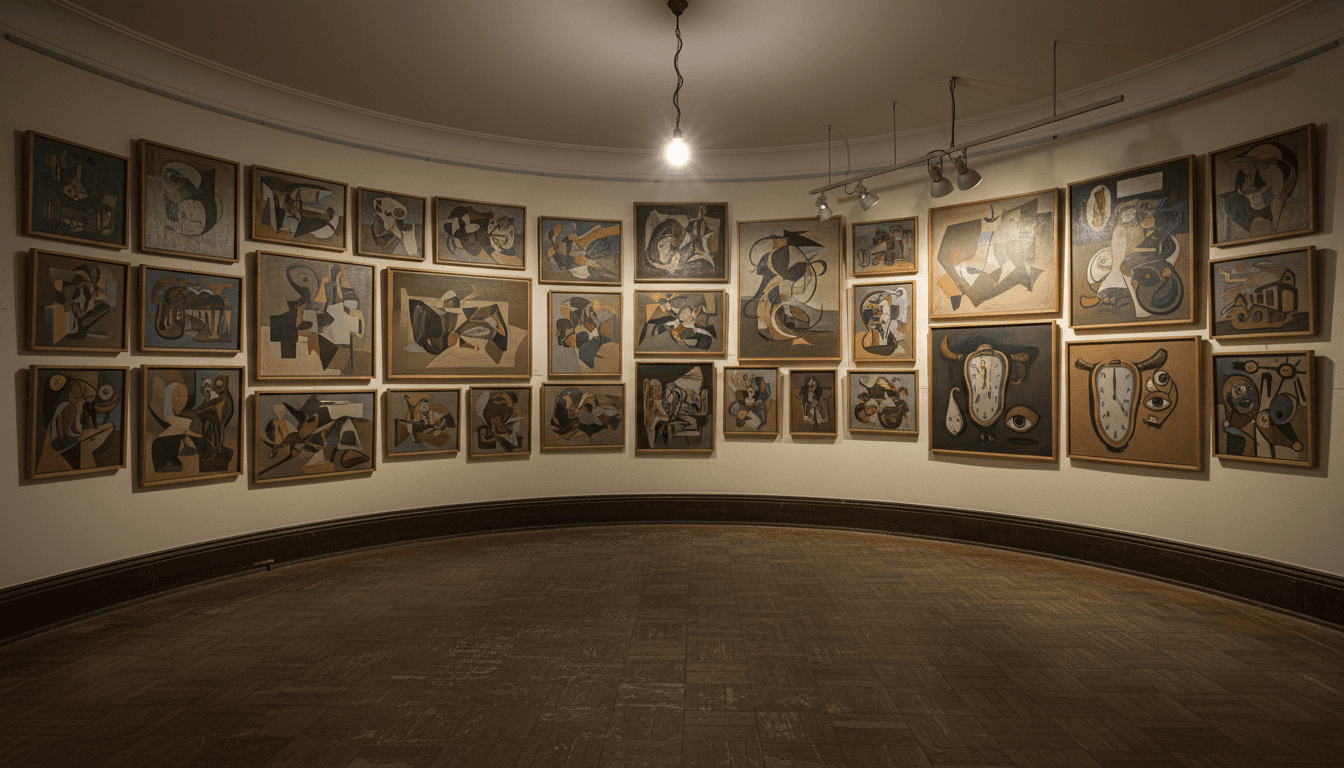
He turned two commercial spaces on a seventh floor into four galleries. In the Abstract Gallery, according to the gallery's Wikipedia entry, "undulating walls of ultramarine canvas" stood over a floor painted Thalo blue, and the paintings were suspended in the room from rope modules. In the Surrealist Gallery, curved wall units thrust unframed pictures out towards the viewer on adjustable arms — in Wallace's telling, "sawn-off baseball bats" — while spotlights lit them one at a time in a random, electrically controlled sequence, to the sound of an oncoming train. In the Kinetic Gallery a spiral ship's wheel rotated the contents of Duchamp's Box in a Valise, and small works by Paul Klee — seven of them, Wallace counts — revolved in front of the viewer whenever someone tripped a beam of light.
Time, in a review that TheArtStory quotes, found that beyond the painting library "gallery-goers enter a kind of artistic Coney Island". Guggenheim's own summary was "very theatrical and extremely original". The same entry calls the design "an enormous revelation to the young artists struggling to find their voices in New York City".
None of it lasted. That entry says the design "did not seem to have immediate effects on other galleries", and that the curving walls were later sold to a clothing store. Kiesler moved on to the 1949 "Manifesto of Correalism", a 1950 model of the Endless House shown at the Kootz Gallery, and the Shrine of the Book in Jerusalem, which was inaugurated in April 1965, a few months before his death; the Venice museum's biography lists all three.
That is the room posterity remembers, and it was built for a collection. The unframed canvases, the lighting cues and the revolving Klees all made Europe's avant-garde feel like an event. The young Americans' solo debuts took place somewhere else.
The room next door: where the Americans hung
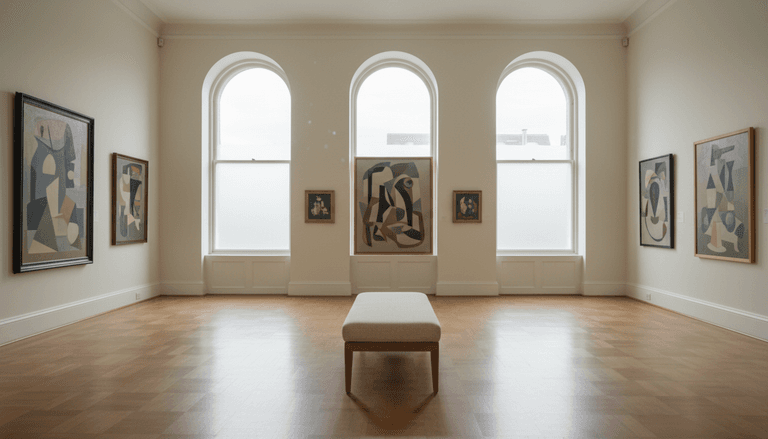
The fourth gallery was the plain one. The Daylight Gallery took its name from the picture windows that its two front rooms faced on 57th Street, and the Wikipedia entry describes it as "a normal rectilinear gallery with white walls". It was not bare — it held Kiesler's wheeled Painting Libraries, easel units with projecting glass rods — but it was a room in which a painting hung on a wall. All of Guggenheim's temporary exhibitions took place there: 53 of them, featuring 103 artists, between the winter of 1942 and the summer of 1947.
The list includes the New York debuts of Baziotes, Robert De Niro Sr. — the actor's father — David Hare, Motherwell and Pollock, and important early exhibitions of Richard Pousette-Dart, Rothko and Still. It also includes two group shows of women artists. Exhibition by 31 Women ran from 5 January to 6 February 1943 and was "juried, an unusual practice outside of Europe at the time", by a group that included André Breton, Duchamp and Max Ernst; Frida Kahlo, Leonora Carrington, Louise Nevelson, Meret Oppenheim, Sophie Taeuber-Arp and Dorothea Tanning were among the exhibitors, and Georgia O'Keeffe declined to take part. The Women, from 12 June to 7 July 1945, brought together 33 artists, among them Louise Bourgeois and Lee Krasner.
The Spring Salon for Young Artists came in May 1943, a competition for American artists under 35 judged by Duchamp, Mondrian and Guggenheim's New York advisers. Mondrian died in New York the following February. The critic John Russell, in a 2002 review in the New York Review of Books, notes that the salon was where the little-known Pollock was singled out in the press for the first time. His first solo show opened on 8 November 1943, the first of four that Guggenheim gave him, and the Museum of Modern Art bought The She-Wolf, one of the paintings in it, in May 1944. Putzel urged her to give Rothko a show, and she did, in 1945. After Pollock's second show, in April 1945, the critic Clement Greenberg called him "the strongest painter of his generation".
The arrangement is the argument. The theatre belonged to the collection, which could carry it; the Americans got a white room that did not compete with them. The theatre earned the gallery its notice, and the plain room did the gallery's work.
Advertisement
The objection: other people chose
The strongest objection is that Guggenheim chose none of this. Wallace's account of judging day in May 1943 has her stopping beside Mondrian, who was standing in front of a Pollock canvas, and asking, "Pretty awful, isn't it?" Mondrian said nothing. About twenty minutes later, Wallace writes, he told her: "I have a feeling that this may be the most exciting painting that I have seen in a long, long time." Wallace also reports that she found Pollock "rather difficult", a man who seemed to her "like a trapped animal who should never have left the prairies of Wyoming". The critic Ruth Yeazell, reviewing Francine Prose's biography in the New Republic, observes that Guggenheim was "nothing if not a quick study, especially when an authoritative man was laying down the word".
The professionals agree. Russell, reviewing Anton Gill's biography, wrote that after years in the business she was still "no judge of paintings"; she had in Duchamp "an incomparable adviser, from whom she learned on the job", and in New York it was "to a large extent thanks to Howard Putzel that she had made few mistakes". Putzel and Matta, Russell reports, persuaded her to give Pollock his show in November 1943, and it was Putzel who urged her to give Rothko one.
| Role | Who | What they did | When |
|---|---|---|---|
| Designer | Frederick Kiesler | Turned two commercial spaces into four galleries, with curved walls, unframed pictures and a revolving Klee display | Opened 20 October 1942 |
| Judges | Piet Mondrian, Marcel Duchamp and Guggenheim's New York advisers | Judged the Spring Salon for artists under 35; Mondrian told her a Pollock canvas might be "the most exciting painting" he had seen in "a long, long time" | May 1943 |
| Advisers | Howard Putzel, Matta | Persuaded her to give Pollock a show; Putzel urged the Rothko show | November 1943 and 1945 |
| Payer | Peggy Guggenheim | Paid Pollock a $150-a-month retainer, commissioned Mural and lent $2,000 towards his house | 1943–45 |
| Museum buyer | Museum of Modern Art | Bought The She-Wolf, one of the paintings in Pollock's first solo show | May 1944 |
| Critic | Clement Greenberg | Called Pollock "the strongest painter of his generation" | After the April 1945 show |
| Successor dealer | Betty Parsons | Took on Pollock and others after the gallery closed; her own gallery had opened at 15 East 57th Street in 1946 | From 1947 |
Grant all of it. It does not follow that the gallery belongs to the advisers, because advice was the cheap part. Duchamp, Mondrian, Putzel and Matta could tell Guggenheim what was good, and could have told anyone else; what they could not do was hang it, pay for it or put it behind a door with a name on it. Russell calls the show and annual contract that Guggenheim gave Pollock, after he had sold nothing at the Spring Salon, "a solid vote of confidence". When she closed the gallery in 1947, Betty Parsons was — on Wikipedia's account of Parsons — the only dealer willing to represent painters like Pollock.
Deference is also a method. In London Duchamp advised and Guggenheim paid, as the Guggenheim Jeune article shows; in New York Putzel, Matta and Mondrian joined Duchamp. She hired people who knew more than she did, took their judgements and paid for them. That is as good a description of a dealer's working method as it is a criticism of her eye.
What $1,800 a year bought
Pollock's earlier wage had come from the state. Wikipedia's entry on him has him working for the Federal Art Project from 1938 to 1942; the project sustained some 10,000 artists and craft workers and closed for good on 30 June 1943. Early in 1943 he was working as a custodian and maintenance man at the Museum of Non-Objective Painting — her uncle Solomon's museum — according to Artnet. In July he signed a contract with Guggenheim's gallery, as Wikipedia has it, under which he would be paid $150 a month as a retainer, to be set against any proceeds from the sale of his work. That is $1,800 a year, "for his entire output", in Russell's words. Artnet says the stipend "allowed him to quit his job at the museum".
The model was not new. In 1907, when Paris had only half a dozen viable galleries, Daniel-Henry Kahnweiler made contracts with artists "to buy all of their work". What was new was the pairing: a buyer whose first gallery had lost money from its first year, and a painter whose work, Petersen writes, she could sell only "with the greatest difficulty". Petersen adds: "She received his paintings in return for her financial support and often gave them away."
The retainer came with a commission. Mural, painted for the long entrance hall of Guggenheim's townhouse at 155 East 61st Street, was Pollock's first commission and is his largest canvas, 2.43 by 6.04 metres. Duchamp suggested painting it on canvas so that it could be moved. The legend that Pollock painted it in a single night does not survive the Getty's conservators, who found "many areas of dried oil paint evident under subsequent layers", or Pollock's own letter to his brother Frank in January 1944, which says he painted it "during the summer". Guggenheim gave the work away: after she moved to Venice in 1947 she arranged with Lester Longman to donate it to the University of Iowa, and in 2016 its value was estimated at around $140 million.
In November 1945, the month after marrying Lee Krasner, Pollock moved to Springs, on Long Island, to a house that cost $5,000. According to the Pollock-Krasner House's Wikipedia entry, Guggenheim lent the $2,000 down payment "in exchange for artwork". After the move he began painting with canvases on the studio floor, and the technique later called the drip followed; the Wikipedia entry on Pollock dates his drip period to between 1947 and 1950.
Advertisement
The sums look small beside the Palazzo Venier dei Leoni, which Guggenheim reportedly bought in 1949 for $60,000 — more than thirty years of Pollock's retainer. They bought what the Federal Art Project had stopped paying for: time to paint.
1947: the ledger
By May 1947 the books were bad. Russell says Guggenheim was "anxious to get back to Europe" and that the gallery had been "running at a loss for years". Her artists passed to Betty Parsons, whose own gallery had opened in 1946 at 15 East 57th Street.
What followed came quickly, and she was not there for it. On 8 August 1949, just over two years after the gallery closed, Life ran its profile of Pollock under the headline "Jackson Pollock: Is he the greatest living painter in the United States?" Barnett Newman, whom Parsons had met in 1943, had his first solo show at her gallery in 1950, and Robert Rauschenberg his in 1951. Even from Venice Guggenheim kept working for Pollock: in 1950 she arranged his first solo show in Europe, at the Museo Correr.
Russell quotes Lee Krasner, Pollock's widow, on the gallery: "her gallery was the foundation. It's where it all started to happen." The reputation came after Guggenheim left, and it was built on what she had paid for: the retainer, the Mural, the house on Long Island, the first show. That is the sense in which the gallery mattered more than the collection: it did its work before anyone had a reason to want the result.
What a gallery is for
None of this makes the collection minor. It is the reason there is a Royal Academy exhibition at all, and the Pollocks the Venice museum lists as on view — Croaking Movement and Circumcision (both 1946) and Alchemy (1947) — date from the years of the contract. But a collection and a gallery answer different questions. The collection records what its owner could afford to want, and with whose help: in London and Paris between 1938 and 1941, Duchamp's and Herbert Read's. The gallery records what she was prepared to pay for in New York before anyone else would.
Cork Street, as the Guggenheim Jeune article argues, lost money and made a collector. West 57th Street lost money and produced the rest of the story: a retainer, a first show, a white wall. A working painter should not wait for a patron with a townhouse. The lesson is to judge a gallery by what it does for the next painting — whether it pays, lends, commissions, or at the very least gives a plain wall and a date — and not by how good its own walls look.
The collection is what Peggy Guggenheim could afford to want. The gallery is what she was prepared to pay for before anyone else would — and the most valuable thing she ever bought was not a painting. It was Jackson Pollock's time, at $1,800 a year.
For the London half of the story, see Guggenheim Jeune: The London Gallery That Lost Money and Made a Collector; Why Small Galleries Matter More Than Museums makes the wider case for rooms like these, and How to Approach a Gallery Without a Cold Pitch covers how a painter gets into one.